


July 22, 2026, 7:16 am | Read time: 5 minutes
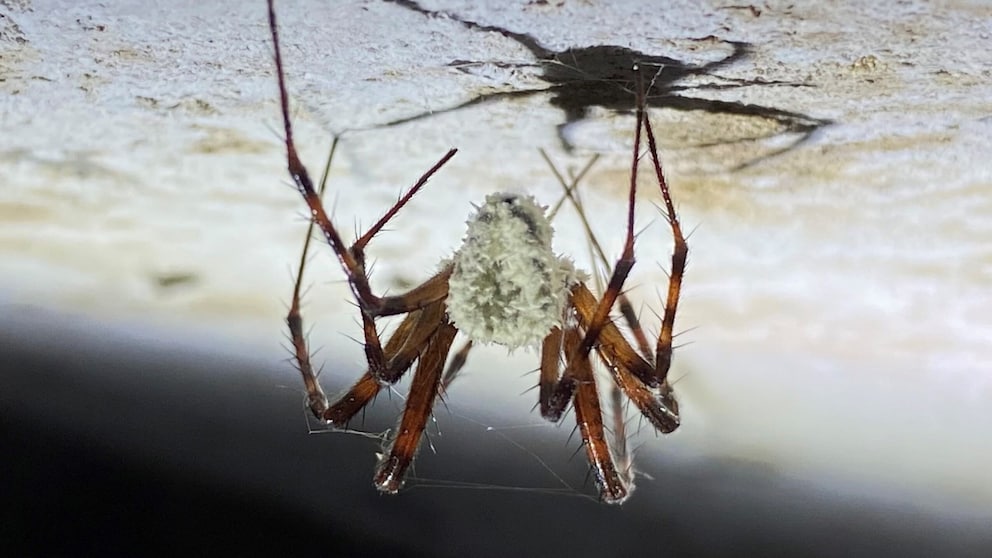
A mysterious fungus is causing a global stir by turning spiders into “zombies.” After infection, the fungus takes control of its host, forcing it to leave its hiding place and eventually die in a location favorable for spreading its spores. What sounds like the plot of the series “The Last of Us” is actually reality: The fungus Gibellula attenboroughii grows inside the spider, influences its behavior, and then spreads to other animals through new spores. Initially observed in Ireland, reports are now also increasing in the U.S.
“Zombie” Spiders Were First Discovered in Scotland
The first discovery was made in 2021 during the filming of the BBC documentary “Winterwatch” in an abandoned gunpowder store in Northern Ireland. Researchers found an infected spider on the ceiling of the building. Dr. Harry Evans, a researcher and Emeritus Fellow at CAB International (CABI), examined the creature and identified it as the orb-weaver spider Metellina merianae. 1
The fungus was completely unknown at the time. In a study published in the journal “Fungal Systematics and Evolution,” Evans and colleagues were able to confirm, based on morphological and molecular evidence, that it is a new species. It was named “after broadcaster and natural historian Sir David Attenborough, a pioneer of BBC natural history programs, who–in his role as head of BBC 2–contributed to the development of the Natural History Unit, which indirectly led to the present nature series during which the new species was first discovered,” as Evans explained in a press release on January 29, 2025.

Global Sightings Are Increasing
In collaboration with a team, Evans later discovered the fungus in other cave systems in Northern Ireland and the Republic of Ireland. In the UK, they were found in caves and gardens. In early 2025, landscape gardener Gareth Jenkins was laying a terrace in a London garden when he discovered something that looked like a large cotton ball. Upon closer inspection, he found something even more frightening: it was teeming with legs.
Jenkins told the “Wall Street Journal” that the spiders were clustered together and looked as if they were frozen in ice: “Their legs were curled up in a terrifying position, as if they were about to jump at my face.”
It is now certain: “Zombie” spiders are not only found in the UK and Ireland. Scientists report discoveries of infected spiders in various regions of the world. In particular, the spiders are noticeable in the U.S. Many Americans have already discovered the conspicuous white, crusted spider corpses in attics and crawl spaces.
In Russia, Simon Butenko also reported a discovery in his parents’ wine cellar in Anapa. “What was particularly eerie was that these spiders were hanging at head height,” he said.
Also of interest: The world’s most venomous spiders
Similar Fungal Infections Also Occur in Ants
The behavior of the infected spiders is reminiscent of similar fungal infections in ants in the Brazilian Atlantic rainforest. There, parasitic fungi also manipulate the behavior of their hosts, driving them to their deaths.
Dr. Evans told the science magazine “Live Science” that the fungus “enters the spider’s body and invades its hemocoel, the cavity that carries the invertebrate’s blood-like fluid.” Once the host leaves its protected environment, the fungus releases a toxin to kill it. It then produces antibiotics that preserve the carcass during mummification.
Under suitable conditions such as high humidity, long fruiting bodies sprout from the spider’s body, releasing new spores–an effective mechanism for spreading the infection.
Mysterious Disease Causes Rabbits to Grow Horns on Their Faces
106 Square Meters! World’s Largest Spider Web Discovered
These Spiders Are Infected
The spider species Metellina merianae, the small cave spider, is particularly affected by the fungus. This species is widespread throughout Europe. It lives in dark and damp places such as caves, but also in moist forests on deadwood. In Central Europe, it is often found in mountainous areas. Females reach a body length of 7–11 millimeters. The spider builds–like other species of the genus Metellina–orb webs in which it catches its prey. 2
After the accidental discovery in 2021, cave explorer and co-author of the study, Tim Fogg, found more examples of the fungus in cave systems in Northern Ireland and the Republic of Ireland, including on another cave spider species, Meta menardi, according to the study. This species is known as the large cave spider and often lives in complete darkness. They inhabit different ecological niches within the caves–and left their usual environment in an infected state to die outside.
The females grow up to 17 millimeters and are thus one of the most conspicuous cave dwellers in our regions. In 2021, this species was named “Cave Animal of the Year” and was also “European Spider of the Year 2012.” 3
It is therefore quite possible that findings will increase in Europe–and also in Germany–depending on how much the fungus spreads in Europe. So far, there is still too little scientific data on this.
Could the Fungus Theoretically Also Infect Humans?
Given the parallels to the HBO series “The Last of Us,” in which a fungus controls humans and triggers a global apocalypse, some wonder: Could the fate of the “zombie” spiders someday befall us humans?
Here, scientists give a clear all-clear. João Araújo, a mycologist at the Natural History Museum of Denmark, explained: “To infect humans, many, many millions of years of genetic changes would be required.” 1
About the Author
Dr. Saskia Schneider is a biologist with a Ph.D. During her studies at the Free University of Berlin, she focused primarily on zoology and animal behavior. In addition to insects, arachnids are also among her areas of interest, and she has already cared for some native spider species in terrariums.