

October 14, 2025, 11:17 am | Read time: 7 minutes
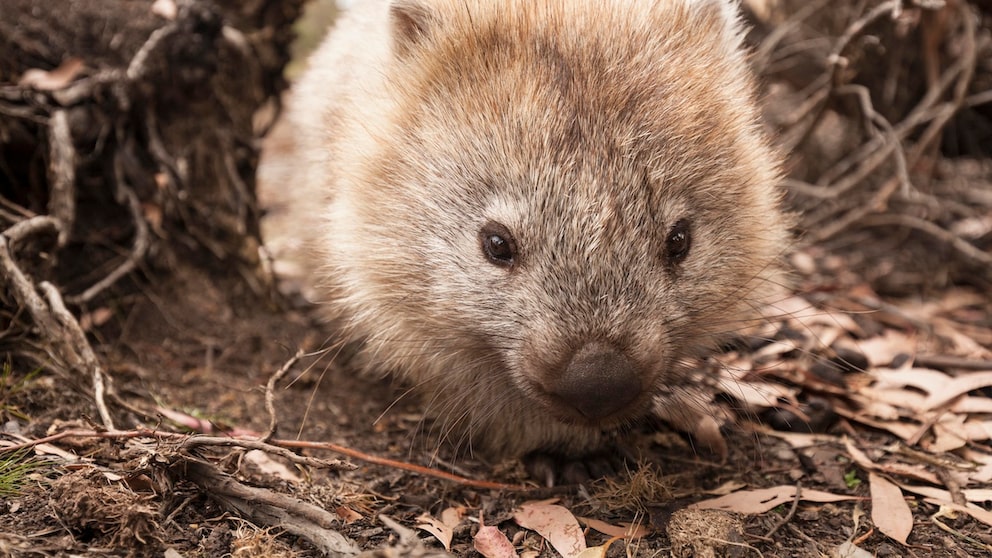
They are cute, round, and at first glance rather sluggish—but wombats are true survivalists. These burrowing marsupials, with their compact appearance, are almost as well-known representatives of Australia’s fauna as kangaroos or koalas. However, there are some fascinating facts that probably only die-hard wombat fans know. PETBOOK explains why they produce cube-shaped droppings, have particularly long whiskers, and how they use their ample rear to literally crush enemies.
Bare Nose vs. Hairy Nose
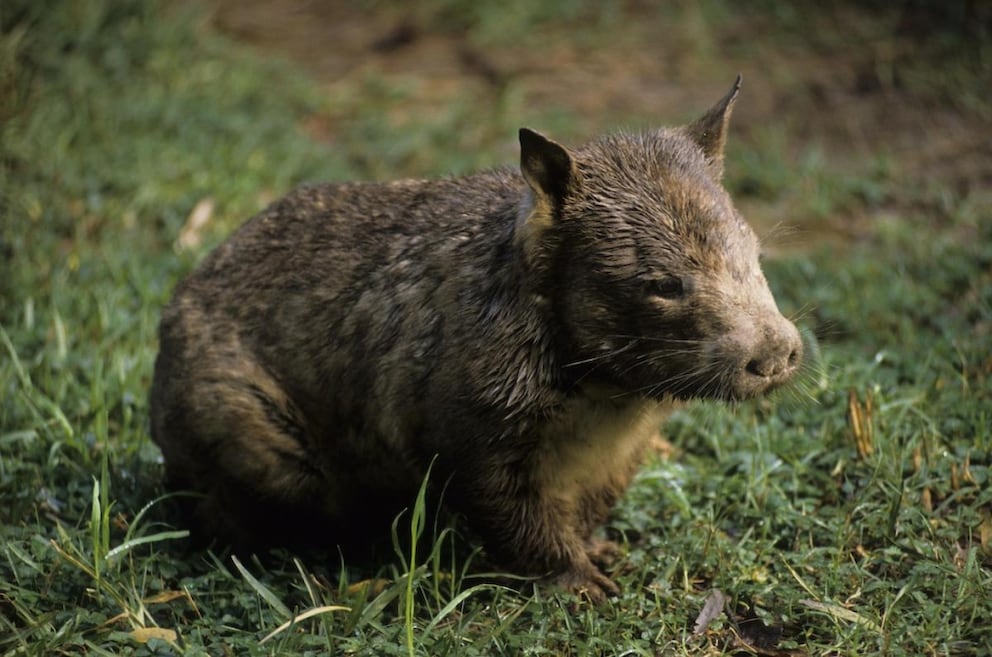
There are three different species of wombats. They can be distinguished at first glance by their noses. There are the northern and southern hairy-nosed wombat and a third species whose nose actually comes without a coat of hair: the bare-nosed wombat. This is the animal most likely to come to mind when the cuddly marsupials are mentioned.
In fact, the bare-nosed wombat is more closely related to the koala than to the other wombat species. Upon closer inspection, these also look different from their famous cousin.
Navigating Tight Tunnels with Whiskers
This nose is not only a distinguishing feature but also plays an important role in perception. In addition to the distinctive nose, the whiskers—or vibrissae—of wombats are highly specialized sensory organs. These hairs are connected to nerve receptors that convert movements into electrical signals and transmit them to the brain. Nocturnal and subterranean animals like wombats rely on these fine sensors to orient themselves in complete darkness.
Scientists have compared the whiskers of southern hairy-nosed wombats with those of bare-nosed wombats. It was noted that the southern species not only have a broader snout but also significantly longer and thicker whiskers—both on the snout and above the eyes. Researchers suspect that the hairy-nosed wombats build larger and more complex burrow systems, which require finer tactile orientation—such as when navigating branched burrows or interacting with conspecifics in shared burrows.
Wombats also rely on their whiskers—and their excellent sense of smell—when foraging. Their favorite food is grass, which they locate using scent and tactile perception. This is supported by a notably large olfactory bulb, indicating a pronounced ability for scent analysis. Like many other marsupials, wombats have a large olfactory center in the brain. 1
Wombats Place Cube-Shaped Droppings
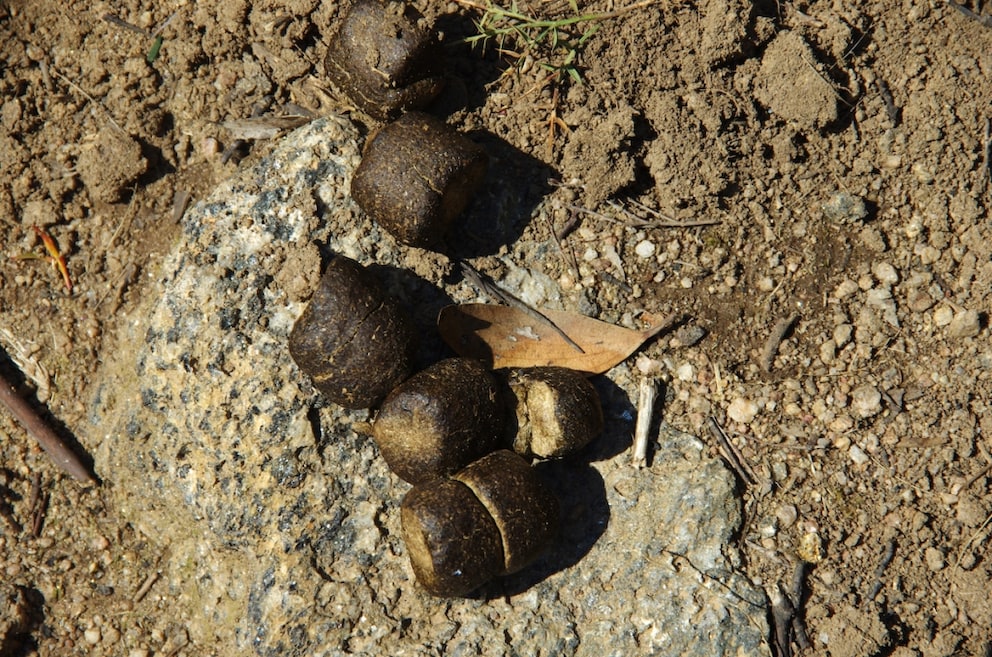
One of the most fascinating habits of wombats is not particularly appealing at first glance. They place their droppings in strategically advantageous locations in the ecosystem. There, it serves as both fertilizer and a scent marker for the animal’s territory. This is important for courtship and mating, as well as for their personal identity and recognition among each other.2
However, the shape of their droppings is particularly unique and has long puzzled scientists. As the only animal in the world, the wombat produces cube-shaped, angular droppings. The reason for this is not that their intestines are also angular, as a scientific study has shown. According to the magazine “Science,” wombats produce up to 100 cubic droppings per day. This occurs in the last part of their digestive tract, which is partially twice as thick and four times as stiff as other parts of the intestine. This allows the animals to produce stronger contractions of the intestine, forming corners and edges.
However, the advantage this extreme form of digestion offers wombats is still unclear. Some researchers suspect that the square droppings adhere better to the rocks, which wombats like to decorate with their excrement, due to their shape. Others believe that the wombat uses these strong contractions to recycle as much water as possible from the food pulp, as it is dependent on this in very dry areas.
Wombats Are Masters at Digging
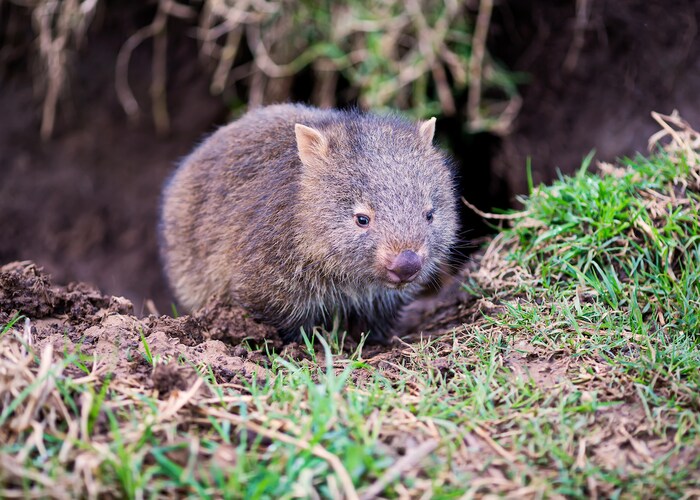
But it’s not just their droppings that keep the ecosystem in which wombats live intact. Wombats are true masters at loosening, turning over, and fertilizing the soil. The nocturnal animals create complex tunnel systems that are up to 3.5 meters deep and about 20 meters long.
Because they spend a large part of their lives underground, there is another peculiarity to discover in these marsupials. The pouch in which they carry and nourish their young is positioned backward, so the baby is not squashed in the narrow tunnels. If the wombat mother takes a sunbath, you can sometimes see a baby peeking out from the pouch directly between the hind legs.

Wombats Use Their Rear as a Weapon
Wombats are one of the largest rodent species in the world. The bare-nosed wombat is the largest and can weigh up to 40 kilograms with a body length of 120 centimeters. However, their weight is not due to fat but consists mostly of muscle mass. Thus, the cute, plump-looking animals can also run up to 40 km/h when predators like dingoes cross their path.
But to defend their burrow, the marsupial has developed a clever tactic. When they notice an enemy, they literally block the entrances to their tunnel system with their compact rear. With a reinforced layer of skin, bones, and cartilage, this is supposed to represent an insurmountable barrier. However, if an enemy is not deterred or begins to dig around the wombat into the ground, the animal’s sheer muscle strength comes into play again. They press the intruders into the ground until they give up or are crushed.
Their Teeth Have No Roots
Like that of most rodents, the teeth of wombats continue to grow throughout their lives. They constantly wear them down by consuming fibrous plant materials, thus keeping them in shape. They feed on grasses, mosses, as well as roots and fungi.
For marsupials, Wombats also have a very unique set of teeth. They have only 24 teeth, with no canines at all. Additionally, they have almost no tooth roots, which allows for the constant growth of even the molars.
Many believe that wombats appear cute and defenseless due to the lack of canines. However, they primarily use their front teeth as a threat display and will use them if necessary. An agitated wombat moves its head up and down while baring its incisors. It also emits a loud growl. Even though the marsupial is generally vegan, one should not approach it if it feels threatened.
Why Meerkats Even Eat Scorpions
This Animal Even Takes on Lions and Venomous Snakes
In Tasmania, There’s a “Chief Wombat Cuddler”
There are jobs that are more desirable than others for many. One of them was advertised in 2016 and spread like wildfire through the media. At the Bonorong Wildlife Sanctuary in Tasmania, orphaned wombat babies are regularly raised. Since they are used to intense physical contact with their mother, they are wrapped in blankets and need people who care for them with dedication (and a lot of body warmth).
This position was promoted with a PR campaign at the time to draw more attention to the work of the animal protectors. The lucky winner was able to cuddle wombats for three whole days and received accommodation and meals. However, the real everyday life of a wombat cuddler is much more strenuous. Caring for orphaned “pinkies”—as immature wombat orphans are also called—is a full-time job, as Linda Tabone, a wombat cuddler at the wildlife sanctuary, told the British tabloid “Mirror.”
Before she retired, she couldn’t have imagined doing this work, she told the “Mirror.” Because wombats are very clingy as babies and require a lot of attention, it doesn’t bother her if the animals follow her everywhere. “When I go into the garden to prune the roses, the little ones come with me and learn to dig holes in the flower bed. But I take that as a good sign that their digging skills are improving.” Linda Tabone’s job is to prepare the animals for their release into the wild. She has already prepared 60 wallabies and 40 wombat joeys for their release back into the wild.
This Marsupial Has Not Only Iconic but Also “Endangered” Status
All wombats are protected animals throughout Australia. The southern hairy-nosed wombat and the bare-nosed wombat are considered endangered, while the northern hairy-nosed wombat is considered critically endangered. Its territory is tiny. A 2013 study reported only 138 to 160 individuals and a reintroduction project with twelve animals in the Australian state of Queensland.3 More recent figures from the Australian Wildlife Conservancy estimate about 300 remaining animals.4