

January 27, 2026, 10:09 am | Read time: 6 minutes
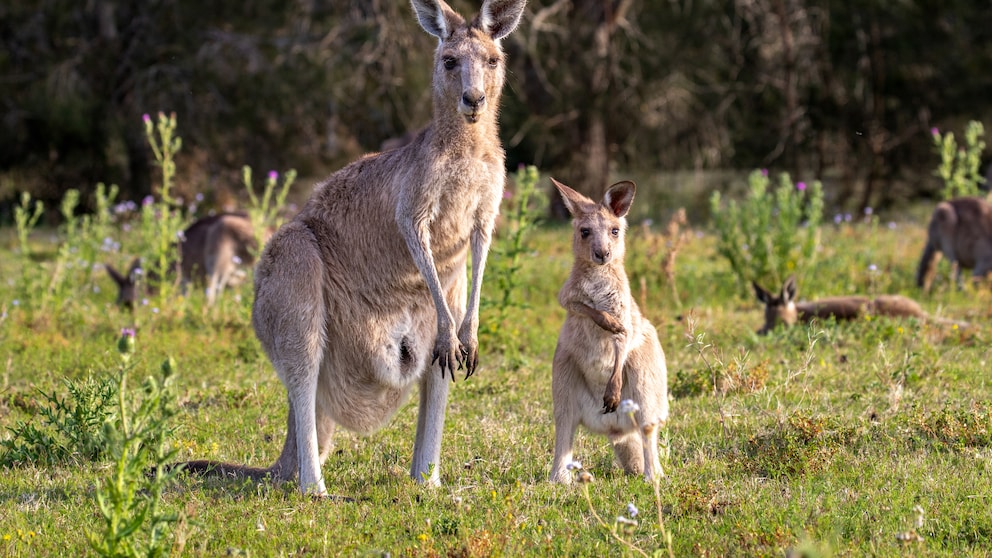
Many people are fascinated by kangaroos. Their locomotion is funny to watch, and young kangaroos looking out of their pouch always look cute. But the marsupials can do much more than hop around and enchant their observers. PETBOOK presents six exciting facts about kangaroos.
There are more than 60 species of kangaroo in the world—including the red giant kangaroo and the wallaby. As different as they are in size, color, distribution area, and habitat, they also have some things in common. Probably the best known are: All kangaroos carry their young, known as “joeys,” in a pouch and move around by hopping. But there are also some lesser-known, interesting facts about kangaroos. PETBOOK reveals six of them.
Overview
At Birth, They Look Like Little Worms
You read that right: Kangaroo babies are not born as cute mini marsupials that look like smaller versions of their parents. Nor do they hop around the Australian steppe with their conspecifics after just a short time. Instead, they are born in an embryonic state, and they look like tiny little worms.
The reason: after fertilization, a kangaroo embryo only develops in the womb for a short time before its development is interrupted. It is born and then goes into a dormant state. To do this, the kangaroo embryo must enter the mother’s pouch, where it grows and develops for around 30 to 35 days after birth. But how does the animal, which is only a few millimetres in size at birth, manage this? The tiny worm uses its tiny front legs to move through a stream of secretions to the mother’s pouch—a major challenge, as it is naturally very weak and barely developed.
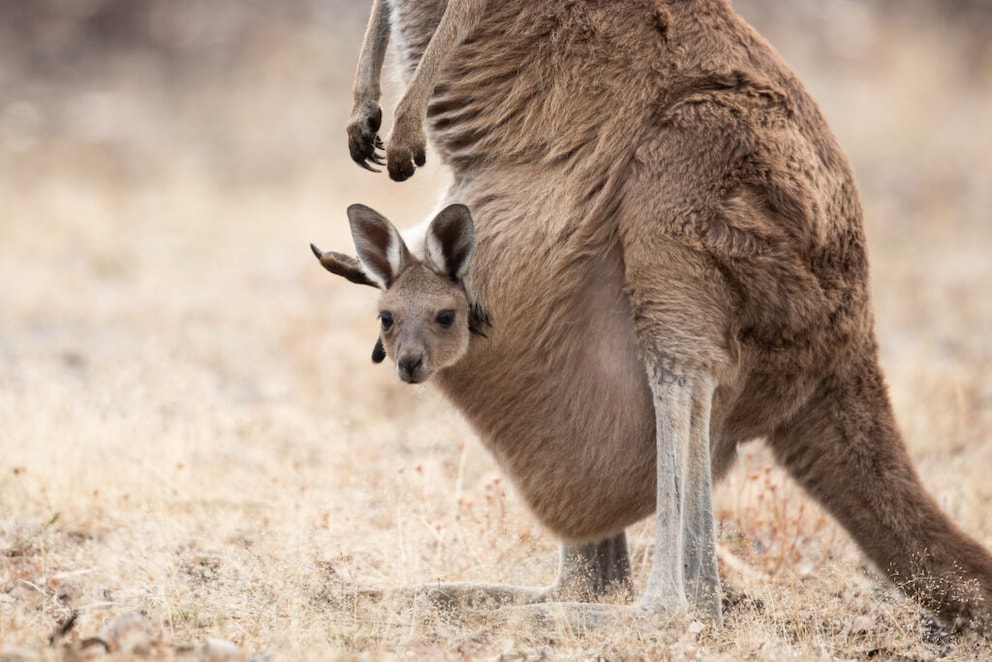
Once in the pouch, it attaches itself to one of the mother’s four teats and, depending on the species, remains in the pouch for almost a whole year. Here, young animals, called “Joeys”, can grow up safely while the mother can continue to be active. The young develop in the protected environment until they eventually leave the pouch and make their first small excursions. In the beginning, however, it always returns to its mother’s safe pouch.
Kangaroos Really Like to Box
Many people probably have the image of the “boxing kangaroo” in their head when they think of the marsupials, which are considered to be pugnacious. Perhaps it even has the characteristic red boxing gloves in your mind? No wonder. After all, the boxing, glove-wearing kangaroo has been featured on many posters and in Hollywood productions—such as the 2003 comedy “Kangaroo Jack.”
In reality, kangaroos actually like to punch each other. The animals use boxing to establish their hierarchy within their social group and resolve conflicts. Unlike in human boxing, however, they do not hit each other fully, but rather push each other. The aim is to unbalance their opponent. However, they only hit people in absolutely exceptional situations. They are flight animals that try to avoid conflict as much as possible. Only if they feel threatened or cornered can kangaroos “box” humans to defend themselves.
Kangaroos Don’t Actually Have Arms
Just because kangaroos like to box and are sometimes depicted wearing boxing gloves in comics and edited photos doesn’t mean they use their hands. Strictly speaking, they don’t have arms at all, but four legs.
The reason: in terms of biological systematics, kangaroos belong to the so-called “Tetrapoda,” the Greek term for “quadrupeds.” When they hear this term, many people automatically think of animals that stand on four feet or hooves, such as cows, horses, or sheep. However, the term Tetrapoda actually refers to a whole class of vertebrates with four limbs. This also includes birds, reptiles, amphibians, and mammals, whose feet have completely or partially regressed or developed into other limbs in the course of evolution. Parrots, for example, developed wings through evolution, while snakes lost their legs completely. This enabled the animals to adapt ideally to their habitat.
The front legs of kangaroos have also changed over the course of evolution and have become shorter. Because the hind legs are significantly longer than the front legs, a four-legged gait is hardly possible for kangaroos today. Instead, they move their front and hind legs in pairs when walking. They also use their front legs to reach for leaves and undergrowth, for example. Nevertheless, they are still legs, not arms. The hind legs of kangaroos, on the other hand, are much stronger, longer, and enable them to hop—their primary method of locomotion.
The Animals Use Their Tail as a “Fifth Leg”
While many mammals have a tail and use it to communicate with conspecifics, kangaroos use theirs as a “fifth leg”. This was discovered by researchers at Simon Fraser University in Canada.
According to the research findings, the animals use their tails as an additional leg when walking, which gives them balance and momentum when hopping. This is so strong that it exerts as much force as all the other legs put together.
When kangaroos need to rest, they raise their hind legs and rest on their tails. The tail is also used when the animals are attacked. They then lean on it and defend themselves by kicking or punching with their legs. 1

Why Wombats Have Such Hairy Snouts

Why so many cats have a pot belly and what it means
Only One Kangaroo Doesn’t Hop – but It Could Explain Why All the Others Do
Hopping is the trademark of kangaroos—but not all of them do it. The muskrat kangaroo, a rare forest dweller in northern Australia, stays down to earth: It walks on all fours, even at top speed. This primitive form of locomotion could also be the key to understanding how hopping evolved in kangaroos.
A so-called “bound” or “half-bound” was observed most frequently in them: This involves the hind legs moving forward simultaneously, followed by the front legs—a gait reminiscent of hopping, but remaining on all fours. Even when moving quickly, the animal uses all four limbs and never switches to walking on its hind legs alone.
These movement patterns have not been documented to this extent in any other known four-legged marsupial species. These observations support the theory that kangaroo hopping evolved in stages—from quadrupedal bounding to bipedal hopping. 2
Kangaroos Can Survive for Days Without Water
Kangaroos live in New Guinea and Australia, for example, in desert-like regions. In the outback, there is sometimes no rain for months and temperatures of up to 50 degrees. Kangaroos can survive even in these extreme environments where water and food are scarce. The animals regulate their water balance, and their metabolism slows down when food is scarce in order to maximize their energy efficiency. As a result, certain kangaroo species, such as red giant kangaroos, can survive three to five days without water. 3