

July 24, 2025, 2:45 pm | Read time: 4 minutes
They have long ears, strong hind legs, and a short stubby tail—at first glance, hares and rabbits look deceptively similar. But appearances can be deceiving: Behind these visual similarities lie two distinct species. PETBOOK explains why domestic rabbits are not actually hares and how to tell the difference between a hare and a rabbit.
Are All Rabbits Also Hares?
Wild rabbits and hares belong to the same animal family, the Leporidae. Rabbits kept as pets are the domesticated form of the wild rabbit. Domestic rabbits are bred in various sizes and fur colors. There are a total of 88 recognized breeds of domestic rabbits, including the long-haired Angora rabbit and the dwarf lop with its drooping ears.1
One of the main differences between rabbits and hares is that domestic rabbits are kept as pets, while hares are always wild animals.
Good to know: In Germany, the hare is now considered “threatened,” and in some states even “highly threatened.” It is not permitted to remove hares from the wild and keep them in captivity. Our domestic rabbits are always rabbits.2
How Can You Tell Rabbits and Hares Apart?
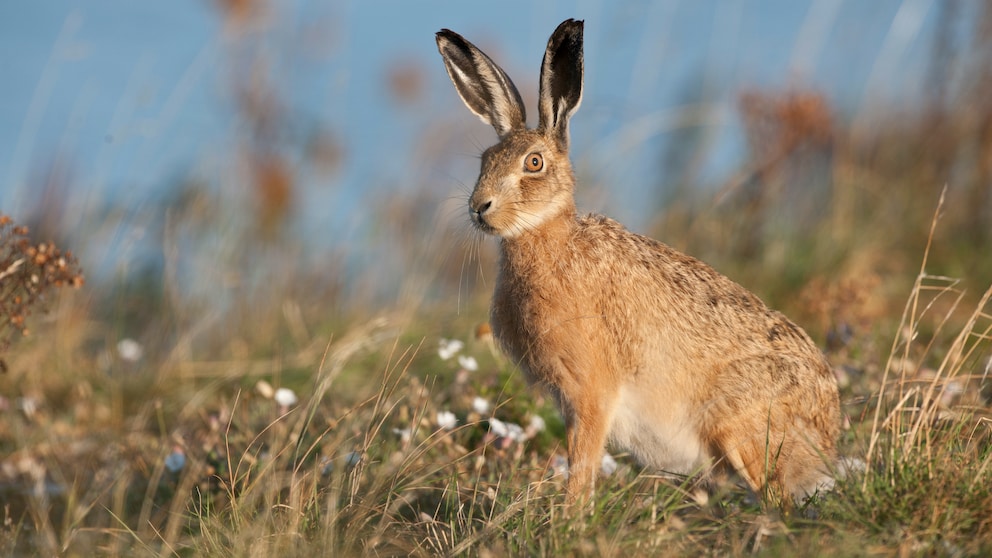
The fact that rabbits and hares are different species is evident in several characteristics and behaviors. For example, the hare is a solitary animal that seeks shelter in ground hollows or under bushes. In contrast, rabbits are social animals that live in groups and create underground tunnel systems as their homes. In direct comparison, hares are larger and more wiry than rabbits. They have longer ears and stronger hind legs than their smaller, stockier relatives. 3 4
Speaking of relations: While hares and rabbits belong to the same family, the species cannot interbreed. There are no hybrids of wild hares and tame domestic rabbits—partly due to their different chromosome sets. Differences are also evident in the offspring of the two species. Young hares are born with fur and open eyes, while rabbit babies are born naked and blind. 5
Hare or Rabbit? How to Tell the Difference
Here is an overview of the key characteristics that help distinguish between a hare and a rabbit.
The Ears
- If the ears are long with black tips, it’s a hare.
- If the ears are short and round without black tips, it’s a rabbit.
The Size
- Adult hares can grow up to 53 cm and have a wiry body.
- Wild rabbits reach up to 40 cm in body length and appear more compact.
Fur Color
- Hares have mottled fur with lighter underfur, and their belly is white.
- Rabbits are gray-brown with darker underfur, and their belly is lighter than the rest.
Legs
- Hares have long hind legs.
- Rabbits have short hind legs.

The Iberian lynx is no longer threatened with extinction

Do you know the world’s only black wild rabbit species?
Diet and Habitats of Hares and Rabbits
Further differences between hares and rabbits concern their diet. While both are herbivores, hares prefer to nibble on plant shoots, roots, grains, and bark. In contrast, rabbits munch on grasses, herbs, leaves, and vegetables. In the wild, wild rabbits inhabit open landscapes with loose soil where they dig their burrows. As cultural followers, they are also found in cities, such as in gardens and parks. Hares, on the other hand, also like semi-open landscapes, such as light forests.
In the face of danger, hares and rabbits behave differently. While rabbits quickly disappear into their underground burrows, hares crouch motionless on the ground. Only at the last moment do hares take flight, hopping away with their long, strong legs. In terms of speed, hares have the edge: They are significantly faster than the smaller rabbits. 6
What Is the Difference Between a Rabbit and a “Karnickel”?
The question remains whether there is a difference between a rabbit and a “Karnickel.” The answer is: “Karnickel” is another term for rabbit, but many rabbit enthusiasts find it derogatory. It’s similar to calling a dog a “mutt.”