

March 28, 2023, 12:06 pm | Read time: 4 minutes
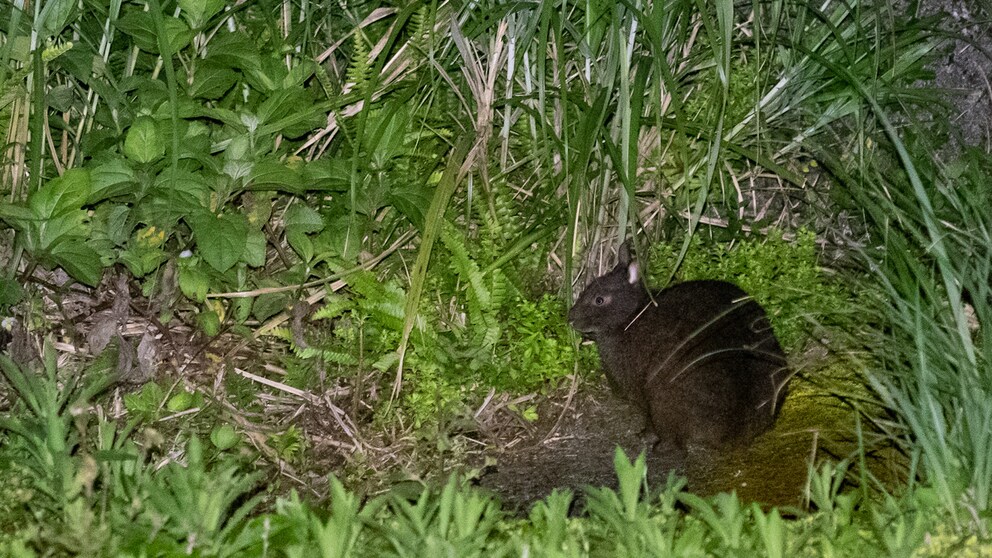
Domestic rabbits are bred in various colors. They come in brown, white, gray, cream, and even black. These color variations originally arose through natural mutations and were then selectively bred. The wild rabbit, from which our domestic rabbits descend, has exclusively gray-brown fur. In nature, there is only one species of rabbit that has a black coat. Where it lives and what makes it so special.
Having black fur is especially advantageous for nocturnal animals. They can move around in the dark without immediately attracting the attention of predators. Wild rabbits are generally crepuscular. For them, a too-dark coat would be more of a problem, as it might attract wolves, foxes, and lynxes. And indeed, the only black rabbit species in the world is nocturnal. What is its name and where is it found?
Black Rabbits as Living Fossils
The Ryukyu rabbit, also known as the Amami rabbit, lives exclusively on the two Japanese islands of Amami-Oshima and Tokunoshima. There, it inhabits coastal vegetated rocks and subtropical forests. The Ryukyu rabbit is only distantly related to our domestic rabbit and its wild ancestors, the wild rabbits.
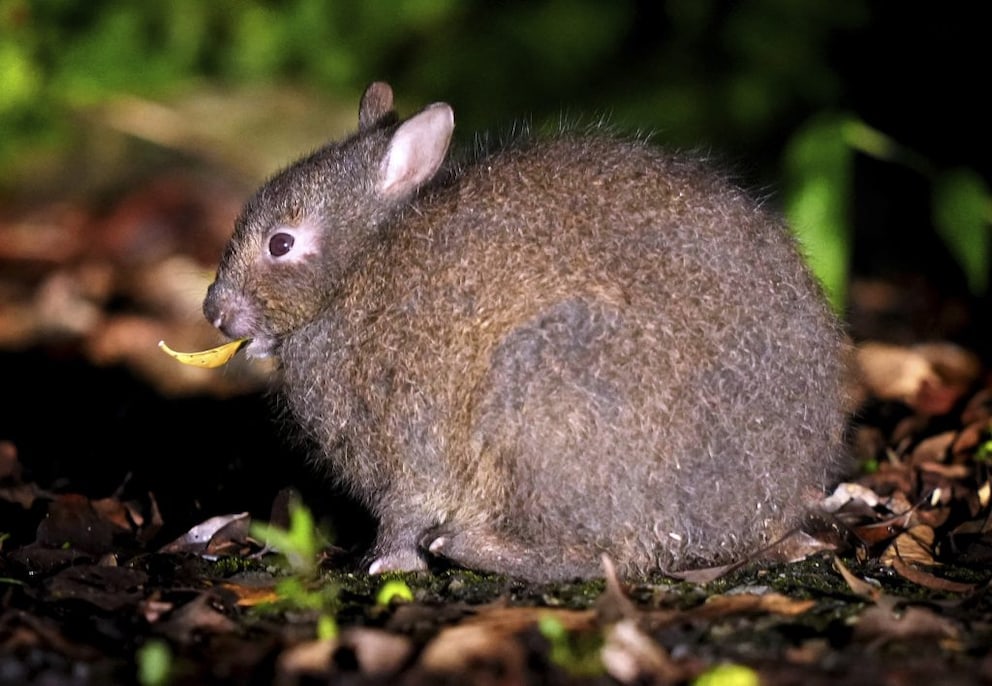
While all mentioned species belong to the hare family, the Ryukyu rabbit is classified in a separate genus. Its appearance differs significantly from our native long-eared rabbits. Amami rabbits have dark, woolly fur and relatively short ears. Their legs are also rather short, but their claws are quite long. The animals are considered living fossils, essentially as particularly primitive rabbits.
Also interesting: Why rabbits need to eat their own feces
The Special Role of the Amami Rabbit
Like our rabbits, Amami rabbits are strict herbivores. They nibble on plants such as Chinese silver grass and false chestnuts. Recently, researchers from Kobe University discovered that the Japanese rabbits play an important role in the propagation of the plant species Balanophora yuwanensis. This is a plant from the sandalwood order.
This plant resembles a fungus more than a plant. It lacks chlorophyll, the green pigment, and does not perform photosynthesis. Instead, it taps into the roots of other plants to obtain nutrients. Its bright red fruiting bodies are readily eaten by the black rabbits. In this way, the animals also ingest the plant’s seeds and excrete them unharmed. This usually occurs near the rabbit burrows, where the parasitic plant conveniently finds a host plant. One could say: A Gothic rabbit helps spread a vampire plant.

Wildcat or House Cat? How to Tell the Difference

The Iberian lynx is no longer threatened with extinction
Cloning Attempts for Rare Black Rabbit Species
The problem is that there are only a few thousand Amami rabbits left. The species is listed on Japan’s Red List of endangered mammals and is classified as “critically endangered.” There are several reasons for this: The black rabbits fall victim to introduced predators like dogs and mongooses. Additionally, their habitat, the subtropical island forests, is increasingly being destroyed. Due to their special relationship, the extinction of the black rabbits would likely also mean the end of the plant species Balanophora yuwanensis.
But there is hope. In 2005, the Japanese government decided to eradicate the introduced mongooses in the Ryukyu rabbits’ habitat. This action apparently succeeded, as the populations are slowly recovering. Additionally, attempts have already been made to clone the rare black rabbit. Researchers from Osaka University inserted a cell from a deceased Amami rabbit into a hare’s egg cell. This was then implanted into an animal surrogate mother. Whether this practice can create a healthy population remains questionable.
Sources
- Spektrum.de, “Bizarre Plant is Dependent on Rare Rabbits”, (accessed March 27, 2023)
- Sumikai.com, “Endangered Amami Rabbits Gradually Recovering in Japan”, (accessed March 27, 2023)
- Welt.de, “Endangered Rabbit Cloned”, (accessed March 27, 2023)