

August 20, 2026, 2:51 pm | Read time: 4 minutes
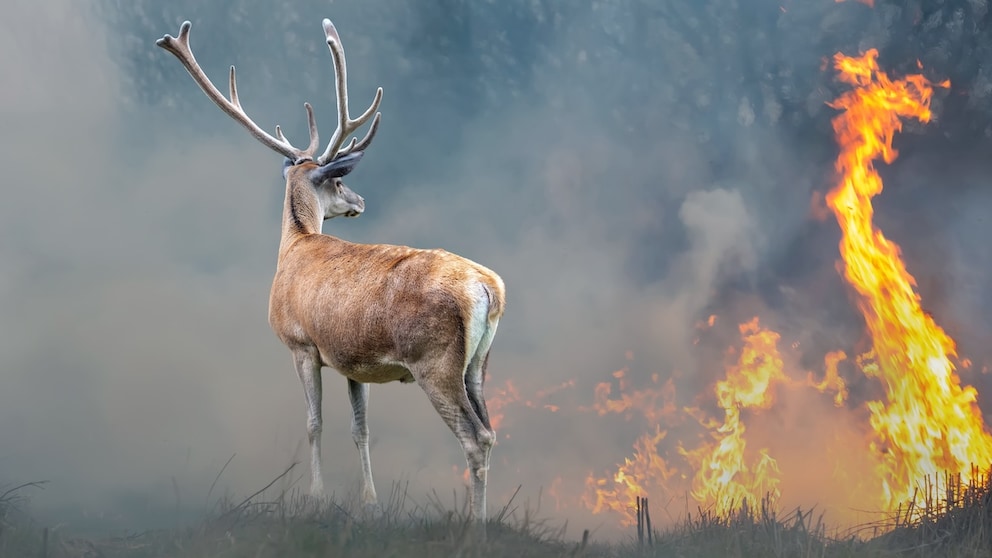
Blazing flames, towering smoke clouds, and charred landscapes—wildfires not only cause enormous damage to nature but also threaten numerous wildlife species. But can deer, hedgehogs, snakes, and other forest dwellers escape the flames at all? And what happens to the animals that survive a fire? PETBOOK asked the German Nature Conservation Association (NABU).
Which Animals Are Particularly at Risk
Silvia Teich from NABU explains: “Small and less mobile species are more often victims of flames and heat than larger and very mobile species. Therefore, the survival chances of flightless insects, snails, hedgehogs, mice, amphibians, and reptiles are significantly lower than those of birds and large mammals, such as wild boars or wolves.”
Observations from current fire areas in Belgium, France, and Spain confirm this picture. While larger mammals can often flee in time, animals that live on the ground or move slowly are particularly at risk. They either fall victim to the flames directly or lose their habitat.1
Do Wild Animals Even Have a Chance to Escape?
“Many animals clearly sense the approaching fire danger early and have a species-specific survival program (escape or burrowing). An ancient emergency program kicks in. Of course, it always depends on how quickly, completely, and extensively it burns,” says NABU.
Experts repeatedly report that many animals flee even before the actual fire area. But the faster a fire spreads, the more difficult the escape becomes. Especially in large-scale forest and vegetation fires, animals can become trapped or find no safe retreat.
The Danger Often Doesn’t End With the Fire
Surviving the flames doesn’t automatically mean an animal is saved. After major fires, food, shelter, and retreat areas are often lacking. Experts report from current European fire areas about disoriented animals venturing into settlements and cities in search of food. There, the danger from traffic increases, among other things.
“It depends on the type of fire. If it was a fast and less intense ground fire, the heat often doesn’t penetrate deep into the ground, and new vegetation quickly sprouts again. Then small animals hidden in the ground, rock crevices, or ponds often still have a chance,” Teich explains. It’s different with intense ground fires. These poison and destroy much of the life down to deeper soil layers. As a result, surviving animals simply starve, according to the spokesperson.
She adds: “From an ecological perspective, the long-term loss of habitat and ecosystem functions weighs even heavier than the fate of individual animals that perish cruelly in the flames. As long as habitats and ecosystems are vital and interconnected, species can survive, and fire-related disturbances are part of nature.”
Smoke Is Also Dangerous for Animals
Not only the flames themselves pose a threat to wildlife. Smoke can also severely affect them. NABU states: “Smoke is toxic—for all animals (and humans too). If animals cannot flee in time, they can die from smoke inhalation.”
During the recent major fire in the High Fens, the smell of smoke was temporarily noticeable more than 100 kilometers away. Especially animals that cannot quickly get to safety or are already weakened suffer from the smoke gases. Additionally, visibility is reduced, and many animals lose their orientation. Even outside the actual fire area, wildfires can therefore have significant consequences for wildlife.2
This Snake, Which Can Grow Up to 1.5 Meters Long, Lives in German Lakes
These Birds Deliberately Set Fires to Kill Their Prey
What to Do If You Find an Injured Wild Animal?
Especially after larger wildfires, weakened and injured wild animals are repeatedly discovered. Experts therefore recommend quickly seeking professional help rather than attempting to care for them yourself: “Injured animals—no matter what caused their injuries—should be taken to a wildlife rescue center or a veterinarian.”
Even though the effects of a wildfire cannot be undone, wild animals can be helped in summer in simple ways. Birds, insects, and other animals appreciate shallow water dishes in the garden or on the balcony. It’s important to regularly change the water and keep the containers clean.3
Are There Any Winners in a Wildfire?
Teich gives a clear answer to the question: “No animal is likely to benefit.”
Although vegetation can sometimes recover surprisingly quickly after rainfall, grasses, bushes, and young plants often return within months. However, for many animals, not everything is back to normal. Food, hiding places, and breeding sites are often missing for years. Additionally, many surviving animals are weakened or must find new territories. It can take years or even decades for entire ecosystems and animal populations to recover from a severe wildfire.