


April 20, 2026, 11:56 am | Read time: 4 minutes
Using fire strategically to hunt prey—what sounds like science fiction is apparently a reality in Australia. So-called “firehawks” are said to pick up burning branches and start new fires to drive animals out of hiding. PETBOOK editor and biologist Saskia Schneider explains how much truth there is to this behavior, which birds exhibit it, and why it continues to intrigue researchers.
Firehawks Use a Unique Hunting Technique
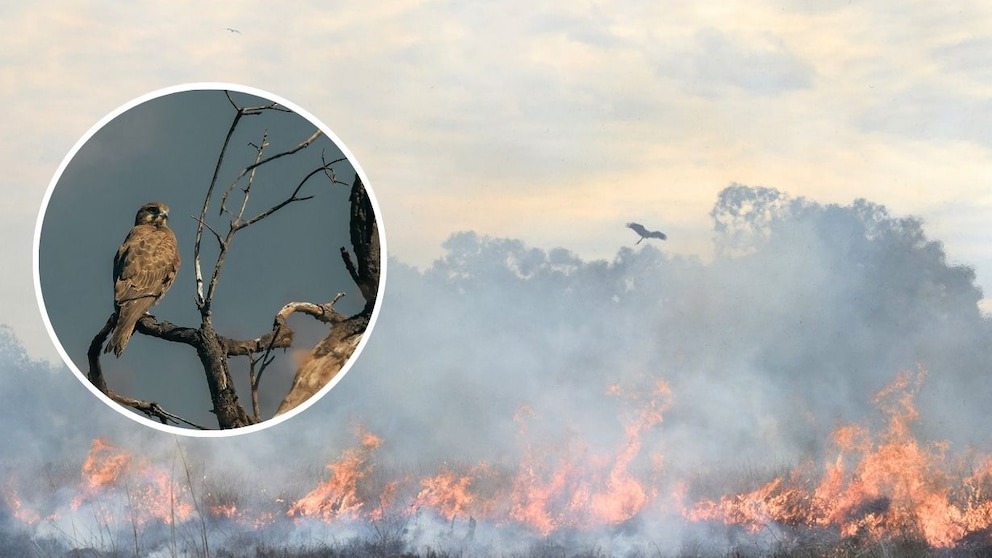
This behavior is not limited to a single species but includes several bird species, such as black kites, whistling kites, and brown falcons. These birds of prey are already known for following fires. Where there is smoke and fire, insects, small mammals, and reptiles flee, making them easy prey for the birds.1
But some of these birds take it a step further: They don’t just wait for the fire—they actively start new fires themselves.
How the Birds Start Fires
Observations show: The birds of prey fly deliberately into burning areas, grab smoldering branches with their beaks or talons, and carry them to untouched areas. There, they drop the burning branches, sparking new fires. What happens next is the crucial moment for the birds: Animals flee in panic from the grass or bushes and are caught in flight or on the ground.
Eyewitnesses even report that the birds deliberately try to transport fire over obstacles, such as roads, rivers, or already extinguished areas. Sometimes, several birds work together. This clearly argues against coincidence and for a consciously employed behavior.2
How Did This Behavior Develop?
Australia’s savannas have been shaped by fire for thousands of years. Fires are a natural part of the ecosystem there, triggered by lightning but also through deliberate fire management by Indigenous communities.
Birds of prey have learned to exploit this situation. The fact that some of them actively transport burning branches could be an evolution of this hunting behavior. A learned “trick” that is particularly rewarding for individual birds.
Interestingly, Indigenous peoples in Australia have reported these “firebirds” for generations. For a long time, this was dismissed as a myth. Only in recent years has research begun to take these reports seriously and systematically investigate them. The first valid scientific study on firehawks was published in 2017.3
Don’t the Fires Also Destroy Habitat?
Fire often seems destructive to us. However, in many parts of Australia, it is a natural part of the habitat. Many plants even depend on burning regularly to renew themselves.
Nevertheless, the behavior of firehawks can cause problems, especially for firefighters and land managers: Fires that are supposedly under control can reignite or spread further due to the birds.
For other animals, the additional fire can become a risk if refuges are lost. At the same time, this behavior shows how closely hunting strategies and ecosystems are intertwined.
Why Wildfires Are Deadly for Many Wildlife

Why Australia Culled Over 700 Koalas
Are the Birds Being Targeted?
There are indeed reports that birds of prey spreading fire have been specifically targeted or even killed, especially where fires cause economic damage, such as in agriculture. The problem is that not only are the ” firehawks ” affected, but also other, sometimes rare, birds of prey.
Today, there is a growing recognition that these animals are part of a complex ecosystem. Instead of fighting them, researchers and rangers are trying to better understand their behavior and incorporate it into fire management.4
Conclusion: Behavior Challenges Many Previous Assumptions
Firehawks demonstrate how surprising and complex animal behavior can be. The fact that birds of prey not only use fire but actively spread it challenges many of our previous assumptions.
At the same time, it becomes clear: In nature, there are no simple categories like “good” or “bad.” What looks like destruction to us is a sophisticated survival strategy for these birds.