

August 17, 2026, 8:48 am | Read time: 4 minutes
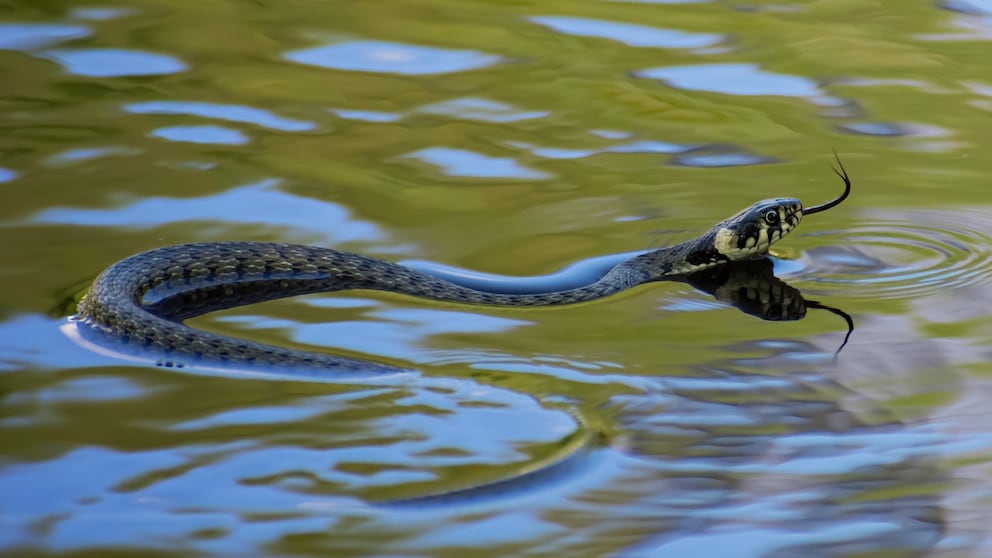
A plunge into the cool water, then suddenly a snake in the water? In fact, two species of snakes in Germany are excellent swimmers. Whether swimmers need to be afraid and how they should behave if they encounter one is explained by the German Wildlife Foundation and NABU to PETBOOK.
These Snakes Live in and Around German Waters
One of the best-known water snakes in Germany is the grass snake. It prefers to live near bodies of water and is considered an excellent swimmer, explains Jenifer Calvi, press officer of the German Wildlife Foundation. Large females can even reach an impressive length of up to 150 centimeters.
For humans, the species is completely harmless. “Although grass snakes have so-called Duvernoy’s glands, which produce a weak secretion, it is harmless to humans and only serves to paralyze smaller prey,” Calvi explains.
Grass snakes are also extremely shy. Instead of seeking human proximity, they try to flee. If the animal feels threatened and cannot escape, it resorts to an unusual strategy: it plays dead. It turns onto its back, rolls its eyes, and lets its tongue hang out of its open mouth.
In addition to the grass snake, there is another native water snake: the dice snake. “It is one of the rarest reptiles in Germany and is listed as ‘Critically Endangered’ on the Red List,” says Calvi. Today, it is only found sporadically in Rhineland-Palatinate and Saxony.
Silvia Teich, spokesperson for NABU, also confirms to PETBOOK: “There are two species of snakes in Germany that also live in water and are good swimmers. They are the grass snake and the dice snake. Both are completely harmless and non-venomous to humans.”
Are Snakes Becoming More Common in Swimming Lakes?
Swimmers frequently report encounters with snakes in the water. However, experts say there is no evidence that the animals are becoming more common. “Such observations are not available—rather the opposite is true,” says Calvi.
The populations of many native snake species are actually declining and are partially endangered, according to NABU. The main cause is the loss of suitable habitats. All native snake species are therefore under special protection.
Can Water Snakes Be Dangerous to Swimmers?
The clear answer from the experts is: no. Calvi explains: “Native snakes are flight animals that consistently avoid contact with humans.” Even slight vibrations are usually enough for the animals to retreat. “Even in the water, a grass snake would always dive and swim away if disturbed.”
According to the German Wildlife Foundation, native snakes are often mistaken for much more dangerous species from other parts of the world. “A common misunderstanding is attributing characteristics to native species that are known from exotic snakes.”

The 7 Native Snake Species of Germany and How to Identify Them

Snakes That Live in the Garden and How to Identify Them
Can Snakes Bite in the Water?
“A bite in the water could theoretically only happen under one condition: if you actively grab the snake, corner it, or accidentally step directly on it in shallow water and the animal sees no escape route,” Calvi explains.
Even then, a bite would generally be harmless to healthy people. Grass snakes would only leave a superficial wound that should be disinfected, according to the German Wildlife Foundation.
How to React if You Discover a Snake in the Lake
If you suddenly spot a grass snake while swimming, the main thing is to stay calm. If swimmers do encounter a snake in the water, NABU spokesperson Teich advises avoiding it. Swimmers should especially avoid one thing: touching the snake. “Do not try to grab the snake to pick it up. This triggers stress reactions in the snake. Let the snake pass by you in peace,” says the German Wildlife Foundation.
Their spokesperson Calvi even sees it as an opportunity: “Pause, marvel, and enjoy, because this sight is rare.” After all, grass and dice snakes have become rare in Germany. “The grass snake—females can grow up to 150 centimeters long—is an extremely elegant swimmer, whose sight is rare and definitely worth it.”