

November 5, 2026, 4:09 pm | Read time: 4 minutes
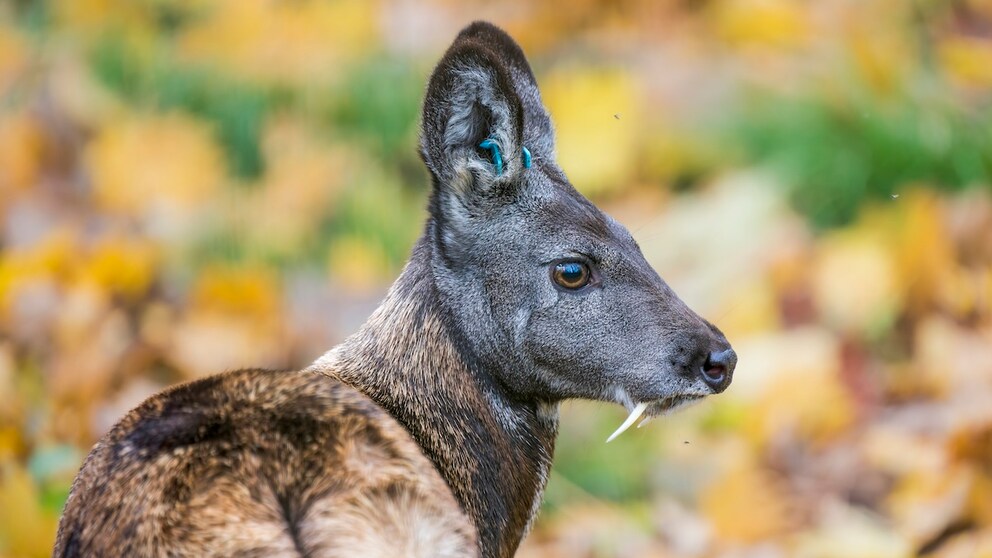
It looks like a small deer but has two massive tusks in its mouth: The male Siberian musk deer has canine teeth that can extend up to four inches below its upper lip. Despite its appearance, this rare animal is not a dangerous predator but a herbivore. So why does it need these unusual weapons?
Only the Males Have the Long Canines
The most striking feature of the Siberian musk deer is hard to miss: Male animals have significantly elongated canine teeth in the upper jaw. According to WWF Austria, they grow downward from the mouth and can reach lengths of about three to four inches. Females do not have these prominent weapons in a comparable form.1
The unusual nature of the dentition is evident from a skull in the Zoological Teaching Collection at Humboldt University in Berlin. The elongated upper canines of a male Siberian musk deer are clearly visible. Unlike predators, they are not used to catch prey or tear flesh, as musk deer are pure herbivores. They feed on grasses, herbs, mosses, lichens, leaves, and twigs. Therefore, their fearsome teeth have nothing to do with their diet.2
Why the Musk Deer Needs Its Tusks
The long canines effectively replace the antlers that male deer typically use in confrontations with rivals. When two musk deer males encounter each other during mating season, they first display their weapons to each other. If neither rival backs down, the display can escalate into a serious fight, with the males using their canines against each other. These confrontations can sometimes lead to bloody and severe injuries.3
Also interesting: 7 Animals That Look Like They’re From a Horror Movie
The Siberian Musk Deer Is Not a True Deer
Its appearance and names like “musk deer” suggest that the animal belongs to the deer family. However, this is not the case. Musk deer form their own family, Moschidae, within the order of even-toed ungulates. They were once classified as primitive representatives of deer. Today, they are considered a distinct group, whose exact position between deer and bovids has been a topic of scientific debate for a long time.4
The absence of antlers in musk deer is not an unusual loss for a deer species. It is rather part of their own evolutionary design. In addition to the large canines of the males, they also differ from true deer in their body structure.
An Early Relative Lived Millions of Years Ago
The history of musk deer goes back a long way. A paleontological study focuses on Moschus grandaevus, the oldest known member of the genus Moschus. Fossils of this extinct species have been found in southern East Siberia and dated to about 7.5 million years ago. Moschus grandaevus was smaller than today’s Siberian musk deer but already had typical features like strong hind legs for leaping in hilly terrain.5
7 Animals That Look Like They’re From a Horror Movie

Red Deer Named Germany’s Animal of the Year 2026
Where Does the Siberian Musk Deer Live?
Siberian musk deer inhabit forested mountain landscapes. They primarily reside at elevations from about 3,300 feet to the tree line. Other musk deer species are found in mountain forests at altitudes between 8,200 and 15,700 feet.
Outside the mating season, these wild animals mostly live alone. Since they are also mainly active at dusk and night and inhabit hard-to-reach regions, their behavior is still relatively unexplored. The sense of smell apparently plays an important role. Musk deer communicate using scent markers to define their territory.
Also interesting: Did You Know Bambi Isn’t Actually a Deer?
The Precious Scent Became Their Downfall
Their name comes from a gland that only males possess. It is located on the abdomen between the navel and the genitals and produces a strongly scented secretion, musk. It likely serves primarily to mark territory and convey information to other musk deer during the mating season.
For humans, real musk has been coveted for centuries. It was used in perfume production and still plays a role in parts of traditional Asian medicine. According to WWF Austria, more than 90 percent of the world’s natural musk consumption is used for these purposes. The high demand has devastating consequences for the animals. To obtain the gland, male musk deer are often killed.