

February 3, 2026, 3:57 pm | Read time: 5 minutes
Few birds touch people as deeply as the robin. With its orange-red breast, large dark eyes, and striking friendliness, it almost seems to seek our company. But what does a robin in the garden really mean? And why does it seem to appear more often in winter than in summer?
Overview
Why Are Robins Mostly Seen in Winter?
Many people wonder why robins seem to appear only in the cold season. In fact, they are present year-round—but much more reserved in summer. During the breeding season, they retreat to dense hedges, bushes, and ground cover.
In winter, their behavior changes. Insects become scarce, making gardens and feeding stations more important. As a result, robins show less shyness. Additionally, some robins from Northern and Eastern Europe migrate to Central Europe, making it seem as if there are suddenly more. Robins are partial migrants, meaning:
- Many stay in Germany year-round
- Others move to milder regions during frost (such as Western or Southern Europe)
- Still others come to us in winter from colder areas
Robins are also known for being unusually curious and fearless. This is due to their lifestyle: In the wild, they often follow wild boars or other digging animals to eat disturbed insects. People digging in gardens or raking leaves are quickly recognized as “useful disruptors” and are usually not further noticed. Additionally, robins are solitary and defend their territory vigorously. Instead of hiding in flocks, they seek attention—even from humans.
What Does a Robin in the Garden Mean?
In many cultures, the robin is a symbol of hope, new beginnings, and comfort. Especially in European folklore, it is often associated with the deceased, as a kind of feathered messenger reminding us of loved ones. While this meaning cannot be scientifically proven, its emotional impact is real: Robins often appear in quiet moments, move slowly, and seem almost “observant.”
Biologically, their proximity to humans is not a sign of symbolism but of adaptability. The robin (Erithacus rubecula) has learned that gardens can be safe habitats with plenty of food. This is one reason it is among the best-known and most popular songbirds in Europe.
What Does a Robin Look Like?
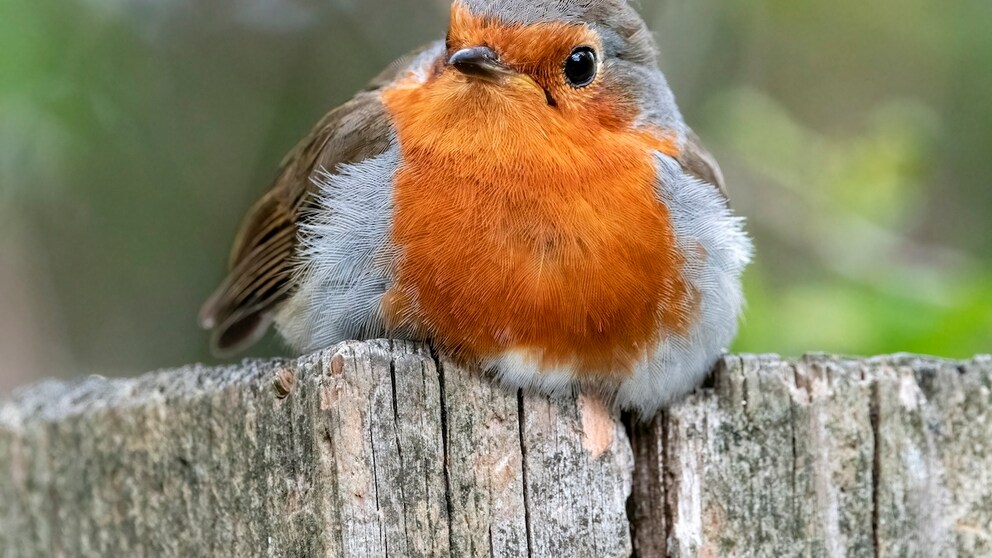
For many robin enthusiasts, this will be nothing new: The small, round bird has a body length of about 13–14 centimeters and weighs 16 to 22 grams. Also typical are:
- the bright orange-red breast and forehead,
- a gray-brown back,
- a light belly,
- large, dark eyes that give it an almost “childlike” expression.
Young robins look completely different: They do not have a red breast but are brown-speckled, an important camouflage against predators. There is no pronounced sexual dimorphism in robins, meaning males and females look almost identical. Even the coloring of the red breast is not a reliable distinguishing feature.
Differences are more apparent in behavior: Males sing more frequently and longer, while females take on most of the brood care.
How Do Robins Live?
Originally, robins lived mainly in open forests and forest edges. Today, they are typical cultural followers and can be found in parks, gardens, cemeteries, and even city centers. Robins are pronounced loners. Unlike many other songbirds, they do not form flocks and defend their territory vigorously. Their territorial defense against conspecifics is particularly noticeable and can be physical if necessary.
They usually move close to the ground, hopping in short movements and often standing upright to attentively observe their surroundings. They prefer to sleep protected in hedges, ivy, woodpiles, or dense shrubs. The breeding season usually begins in March or April and can extend into summer. Robins often breed twice a year, sometimes even three times if conditions are favorable.
The nest is typically well hidden near the ground, often in hedges, between roots in wall niches, or semi-open nest boxes. Nests are built and lined with moss, leaves, and fine stalks. A clutch consists of 5 to 7 eggs, which the female incubates for about 13 to 14 days. The young birds leave the nest after about two weeks but are not yet fully independent. Many young birds do not survive their first year. In the wild, robins live an average of 2 to 5 years. However, some banded individuals have lived over 10 years—a rarity.
Are Robins Part of the Thrush Family?
Despite their popularity, many people know surprisingly little about their biological classification and lifestyle. Systematically, robins belong to the flycatcher family (Muscicapidae). They were previously classified with thrushes, but newer genetic studies show a closer relationship to other small insectivores, such as:
- Nightingale
- Bluethroat
- Black redstart
This places robins in a group of birds known for their varied songs and territorial behavior. They are most often confused with the black redstart. The bullfinch (also known as the Eurasian bullfinch) is sometimes mentioned, but it is significantly larger and more brightly colored.
Blackbird or Thrush? How to Tell the Difference
Eurasian Bullfinch, or Robin? Who’s Really Sitting in the Garden
What Do Robins Prefer to Eat?
Robins are insectivores with a preference for soft food. Their diet includes:
- insects, larvae, and spiders
- earthworms
- berries and soft fruits
- in winter: oatmeal, raisins, mealworms
At feeding stations, they avoid hard seeds and prefer ground food and shallow dishes. These should be placed securely away from cats and rats.
Conclusion
The robin is not a mystical messenger from another world—but a fascinating, intelligent bird that has learned to live with us. Its presence is comforting, its behavior extraordinary, and its appearance in winter is primarily a sign that the garden is a valuable habitat.