

June 7, 2026, 3:48 am | Read time: 5 minutes
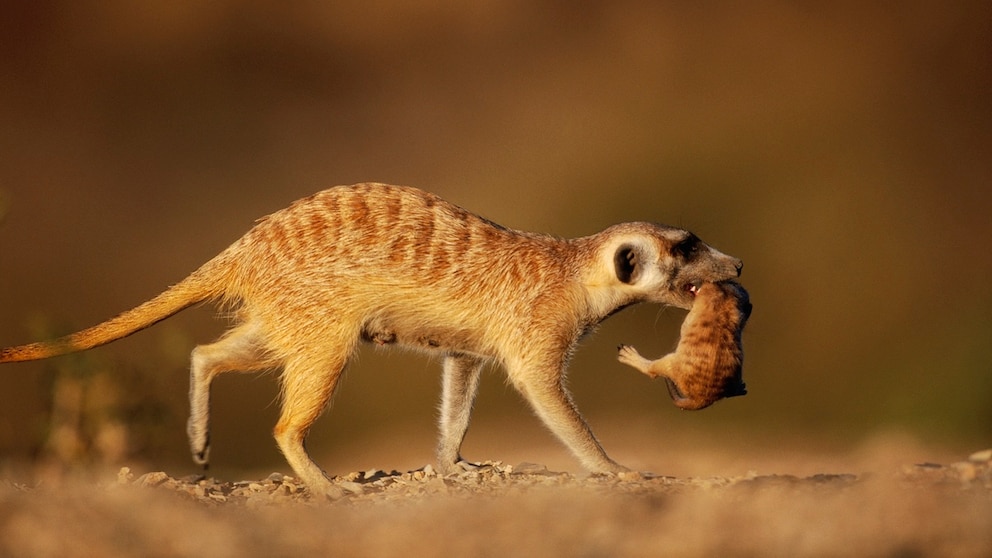
Watching a group of meerkats automatically puts you in a good mood: These small mammals belong to the mongoose family and live in colonies of up to 40 animals in the savannas and deserts of southern Africa. They likely owe their name to their typical upright posture, as some animals act as sentinels, watching for enemies and warning the group of impending danger with high-pitched, barking sounds. The colonies inhabit underground burrows, which they often take over and expand from ground squirrels. However, meerkats exhibit many other fascinating behaviors, eight of which PETBOOK presents.
Overview
Meerkats are Predators
Meerkats are often mistaken for prairie dogs, but the latter belong to the order of rodents and the squirrel family, while meerkats belong to the order of carnivores and the mongoose family. Prairie dogs also live in self-dug burrows, but on a completely different continent, namely North America. Their body structure is much stockier than that of the slender, graceful meerkats. In English, meerkats are referred to as “meerkat,” which is often incorrectly translated into German as “Meerkatze.” However, they have absolutely nothing to do with this primate genus.
Also interesting: Why ground squirrels increasingly sleep through mating season
Meerkats Even Eat Scorpions
Meerkats may look cute, but these small predators are quite formidable when it comes to food acquisition. While prairie dogs are strict vegetarians, meerkats eat insects and are also fond of small birds or their eggs. Lizards, snails, and even scorpions or venomous snakes are on the menu for the greedy mongooses, as they are immune to most poisons.
Meerkats Have Natural Sunglasses
Meerkats have conspicuously dark eye rings. These are not from constant vigilance and lack of sleep. They likely prevent the animals from being blinded by the sun when they look into the distance, such as when watching for a predator. The dark rings are like natural sunglasses. Another practical feature is that they can close their ears while digging to prevent sand from entering their ear canals. The lively mongooses are excellent runners and can reach speeds of up to 20 mph.
Meerkats Move Every Few Months
They could also be called nomads of the desert, as meerkats change their territory every few months. Then it’s time to dig again, as such a burrow consists of over 15 entrances and exits and a tunnel system with various chambers that lie up to six feet underground. When it’s scorching hot outside, it’s pleasantly cool in this burrow. Another practical feature comes in handy: meerkats can close their ears while digging to prevent sand from entering their ear canals.
Meerkats Have a Clear Division of Labor
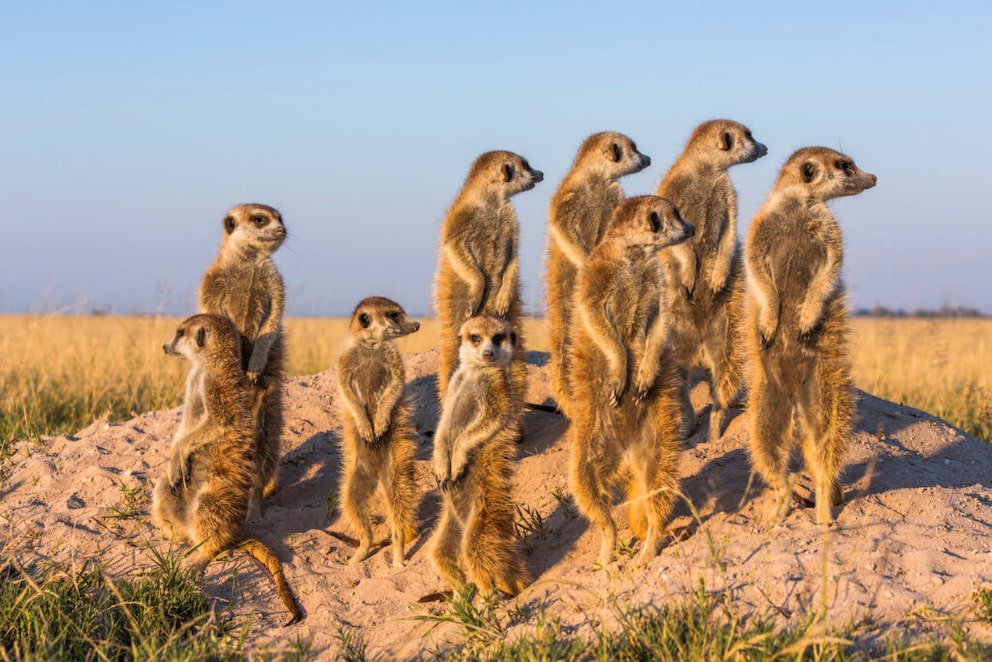
Meerkats are among the most social animals. In their colonies, there is a clear division of tasks: While most search for food, there are special sentinels who watch for approaching predators, such as birds of prey. They then emit barking sounds, and everyone quickly disappears into the burrow. Researchers believe that the warning calls even vary, allowing the sentinels to communicate whether the predator is approaching from the air or sneaking up on the ground. If a ground predator, such as a snake, is spotted, the meerkats band together to try to drive the intruder away. Even a sentinel needs to search for food sometimes, so the social animals take turns to ensure the alarm system functions perfectly.
Meerkats Have Babysitters
For the very young, there is a dedicated babysitter who watches over them when the females are otherwise occupied. This is crucial, as despite this care, only one in four pups survives. The babysitters do not eat during this time and lose up to two percent of their weight per day. Once the young can eat solid food, they receive special teachers who teach them what is edible and how to hunt. They practice with dead animals to later catch live prey.
In Meerkat Colonies, the Females Rule
The colony is led by a meerkat pair. Usually, only the highest-ranking female has offspring. Surprisingly, these are also nursed by other females who do not have their own young. If the alpha male meerkat dies, another takes its place. However, if the alpha female meerkat dies, it means the end of the family. Generally, in these wild animals, the females tend to be in charge.

Rabbit or Hare–Do You Know the Difference?
The Squirrel Is the Garden Animal of the Year 2026
If Mama Meerkat Is a Late Sleeper, So Are Her Kids
Alex Thornton and his team from the University of Cambridge observed with the “Kalahari Meerkat Project” in the Kalahari Desert that the meerkats there sleep for varying lengths of time. The sleep rhythm varies from group to group and is passed on to the offspring. So if Mama Meerkat is more of a late sleeper, her children won’t be early risers. Why some of the animals get up earlier than others is still unknown. Perhaps, like humans, there are early risers and night owls among meerkats?
Sources
- madiba.de, “The Meerkat Who’s Who“, (Accessed on 06.06.2026)
- Spektrum.de, “Meerkats Have Sleep Traditions“, (Accessed on 06.06.2026)
- Geo.de, “Meerkats“, (Accessed on 06.06.2026)