


July 6, 2026, 2:50 pm | Read time: 6 minutes
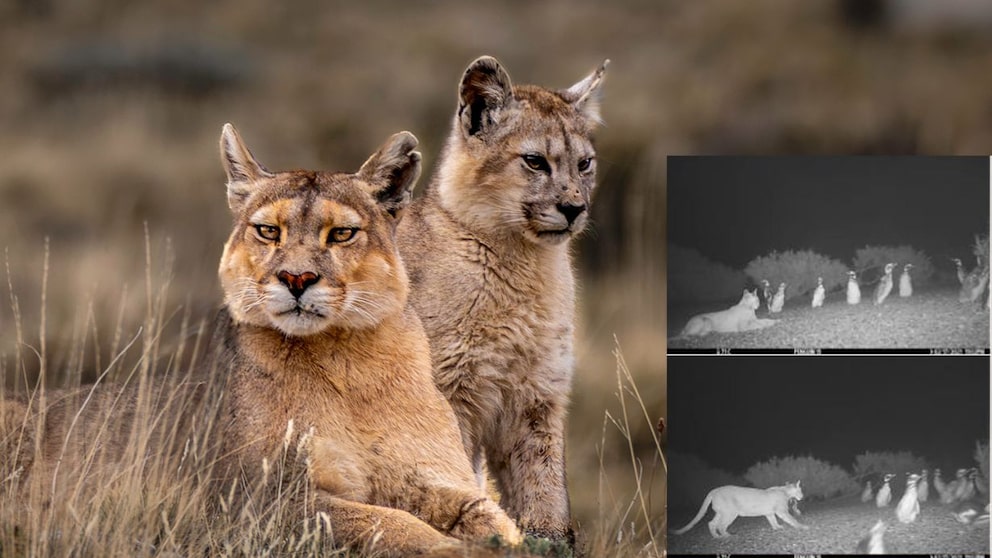
In a national park in Patagonia, something remarkable occurred between predators and prey: Pumas are returning–and hunting penguins. A study shows how this unusual food source is fundamentally changing the movement behavior and social structure of the big cats. The findings could also redefine our understanding of species conservation and ecological restoration.
Penguins Are Not Part of the Natural Prey Spectrum
When considering what pumas eat, penguins would certainly not be among the top ten most mentioned prey animals. In nature, this seabird is not part of the diet of the big cats. Their main food includes deer (white-tailed or mule deer). They also hunt smaller mammals such as coyotes, lynxes, raccoons, rodents (mice, rats, squirrels), rabbits, as well as birds and fish. In short, pumas are versatile carnivores that eat almost anything they can catch.
Penguins, as flightless birds, actually make perfect prey. However, until now, populations of pumas and penguins did not coexist. But through a reintroduction project in Patagonia–an extensive region that spans much of the southern tip of South America and is traversed by the Andes–two species that were previously separated came together.
Pumas Discovered Ground-Nesting Penguins as Easily Available Prey
Globally, the restoration of wildlife populations is increasing–often through protected areas or targeted reintroductions. Animals usually return to ecosystems that have changed significantly since their displacement. Such altered habitats with new species compositions can lead to unexpected interactions.
A study examined just such a novel interaction in Patagonia. It was conducted in collaboration with U.S., German, and Argentine researchers and investigates how the return of pumas and the presence of this unusual food source affect their behavior, movement patterns, social structure, and population density. With the establishment of Monte León National Park in 2004, pumas returned. There, they discovered the ground-nesting penguins as easily available prey. The goal was to better understand how predators adapt to new resources in altered ecosystems. This is a key question for the long-term success of conservation efforts. The results were published in the journal “Proceedings of the Royal Society B.”1
Camera Traps and GPS Trackers Recorded Puma Behavior
The study took place between September 2019 and January 2023 in Monte León National Park (MLNP) in southern Argentina. This is a 610-square-kilometer area with about 40,000 breeding pairs of Magellanic penguins. To analyze the behavior of the pumas, 14 adult animals (9 females, 5 males) were equipped with GPS collars. Movement data was recorded every three hours.
Various metrics were used to evaluate movement behavior, including duration of stay, return time, and size of the home range. Researchers compared these values between times when penguins were present in the park (October to April) or absent (June to August). Additionally, a model to estimate population density was created using camera trap and GPS data.
In addition, the diet of the pumas was examined using food remains in GPS location clusters. Social interactions between animals that either ate penguins or did not were also recorded. Overall, this provided differentiated insights into how the presence of penguins influences the behavior of individual pumas–both in their mobility and social interactions.
Pumas Come Closer Together When Hunting Penguins
Like many members of the cat family, pumas are solitary animals. Their territories are usually vast and rarely overlap to avoid confrontations with conspecifics. However, the presence of penguins changed this.
The study shows: Pumas that ate Magellanic penguins significantly adapted their behavior to the seasonal availability of this prey. During the penguin breeding season (October–April), they stayed in one place longer (an average of 10 hours more), returned faster (50 hours earlier), and had smaller, overlapping home ranges. When the colony was empty, they expanded their activity ranges–the maximum movement distances doubled compared to the penguin season.
These animals also regularly returned to the penguin colony–even when no penguins were present. Pumas that did not eat penguins showed no comparable behavioral changes.
Penguin-Hunting Pumas Show the Highest Population Density Ever Documented for This Species
Noteworthy is also the social behavior: Pumas that hunted penguins encountered conspecifics significantly more often–about five times as often as their counterparts without a penguin diet. Sixty-three percent of these contacts occurred within a kilometer of the penguin colony, mostly between females.
The estimated population density of pumas in the park was 13.2 individuals per 100 square kilometers, the highest ever documented for this species–more than twice the previous peak values.
Colony Became a “Hotspot” of Social Interaction
This study provides an impressive example of how predators adapt to novel food sources–with far-reaching ecological consequences. The high availability of easily catchable prey like penguins led to not only altered movement patterns among pumas but also to a previously rarely documented social tolerance, especially among females. The colony became a “hotspot” of social interaction–a behavior previously described mainly in bears in salmon areas, but not in typically solitary pumas.
Additionally, the study indicates that a single, concentrated resource–in this case, the penguins–can be sufficient to support an unusually dense population of a top predator. At the same time, it became clear that the high density is not solely due to the penguins. Other prey animals such as guanacos, rheas, and hares, as well as the lack of hunting pressure, also play an important role.
These new insights are particularly relevant for conservation strategies: When predators are reintroduced into altered ecosystems, classic “top-down” effects do not automatically occur. Instead, novel networks of relationships can emerge that unexpectedly change the behavior of species–and thus also the impact on the entire ecosystem.

Carnivorous Ground Squirrels Observed for the First Time in California

Videos Show How Orcas Hunt and Eat Great White Sharks
Assessment of the Study and Possible Limitations
The study impresses with its robust study design, the long data collection period of over three years, and the combination of GPS data, field observations, and camera traps. Particularly strong is the linkage of animal movement data with social behavior and population density–a rare multidimensional approach.
Nevertheless, there are limitations. The distinction between pumas that hunt penguins or not is based on minimal evidence–the consumption of at least one penguin. A quantitative assessment of the actual proportion of penguins in the diet is lacking. The GPS data is also unevenly distributed by gender (more females), which limits a complete analysis of gender-specific behavioral differences. Additionally, interactions between pumas were recorded based on GPS data within 200 meters–without direct observations. The exact quality of these encounters (e.g., aggressive, social, random) therefore remains unclear.
Conclusion: Reintroduction Alone Does Not Guarantee a Return to Previous Ecological Conditions
The return of pumas to Monte León National Park shows how dynamic and adaptable predators are to new environmental conditions. The Magellanic penguins, originally benefiting from the absence of predators, became the new main prey–with consequences for the behavior, social structure, and density of the pumas.
The study demonstrates: Reintroduction alone does not guarantee a return to previous ecological conditions–rather, novel interactions arise that can change the entire system. For conservation and management, this means: Success criteria must be adjusted, and local peculiarities must be more strongly considered.