

September 10, 2026, 3:06 pm | Read time: 4 minutes
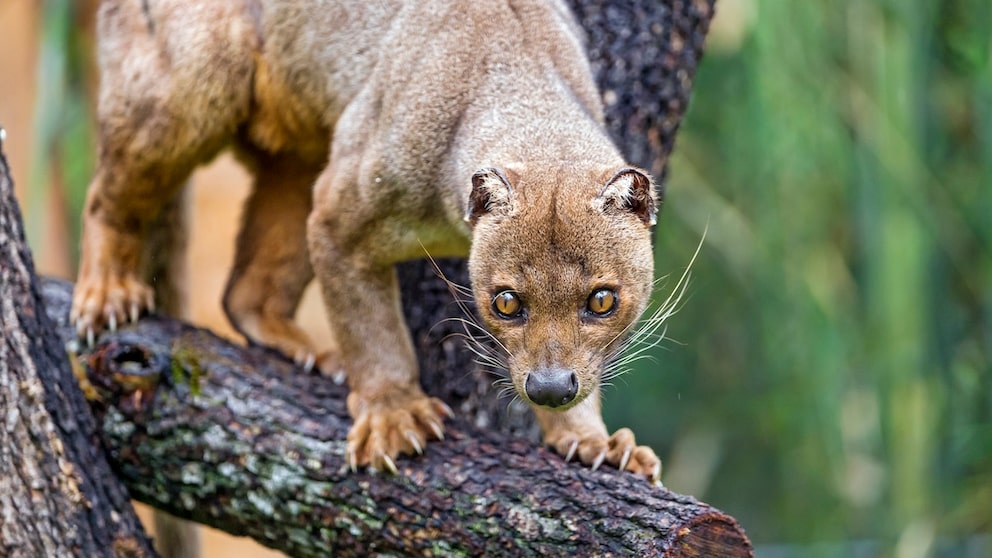
The fossa is Madagascar’s largest predator and a skilled hunter. It typically eats lemurs, reptiles, or smaller animals. However, it sometimes invades chicken coops and kills more animals than it can eat. PETBOOK explains why fossas exhibit this unusual behavior and why they have a bad reputation among many people.
What Do Fossas Eat?
As the largest predator in Madagascar, fossas (Cryptoprocta ferox) are skilled hunters. Their diet mainly consists of lemurs. In addition, they prey on tenrecs, a family of mammals similar to hedgehogs and shrews, found primarily in Madagascar.
Depending on the opportunity, fossas also eat reptiles, frogs, and insects. Their varied diet helps them adapt to different habitats and the available food supply.1
Why Do Fossas Sometimes Kill More Prey Than They Eat?
Despite being skilled hunters, fossas’ hunting behavior often leads to conflicts with humans. When these predators invade a chicken coop, they sometimes kill significantly more chickens than they eat afterward.
Scientists refer to this as “surplus killing.” It is not unnecessary cruelty but an instinct also observed in foxes, martens, and wolves. When prey cannot escape, their frantic attempts to flee repeatedly trigger the hunting reflex. The fossa then kills one animal after another, even though its hunger is already satisfied.
Researchers, including Samuel D. Merson from the University of Oxford and Luke J. Dollar from the Durrell Institute of Conservation and Ecology, studied how often this occurs. For their 2019 study published in the journal PLOS ONE, they surveyed nearly 1,750 households in various regions of Madagascar. Many respondents reported that fossas often kill the entire stock after entering a chicken coop, even though they only eat part of the prey afterward.2
This behavior significantly contributes to the animals’ bad reputation. For affected families, a single attack can mean the loss of all their chickens. Researchers suspect that it is not the frequency of attacks but their extent that contributes to fossas being perceived as problem animals in many places.
From the Rainforest to the Chicken Coop
Fossas do not actually target chicken coops. These predators usually live reclusively in forests, roam large territories, and avoid disturbances whenever possible. Observations from zoos even suggest that the animals are sensitive to unfamiliar stimuli and need retreat options. Therefore, human proximity is likely not a habitat fossas actively seek.3
The problem: Their home is disappearing. From the 1950s to 2014, Madagascar lost about 44 percent of its forest area. Where dense forest once stood, there are now economic fields, pastures, and settlements in many places.4
A 2019 study published in the journal “Nature Climate Change” shows how dramatic the development could become. Researchers warned that the combination of deforestation and climate change could cause large parts of today’s rainforests to disappear within the next 60 years. As the forest shrinks, the hunting grounds of wild animals and natural prey become scarcer. Chicken coops on the forest edge, on the other hand, offer easy prey.5
How Old Do Fossas Get?
Fossas can live up to 20 years and are mostly solitary. After about seven weeks of gestation, the female usually gives birth to two to four young. These remain with the mother for up to 20 months before becoming independent.
Can Fossas Climb and Swim?
Yes, fossas are true climbing artists. Their sharp claws, long tail, and flexible joints help them move safely through trees–even climbing down tree trunks headfirst. This allows them to pursue agile prey like lemurs.
Fossas can also swim and cross rivers and other bodies of water when needed. Occasionally, fish or freshwater turtles are on their menu. While their habitat is primarily the forest, the animals are surprisingly versatile.

Why Ocelots Sometimes Travel With Opossums

This wildcat loves water and barks–hardly anyone knows it.
How Big and Heavy Does a Fossa Get?
Fossas reach a head-to-body length of about 70 to 90 centimeters and usually weigh 5.5 to 15 kilograms. Their almost equally long tail helps them balance in the trees. At birth, the young weigh only 80 to 100 grams and are born blind and toothless. They gradually develop into skilled climbers and hunters.
More Facts About Fossas
In addition to their unusual hunting behavior, fossas have some surprising traits:
Young Female Fossas Look Like Males
Young female fossas temporarily develop a greatly enlarged clitoris, supported by a small bone. This unusual feature regresses with age. Why females develop it is not yet fully understood.6
Unusual Mating Behavior
During mating season, the female chooses a specific tree and stays there for several days. Multiple males compete for mating. The female can mate with several males, which is unusual for an otherwise solitary predator.
The Giant Fossa
Once, a significantly larger fossa species, Cryptoprocta spelea, lived in Madagascar. It was larger than today’s fossa and likely hunted the now-extinct giant lemurs. When and why it became extinct is not fully understood.7