

July 18, 2026, 10:13 am | Read time: 9 minutes
Ocelots are considered silent loners and skilled hunters. Yet, under certain circumstances, they are found alongside opossums. PETBOOK reveals what lies behind this unusual relationship and other astonishing facts about these wildcats.
A Body Made for Life in the Rainforest
The ocelot (Leopardus pardalis) belongs to the genus of spotted cats. The animal’s name sounds exotic—and it is: It originally comes from Nahuatl, a collective term for Uto-Aztecan languages spoken by many indigenous peoples of Central America. There, the word “ocelotl” originally referred to a large wildcat—likely the jaguar. Through French (“ocelot”), the term eventually made its way into German, now specifically referring to the smaller, spotted wildcat Leopardus pardalis.
The ocelot is an ambush predator, primarily active at night—and its senses are perfectly adapted to this lifestyle. Its large eyes allow excellent vision in low light. Like many nocturnal cats, the tapetum lucidum, a reflective layer of cells behind the retina, enhances night vision by “reusing” incoming light. This enables the ocelot to detect movements in the underbrush even on moonless nights.
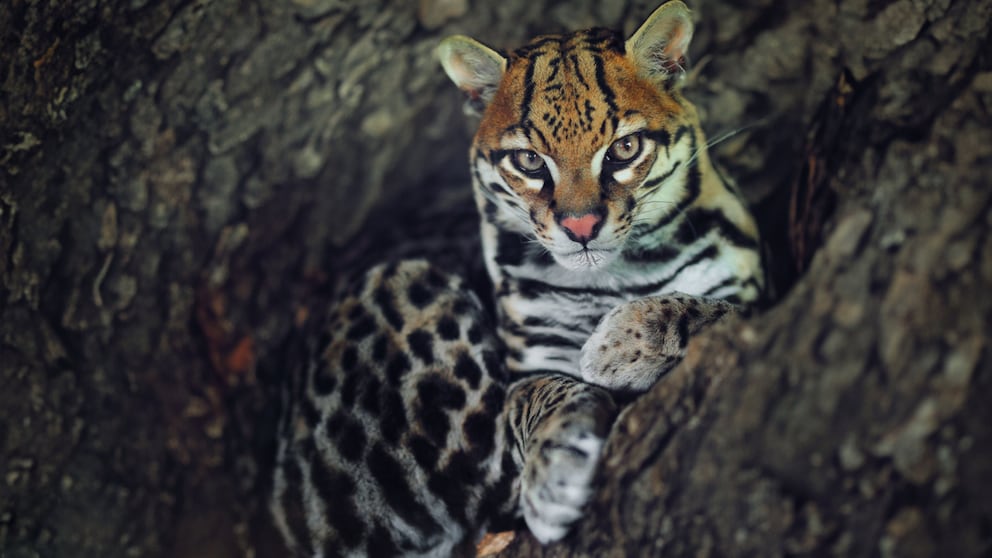
Its round, low-set ears are particularly striking. They serve not only for hearing but also as a crucial camouflage feature due to their shape. Unlike upright, pointed cat ears, they do not protrude above the dense foliage when the ocelot is lurking in the underbrush or a hideout, making it harder for prey to spot. Additionally, ocelots can move their ears independently to pinpoint rustling, chirping, or scurrying sounds—even if the prey is not visible.
Coat Patterns Differ in Rainforests and Dry Areas
The ocelot measures between 72 and 100 centimeters in length. Its tail is relatively short, ranging from 25 to 41 centimeters. Adult animals weigh between 7 and 18 kilograms, with males generally being larger and heavier than females. The muscular build, strong forelimbs, and flexible movement make the ocelot an excellent climber and stealthy hunter.
The coat pattern is unique—each ocelot has its own design. The base color varies from grayish to yellow-brown to orange, depending on the habitat: Animals from humid rainforests are usually ochre-colored, while their relatives from drier areas are more gray. Black spots and rosettes are distributed across the entire body. The underside is always lighter, and the face features a distinctive stripe pattern. Bright spots on the back of the ears—known as “false eyes”—are meant to deter potential attackers.
The Ocelot’s Diet–Anything Not Up a Tree
Ocelots are highly versatile hunters. Their main prey consists of small to medium-sized vertebrates weighing less than a kilogram. These include spiny rats, tree porcupines, opossums, birds such as tinamous, reptiles, amphibians, and occasionally fish. In rare cases, they take on significantly larger animals—such as coatis, sloths, or even young peccaries. Occasionally, crabs or insects are also on the menu. Their hunting technique is highly effective: They can remain motionless for up to an hour, striking swiftly at the right moment.
A much-discussed study from the Caratinga Biological Station (CBS) in southeastern Brazil impressively shows that ocelots regularly prey on primates under certain conditions. In this study, 27 percent of the samples contained one or more of these species:
- the brown howler monkey (Alouatta guariba)
- the woolly spider monkey (muriqui) (Brachyteles hypoxanthus)
- the brown capuchin monkey (Cebus apella)
Of these, 20 percent were howler monkeys, which were correspondingly common in the ocelots’ diet. However, spiny mice (Calomys) and unidentified birds were most frequently detected. Notably, these monkey species—including the endangered woolly spider monkey—were not considered typical prey for medium-sized cats. This suggests a high ecological flexibility of the ocelot, but also a potential threat to primate populations in certain areas. 1
Do They Also Eat Caimans?
Unlike the jaguar, which is about three to five times larger, the ocelot takes any prey it can catch. This allows the smaller wildcat to avoid direct competition with the larger predator and stay out of its way. However, a 2006 study also showed that ocelots and pumas may tackle larger prey when the jaguar population in their area is very small. This includes certain caimans. 2
Ocelots share their habitat in tropical wetlands with small crocodiles—and occasionally hunt them. With their sharp teeth and claws, they raid nests and eat caiman eggs—a valuable protein source. In rare cases, they are said to attack newly hatched young and small caimans up to the end of their first year, such as on the shore where they are easily surprised. While they are not a threat to adult caimans, they contribute to the natural regulation of populations—similar to coatis or birds of prey.
Range from Texas to Argentina
The natural range of the ocelot extends from the southern United States to northern Argentina and Uruguay. The cat is also native to the Caribbean island of Trinidad. In the United States, it was long considered extinct—only in southern Texas does a small population of an estimated 50 to 100 animals still exist. The species reaches its highest density in the Amazon basin, but even there its habitat is steadily shrinking due to deforestation, agriculture, and settlement.
Ocelots prefer dense, cover-rich habitats such as tropical rainforests, mangroves, or dry forests up to elevations of over 3,000 meters. They avoid open areas, as they rely on vegetation for both camouflage and hunting success.
Solitary Life on Silent Paws–or More Social Than Thought?
As typical loners, ocelots are considered strictly territorial. The size of their territory varies greatly, depending on gender, food availability, and vegetation. While males claim territories of up to 31 square kilometers, females often settle for smaller areas—or so it was long believed.
However, a study challenges this common assumption: A study from Barro Colorado Island in Panama showed surprisingly close spatial overlaps using camera traps and genetic analyses—even among same-sex animals. Researchers documented an extremely high population density of up to 1.74 ocelots per square kilometer—the highest ever recorded for this species.
This was evident from “toilet corners” used by many animals simultaneously. Behavioral analysis showed that male ocelots overlapped their territories significantly—on average with over six other males and eight females. Females overlapped less, but some showed remarkably close spatial sharing with other females. Genetic analysis revealed that spatially overlapping animals were most likely related. 3
While this overlap of territories may also be due to the island location, it also shows that ocelots can cope with smaller territories and many social contacts.
Surprising Friendship with an Opossum?
A research team from Bielefeld University and ETH Zurich documented for the first time that ocelots in the Peruvian Amazon repeatedly traveled with common opossums—without signs of hunting behavior or aggression. The animals moved side by side through the rainforest, with the opossum often leading and the ocelot following.
Why the two species form this unusual bond is not yet fully understood. However, researchers suspect that both could benefit: The opossum might be better protected from its own predators near the predator. Conversely, the ocelot could benefit from the opossum’s abilities—such as its resistance to the venom of many vipers or its knack for finding food. Scientists also consider a kind of “chemical camouflage” through mixed scents possible. The observation is considered the first documented evidence of such a relationship between ocelot and opossum, suggesting that the wildcat’s social behavior may be more complex than previously thought. 4
Ocelot Even Adapts Reproduction Rate to Environment
The nocturnal cats spend their days in tree hollows, dense bushes, or on branches. Only with the onset of darkness do they become active, hunting prey—especially when the crepuscular jaguar has already disappeared, leaving them free to roam. They cover many kilometers per night—either stealthily through the underbrush or waiting at a strategically advantageous spot until prey approaches.
Their reproduction is also adapted to their habitat: While animals in tropical areas can mate year-round, reproduction in cooler regions is usually concentrated in the fall. After a gestation period of about 80 days, the female gives birth to one or two young in a protected nest. Births are rare, as female ocelots usually give birth only every two years—an unusually low reproduction rate for a cat of this size.
The young weigh only about 250 grams at birth and are blind and helpless. The mother alone takes care of rearing and protection. After about three months, the young are weaned but remain in the maternal territory for up to two years before becoming independent. Young animals are allowed to stay in the mother’s territory for some time before seeking their own areas—if they have the space to do so.

Hardly anyone knows these 16 wild cats

Otter or Weasel? Few People Know the Jaguarundi
Illegal Pet Ownership–the Underestimated Problem
Despite clear legal regulations and international protection status, images of ocelots in private households often circulate—often as exotic “luxury pets.” But this is not only illegal but also highly problematic. Ocelots are considered adaptable, but their low reproduction rate makes them vulnerable to disturbances. It’s even worse when helpless young are poached for the pet market. Intensive monitoring of populations, habitat protection, and strict enforcement against illegal trade are therefore essential.
The IUCN currently lists the ocelot as “least concern,” but points to increasing threats: habitat loss, fragmentation by roads, and genetic impoverishment of small remnant populations—especially in North America. Targeted conservation measures are being implemented there, such as leaving riparian vegetation along irrigation ditches to maintain wildlife corridors.
Additionally, the species is subject to the Convention on International Trade in Endangered Species (CITES Appendix I). This means: Any trade in ocelots—including offspring or (parts of) dead animals—is strictly prohibited. In the past, demand for pelts and young led to the brutal hunting of mother animals. Even today, illegal trade exists, particularly in Central and South America.
In Germany, keeping ocelots is only allowed with special permits, comparable to requirements for zoological facilities. This means: large outdoor enclosures appropriate to their habitat, species-appropriate activities, trained personnel—conditions that are hardly feasible in private settings. Keeping ocelots as pets can lead to significant animal suffering. Many animals suffer from stress, develop behavioral disorders, or become aggressive. Moreover, the demand for exotic pets contributes to poaching and illegal wildlife trade.
Conclusion
The ocelot is a fascinating wildcat whose lifestyle in the wild is not fully researched and is affected by habitat loss and poaching. Ethically, it is not justifiable to keep these animals in captivity. Since this form of keeping poses a threat to animal welfare and conservation, it is also heavily restricted legally. Instead, efforts should focus on protecting the habitat of these fascinating wildcats and ensuring their survival in the wild.