

June 27, 2026, 2:49 pm | Read time: 6 minutes
They swim like otters and bark like dogs–yet they belong to a completely different family tree: fishing cats. These clever and little-known wildcats have remarkably adapted to their habitat, which is unfortunately shrinking.
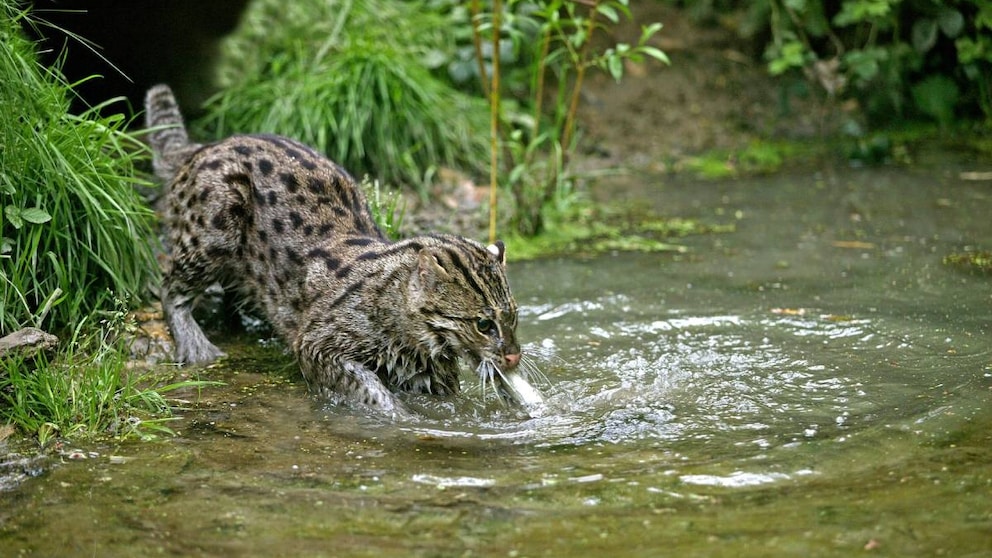
That cats are generally quite averse to water is something the fishing cat must have missed in the “How to Behave as a Cat” briefing. True to its name, this little-known wildcat loves to swim and often hunts its fishy prey in the water. Here’s what else you should know about this fascinating small cat from Asia.
A Barking Cat?
Anyone hearing a fishing cat’s call for the first time might not expect what they hear: Instead of the typical meow of a small cat, a hoarse, barking sound–strikingly similar to that of a small dog–is heard. This completely atypical vocal repertoire for cats is one of the most curious traits of the fishing cat and remains a subject of biological research.
Especially during mating season, which usually occurs between January and February, this barking is more frequently heard in the wetlands of South and Southeast Asia. The sounds likely serve primarily for territory marking and attracting mates–similar to other predators with complex acoustic communication.
But even outside of breeding season, fishing cats use their voices deliberately to warn, communicate, or make themselves known. Barking is not the only sound these animals master. In captivity, purring, hissing, yowling, and a guttural growl have also been observed alongside the barking calls.
Does the Fishing Cat Really Have Webbed Feet?
Another distinctive feature of the fishing cat is its paws. These show clear adaptations to their habitat. Whether the membranes between the toes are truly webbed is still debated among researchers. However, their front paws visually resemble flippers. This anatomical peculiarity allows them to paddle efficiently through water and grab prey beneath the surface–a unique trait among cat species.
It is not even the only wildcat species with mechanisms to move faster in water. The Bengal cat and the flat-headed cat, which live in a similar range, also have similar structures to some extent. The Bengal cat (Prionailurus bengalensis) shows pronounced skin areas, and the flat-headed cat (Prionailurus planiceps) has especially connected toes and short legs.
However, in no other wildcat is the presumed webbing so functionally developed and used as in the fishing cat. It actively uses its partially skin-covered front paws while swimming and hunting, allowing it to move particularly efficiently in water. It does not even shy away from diving completely underwater to hunt fish and other aquatic animals.
Also interesting: These 16 Wild Cats Hardly Anyone Knows
Fishing Cats Are Highly Adaptable
Even in appearance, the fishing cat is perfectly adapted to its habitat. Its fur is olive-gray with darker stripes over the shoulders and neck, which transition into elongated spots on the sides and legs. This makes it perfectly camouflaged in densely forested areas.
With a body weight of 11 to 35 pounds and a head-body length of 22 to 31 inches, it is about twice the size of a house cat. Its tail is relatively short at 8 to 12 inches. However, its muscular structure and length make it the perfect steering tool in water. While swimming, the fishing cat uses it deliberately to maintain stability and quickly change direction–a behavior that actually resembles otters or small water weasels more than a wildcat.
However, the specialized wildcat not only feels comfortable in its habitats–it depends on them. Swamps, riverbanks, mangroves, and floodplains are its preferred habitats. Alternating between swimming, wading, or diving, it can be found in areas of India, Nepal, Bangladesh, Sri Lanka, Thailand, Cambodia, Myanmar, and Pakistan. It particularly enjoys preying on native fish, frogs, snails, and crustaceans there.
Fishing Cats Deceive Their Prey
In fact, fishing cats are not only particularly skilled at catching their prey. They also actively lure them. They tap the water with their paws, making it look to fish and frogs as if an insect is swimming on the surface. When the prey tries to snap at it, a nasty surprise awaits, and it becomes the meal. 1
However, the fishing cat is also quite opportunistic and hunts on trees during times of heavy flooding. Camera traps in 2024 showed that they do this more often than previously thought. Thus, small mammals and birds are also relatively common on their menu. 2
Its non-retractable claws also help it skillfully climb trees. When its habitat is completely flooded, it can move from branch to branch and hunt there. Its adaptability makes it an important species in its ecosystem, a so-called apex predator.

Test Your Knowledge in the Ultimate Wildcat Quiz! How Many Questions Can You Answer?

Hardly anyone knows these 16 wild cats
Human-Wildlife Conflicts Are Not Uncommon
Unfortunately, in times of need, the skilled hunter increasingly seeks food near humans. Lambs have also been documented as their prey. As early as 2015, a study in Bangladesh found that fishing cats are often killed by the local population.
Over 90 percent of incidents occur during the dry season (November to May). Many conflicts arise from assumptions that fishing cats would snatch chickens or catch too many fish for fishermen to take enough themselves–or even out of fear, as they are mistaken for tiger cubs. This study clearly shows that human-wildlife conflicts pose a significant threat to the survival of the fishing cat in Bangladesh, as many incidents are based on ignorance.
It also showed that almost half of all reported human-wildlife conflicts later remain unresolved, and the fate of the animals is uncertain. This indicates significant gaps in monitoring and handling wildlife. Some rescued animals were even released in unsuitable habitats, such as dense forest areas without access to water. 3
Why Protecting Wildcats Is Crucial
Given the rapid decline of intact wetlands and increasing human settlement, systematic conservation measures and educational efforts are urgently needed to counteract this trend. The massive loss of habitat due to drainage or flooding and the overfishing of their habitats lead to a significant decline in this remarkable small cat.
Since 2008, it has been listed as “endangered” on the IUCN Red List. There are likely fewer than 10,000 animals worldwide, and the species has already disappeared in many Asian countries. As an apex predator of wetlands, the fishing cat plays an important role in the ecological balance. Its decline is a warning sign for the state of entire ecosystems in the South Asian region. Protecting the fishing cat also means protecting mangroves, floodplain forests, and numerous other animal species that live there.
In several regions of Asia, especially in India and Sri Lanka, promising conservation initiatives are now underway. These are based on collaboration with local communities and follow approaches that have been successfully applied in other threatened areas. Without education and appropriate collaboration with the local population, conservation is impossible. Preserving their habitats, targeted protection projects, and more attention to their situation could make the decisive difference.