


September 17, 2026, 6:30 am | Read time: 4 minutes
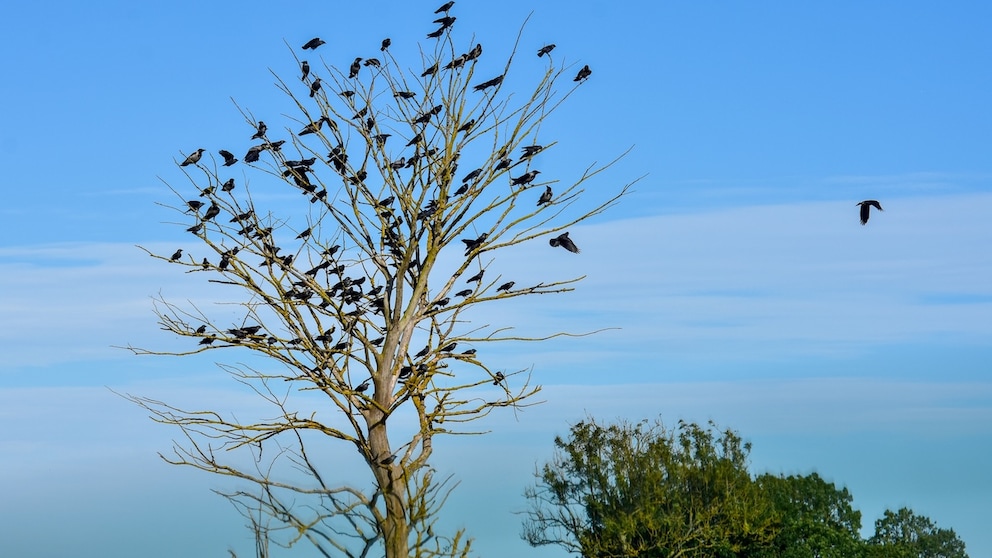
In the evenings, they fly loudly over our cities, circle over parks, and suddenly settle by the hundreds in bare trees. To some people, this seems like a scene from a horror movie, but for biologists, it’s a fascinating social phenomenon. PETBOOK editor and biologist Saskia Schneider explains why crows gather in large flocks, why they prefer city trees and rooftops, and whether they actually pose a threat.
Why do crows gather in groups?
When hundreds of black birds suddenly fly across the sky in the fall and loudly settle in trees, it can seem eerie to many people. Social media quickly refers to these as “Hitchcock moments.” But behind the cacophony of cawing is not a dark omen–it’s impressive social behavior.
Corvids–including crows, rooks, jackdaws, or ravens–are among the most intelligent birds. Researchers have shown that their cognitive abilities in social interactions are sometimes comparable to those of primates (PETBOOK reported). They don’t just randomly live next to each other; they exhibit complex group dynamics with hierarchies, alliances, and stable bonds.1, 2
Especially in fall and winter, being together has clear advantages:
- Protection from predators: Many eyes see more. In large groups, the birds are safer from birds of prey or other predators.
- Safety from hunting: Crows have learned that cities are often less dangerous than open landscapes.
- Information exchange: Roosting communities function like a kind of “news exchange.” Here, the animals learn where there are abundant food sources.
- Finding mates: In large groups, breeding partners can be found.
Additionally, in the fall, migratory birds from Northern and Eastern Europe join the local populations. The flocks seem huge as a result–but they are not an “overpopulation,” just a seasonal gathering.3
Why do crow flocks occupy trees or buildings?
The real spectacle begins in the evening. From all directions, the birds fly to their roosts. These are often right in the city–in tall trees, on power lines, industrial buildings, or even rooftops.4
The city offers corvids clear advantages:
- Warmth: In urban areas, it is usually a few degrees warmer in winter than in the surrounding countryside.
- Less snow and wind: This makes overnighting easier.
- Protection from nocturnal predators: On tall trees or buildings, crows are safer from martens or foxes.
- Food nearby: Food scraps, compost heaps, or nuts provide energy. Crows are also clever enough to crack walnuts using cars.
Before sleeping, the birds often gather at pre-roosting sites, circle the target area several times, and take off again. This apparent chaos has a system: It serves to coordinate the flock. This creates a kind of “flock mood” that synchronizes the group.5
Is it always the same tree?
Many people report that “their” crows sit in the same tree every year. And indeed, roosts can be used for years. Some become regular traditional meeting points with thousands of birds.
Crows remember safe places very well. At the same time, they are flexible. If a roost becomes unusable due to construction work, tree felling, or massive disturbances, they find alternatives–sometimes just a few streets away.
With spring, the picture changes again: Migratory birds return to their breeding areas, local crows become territorial and sleep in pairs in their territories. The large communities usually dissolve then.6
Crows and Death–What Their “Funerals” Reveal
7 Exciting Facts About Corvids
Are crow flocks dangerous?
In short: No. Even though the loud cawing and dark silhouettes at dusk may seem threatening to some–attacks are not expected in fall and winter. The animals are busy eating and surviving.
Only during the breeding season in spring can it occasionally happen that crows defend their nests if they feel threatened. These are usually mock attacks.
Their bad reputation as “nest robbers” is also exaggerated. While crows occasionally eat eggs or young birds, they do not endanger populations. On the contrary:
- They eat insects and thus regulate pests.
- They consume carrion and thus play an important role in the ecosystem.
What often bothers residents is the noise and droppings under the roosting trees. But deterrent actions usually only cause the birds to move to the next park or neighborhood.
Conclusion: Flocks are a sign of intelligence
When crows gather in large flocks on trees or buildings in the evening, it’s not a threatening mass phenomenon–it’s a sign of pronounced intelligence and social structure.
The community offers protection, warmth, information, and social contacts. Cities have become attractive winter quarters for these adaptable birds.
So the next time you stand under a cawing flock, you can look up with reassurance. One of Europe’s smartest bird groups is organizing itself for the night. Loud, black–and fascinating.