


February 28, 2026, 11:27 am | Read time: 5 minutes
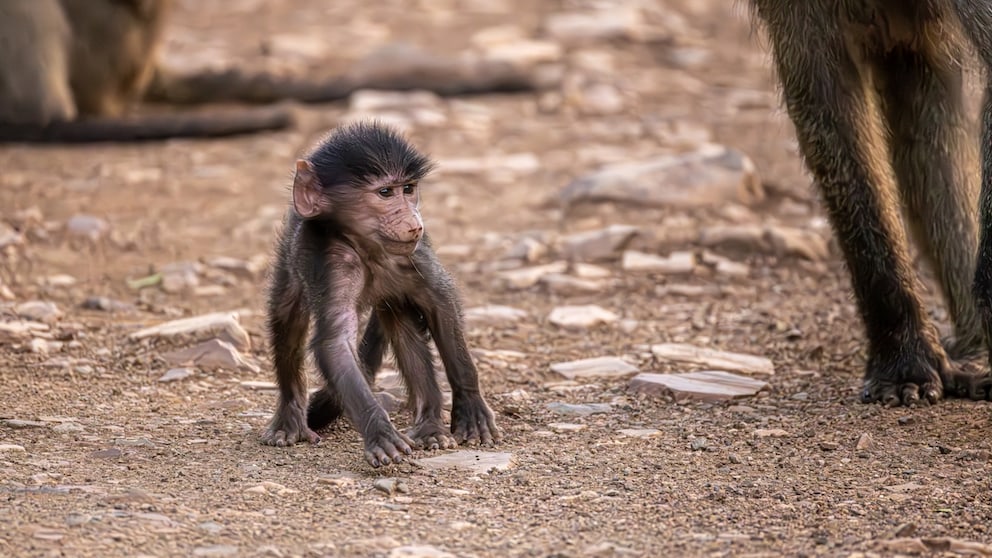
A baby monkey desperately clings to a stuffed animal while its own mother rejects it–millions of people are moved by the images of macaque Punch. A question quickly arises: How can a mother reject her young? PETBOOK editor and biologist Saskia Schneider explains why this behavior in the animal kingdom is not a sign of cruelty but often follows a clear biological logic–and why we should be cautious about anthropomorphizing animal behavior despite our empathy.
The Symbol of Loneliness
“Hang in there, Punch!”–this phrase is currently circulating millions of times on social media. It refers to a young Japanese macaque born in a zoo near Tokyo and shortly thereafter rejected by its mother. Videos show him clinging to a stuffed orangutan while other macaques chase or roughly treat him in the enclosure. For many, he is the symbol of loneliness–but also of resilience.1
What is particularly touching: Baby monkeys usually cling to their mother’s fur right after birth. This helps them build muscles and gain security. Punch didn’t have this opportunity. Caretakers initially tried rolled-up towels–but he chose a plush toy. There are now recordings showing another monkey grooming him. A cautious sign that he might still find his place in the group.
But why does it happen that a mother rejects her young?
Why Do Animals Reject Their Young?
As harsh as it sounds: In the animal kingdom, it’s not about morality but survival. A mother invests enormous energy in pregnancy, birth, and raising her young. If resources are scarce or conditions are poor, she must–biologically speaking–decide where this investment “pays off.” This is not a conscious decision but an instinctive, evolutionarily developed behavior.2
Typical reasons can include:
- Inexperience: First-time mothers are often overwhelmed. Punch’s mother was a first-time mother.
- Stress: According to zoo reports, the birth occurred during a period of extreme summer heat–a significant stress factor.3
- Health issues of the mother: Pain, inflammation, or malnutrition can make care impossible.
- Weakness or illness of the young: In nature, mothers often focus their resources on the stronger offspring.
- Multiple births: Giant pandas, for example, usually raise only one of two cubs because they simply don’t have enough milk for both.
From an evolutionary biology perspective, this behavior serves species preservation. A weakened mother trying to bring all her young through extreme conditions risks her own survival–and thus future reproduction.
This doesn’t mean animals are “unfeeling.” But their priorities follow different rules than ours. It goes so far that some animals even eat their young if necessary.
Are Young Rejected Because They’ve Been Touched?
A persistent myth: If a human touches a young animal, the mother will no longer accept it. This claim is often heard and read, especially regarding birds. But it’s not universally true.
Birds usually have a weak sense of smell. And even in many mammals, human scent alone is not enough to destroy the mother-child bond. Experts know of no animal species that rejects its young solely because of human touch.
If rejection occurs after intervention, the causes are mostly elsewhere: The young was separated for too long, the situation caused enormous stress, or the mother was already at her limit.
Exception: Fawns
Fawns and hares are exceptions. If human scent clings to the offspring, the doe or hare will reject their young–and it must starve, as Torsten Reinwald, spokesperson for the German Hunting Association (DJV), explains on the DJV website. For this reason, animal rescuers use gloves and grass to wrap the young when handling them.
Rejected or Temporarily Left?
Not every young animal that is alone has been automatically rejected. Fawns lie motionless in the grass for hours while the mother feeds. Hare mothers nurse their young only once or twice a day. Many bird species also temporarily leave the nest.
The reason is simple: If the mother stayed with the young permanently, she would lead predators directly to them. Before intervening, one should observe a young animal over a longer period. Only if the animal appears obviously weakened or injured should experts be contacted.
In Punch’s case, the behavior of the other macaques was quickly labeled as “bullying.” However, primatologists emphasize: In strictly hierarchical macaque groups, rank-order interactions are part of normal social behavior. Without a mother, Punch lacks an important social protector and learning partner.4

Too Much Junk Food from Tourists! Monkeys Resort to Eating Dirt as a “Stomach Remedy”
The Sad and True Story Behind Winnie the Pooh
Should We Help Rejected Young Animals?
Our impulse is clear: Of course, we want to help. And yes–in some cases, human intervention saves lives. But often, such cases are more complex than they initially seem.
Wild animals have highly specialized needs:
- species-specific diet
- social learning processes
- bonding with conspecifics
Hand-rearing can be problematic. Studies show that apes raised by humans often develop behavioral abnormalities and later have difficulties raising their own young.5
Therefore, in nature:
- Keep your distance
- Observe and assess the situation
- Contact a wildlife station or animal rescue if in doubt
Thoughtless taking or feeding can do more harm than good. In Punch’s case, the zoo is trying to gently integrate him into the group, which has partially succeeded.6
Conclusion
Little Punch moves us because we see ourselves in him. Because we understand comfort, closeness, and protection as deeply human needs–and believe we see them in him. But when animal mothers reject their young, it usually doesn’t happen out of cruelty. It’s a biological mechanism that kicks in under certain conditions.
This doesn’t mean such images must leave us cold. But it helps to put them into context.