


April 23, 2026, 2:06 pm | Read time: 5 minutes
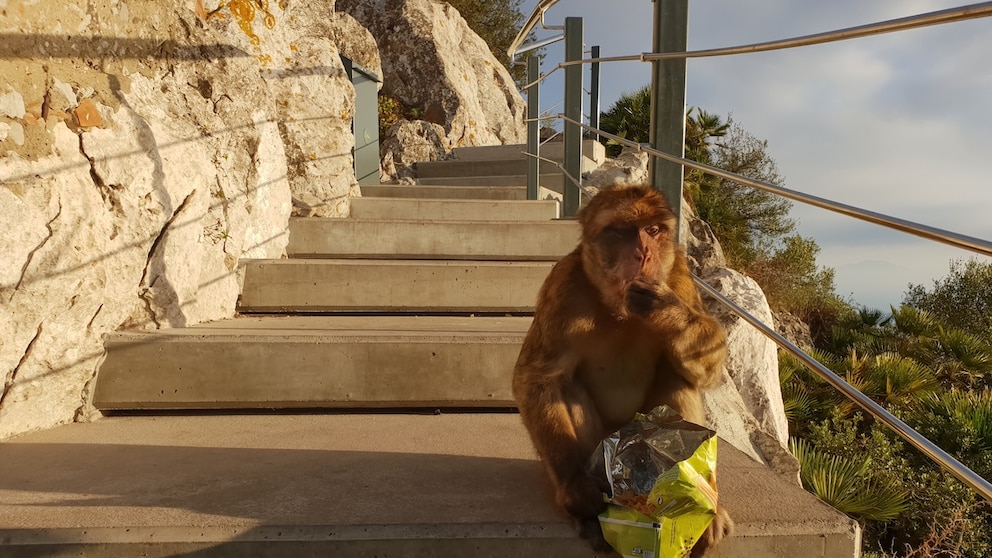
Monkeys in Gibraltar steal chips, ice cream, and cookies—and then eat dirt. Researchers have now taken a closer look at this unusual behavior. A recent study suggests that the macaques deliberately eat dirt to counteract digestive issues caused by human food. PETBOOK editor and biologist Saskia Schneider explains the reasons behind this behavior and why it exemplifies how much we influence wildlife.
Between Chips and Rocks: An Unusual Snack
A brief moment of inattention—and the bag of chips is gone. Visitors to the Barbary macaques of Gibraltar are familiar with these scenes. The animals are notorious for stealing food from tourists. But some of them go for something entirely different. They deliberately eat dirt.
What initially sounds unusual is no coincidence. A recent study from the University of Cambridge shows that there might be more to this behavior than mere curiosity. The monkeys might be helping themselves. And this is precisely because we bring our favorite snacks on tour.1
Tourists’ Food Is Extremely Calorie-Dense
It’s not uncommon for animals to eat dirt. This behavior, known as geophagy, has also been observed in many primate species. The intriguing question is: Why do they do it?
Research suggests that dirt can act as a kind of “buffer” in the stomach. It can help bind toxins or soothe digestion. Especially in primates, it’s suspected that they use this behavior as a form of natural medicine.
This is where it gets interesting in Gibraltar. About 230 Barbary macaques live there in direct contact with humans. Although feeding them is prohibited, they regularly access human food. Thus, the macaques no longer eat only what should be on their menu.
“The foods brought by tourists and consumed by the macaques of Gibraltar are extremely calorie-dense and contain a lot of sugar, salt, and dairy products,” explains Dr. Sylvain Lemoine, study leader and biological anthropologist at the University of Cambridge’s Archaeological Institute, in the science magazine “Phys.Org.” “This is completely different from the typical diet of the monkey species, such as herbs, leaves, seeds, and occasionally insects.”
The researchers wanted to know: Does this have anything to do with eating dirt?
Monkeys Eat Dirt Whenever Many Tourists Are Present
Over nearly two years, scientists observed the monkeys and documented specifically when and under what circumstances they ate dirt. A total of 46 cases involving 44 different animals were recorded.
It was noted that this behavior is unusually common in Gibraltar. Particularly intriguing is the connection to human influence. Whenever many tourists are present, especially in summer, the monkeys are more likely to eat dirt.
It becomes even clearer when looking at what the animals ate beforehand. Monkeys that consumed larger amounts of human food showed significantly more geophagy. There is a clear link between “junk food” and eating dirt.
A Form of Self-Medication?
From a behavioral biology perspective, there is much to suggest that the monkeys are deliberately reacting here. The dirt could help restore digestive balance after consuming unsuitable food.
It’s a bit like us humans. After eating too much fatty or sugary food, we sometimes experience stomach problems. The monkeys seem to have found a way to deal with it.
Researchers even suspect that the dirt could influence the so-called gut microbiome, the bacterial community in the digestive system, which plays an important role in health.
Monkeys Developed Behavior to Continue Consuming Junk Food
But why do monkeys eat junk food at all if it makes them feel bad afterward?
Partly for the same reason we humans do: because it tastes good. But this explanation alone would be too simplistic. “Humans have evolved to seek out and store energy-rich fats and sugars to survive times of scarcity. This leads us to crave calorie-dense, unhealthy foods,” explains Lemoine, founder of the Gibraltar Macaques Project on “Phys.Org.”
The availability of such foods could trigger the same evolutionary mechanism in macaques. Eating dirt may allow them to continue consuming food that negatively affects digestion, but tastes just as good to them as it does to us.
Do Monkeys Learn from Each Other?
It’s particularly interesting that not all monkeys act the same. Some groups show clear preferences for certain types of soil, especially the reddish “terra rossa” soil.
This suggests that the behavior is not only instinctive but also learned. Young animals might observe older ones to learn when and where to eat dirt. This could mean a kind of tradition has developed here, triggered by human influence.
Even Chimpanzees Enjoy Their “After-work Beer”

Can animals lie? A behavioral biologist gives answers
What Does This Mean for Us?
The study clearly shows how much we can influence the behavior of wildlife. The monkeys adapt to our world, even to the extent of developing new strategies to cope with the consequences of our diet.
This is fascinating but also problematic. It means that our behavior can have long-term effects on the health and behavior of the animals.
Conclusion: Clever–but Caused by Us
The Barbary macaques of Gibraltar apparently eat dirt not by chance but as a reaction to an unnatural diet. The connection to human food strongly suggests that they use it to support their digestion.
At the same time, there are indications that this behavior is passed on within groups. What we observe here could be more than a short-term adaptation. It is a new habit triggered by humans.
“The macaques of Gibraltar are closely intertwined with human history and provide a striking example of the interaction between humans and primates,” added Lemoine. “The diversity of human interactions within the macaque groups of Gibraltar creates a natural experiment to understand how human-shaped landscapes influence the behavior and culture of primates.”