

September 19, 2025, 4:41 am | Read time: 4 minutes
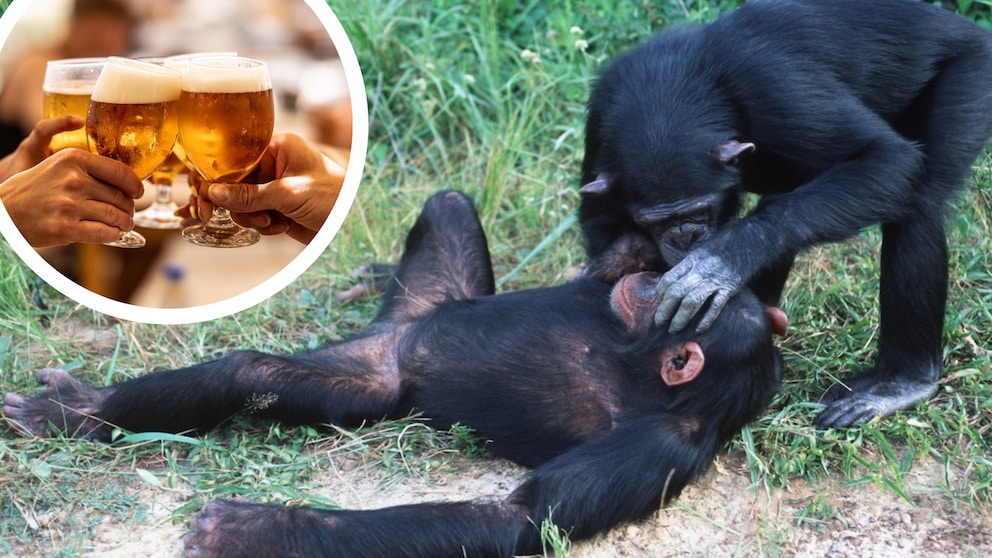
After work in the jungle–and the first one is already at the fruit bar. What sounds like a quirky bar scene from a movie is everyday life for some chimpanzees. Instead of hops and malt, there are fermented fruits–and in surprising quantities. Research shows: Their daily dose is astonishing. PETBOOK reports.
Hangover in the Jungle: When Chimpanzees Go to Happy Hour
Do chimpanzees drink an after-work beer? It sounds strange, but it’s true–almost. Monkeys are frugivores, meaning they eat fruit. They get their daily intake of carbohydrates and sugar from fruits. For a long time, scientists believed that monkeys accidentally ate fermented fruit. But that’s not the case: They deliberately choose fruits with a higher alcohol content. PETBOOK previously reported on this in the article: Animals consume alcohol more often than thought–even in groups!
But how much alcohol do monkeys actually consume? Do they drink us under the table? A research team led by Aleksey Maro from the University of California has, for the first time, determined how much alcohol chimpanzees actually consume throughout the day. They calculated the ethanol concentration in fruits eaten by chimpanzees in Uganda and Côte d’Ivoire. Their work provided new evidence for the so-called “Drunken Monkey” hypothesis. This theory suggests that primates have been regularly consuming alcohol from fermented fruits for millions of years. The study’s results were published in the journal Science Advances. 1
How Researchers Tracked Down the Alcohol
Between 2017 and 2021, the research group collected around 600 samples from 20 different plant species in two chimpanzee populations in Uganda and Côte d’Ivoire. These were exclusively fruits that are actually part of the animals’ diet. The alcohol content was measured using three different methods and then ranked by concentration. Importantly, the chimpanzees themselves were not disturbed during this process, and no direct interactions took place.
Also interesting: 8 bizarre animal facts about mating behavior
Monkeys Easily Drink Us Under the Table
The analyses show that the consumed fruits contain an average of 0.31 to 0.32 percent ethanol. Particularly high values were found in the mulberry fig (Ficus mucuso) in Uganda with 0.41 percent and in the mobola plum (Parinari excelsa) in Côte d’Ivoire with 0.40 percent. Since chimpanzees are pure fruit eaters, they consume about 4.5 kilograms of fruit daily, which includes 14 to 15 grams of ethanol.
For humans, that would be about 1.4 after-work beers. Relative to body weight, the distribution is even higher for monkeys than for humans. A 36-kilogram chimpanzee consumes as much alcohol as a 70-kilogram human who drinks 2.6 alcoholic beverages daily.
Also interesting: The drastic effect of just one alcoholic drink per day on the brain

Chimpanzees Stick Grass in Ears and Rear Because It’s a “Trend”

Too Much Junk Food from Tourists! Monkeys Resort to Eating Dirt as a “Stomach Remedy”
Are Monkeys to Blame for Our Alcohol Consumption?
This makes it clear: Chimpanzees drink, and it’s completely natural for them–a new piece of the puzzle for the “Drunken Monkey” hypothesis. Ethanol could also play an ecological role, such as a scent signal for ripe fruits or as an appetite stimulant. Similar to how we might order an aperitif. The study supports the notion that the human fascination with alcohol is not purely cultural but deeply rooted in biology and has been passed down through millions of years of evolution.
Conclusion
Alcohol consumption in the animal kingdom does not seem to be a coincidence but part of a long evolutionary history. Chimpanzees provide strong evidence for the “Drunken Monkey” hypothesis–and suggest that the human preference for alcohol is deeply embedded in our biology. The study suggests this, as populations living far apart exhibited the same behavior. However, it is unclear whether chimpanzees deliberately select fruits with higher alcohol content. Data on individual differences or possible long-term behavioral changes are also lacking. Therefore, researchers emphasize that field studies with direct observation of individual animals and standardized measurements are necessary. 2