

September 1, 2025, 2:57 pm | Read time: 4 minutes
Many will remember the adventurous books about Lars, the little polar bear. In sometimes more, sometimes less icy surroundings, the bear and his friends embarked on great explorations. Alongside Lena, the snow hare, and Greta the polar bear, the penguin Caruso also stepped into the spotlight of children’s stories. In reality, however, a polar bear and a penguin could never become friends, as penguins live exclusively in the Southern Hemisphere. Find out where penguins live here.
Penguins: Survival Experts Between Ice and Sun
When you think of penguins, the image of a white snowy landscape with endless ice masses immediately comes to mind. Yet, as fascinating as Antarctica is as a habitat, not all penguins live there. From tropical islands to cool cliffs–there are 18 species, each perfectly adapted to their respective habitats. Penguins dispel a common misconception: They are not only masters at surviving in extreme cold.
Antarctica
Half a year in darkness and icy cold–Antarctica is a unique habitat. Penguins have adapted to this and become true survival experts. Of the 18 different penguin species, less than half actually live in Antarctica. The most famous representatives are the emperor penguins, chinstrap penguins, gentoo penguins, and Adélie penguins. All live near coastal waters, where they hunt most of their food. For all four species, krill, a shrimp-like crustacean, is on the menu, along with small fish, squid, and other types of crustaceans. 1
Also interesting: What animals live in Antarctica?
South America
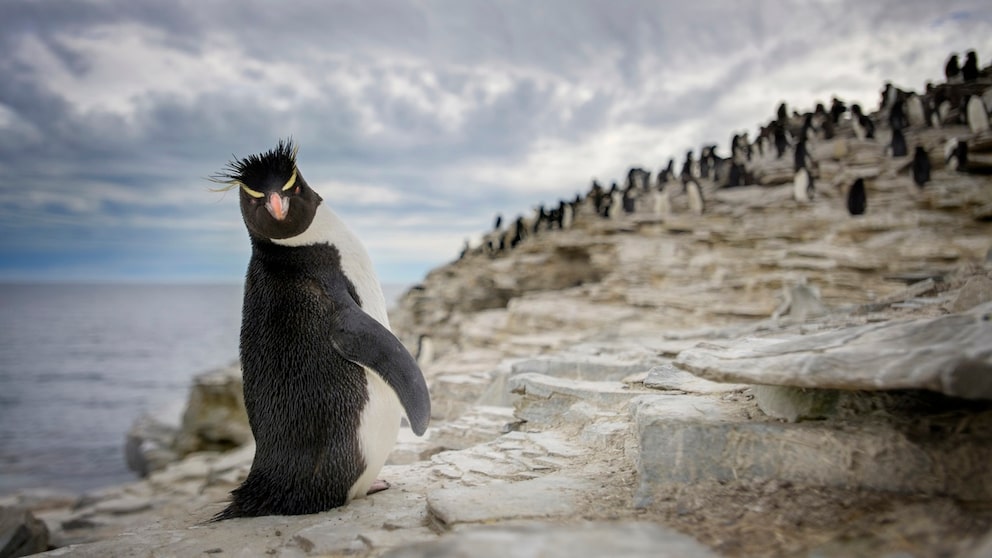
Six more penguin species are native to the rocky coasts of South America. They live along the coasts of the Galapagos Islands, Peru, Chile, and Argentina. In Peru, the well-known Humboldt penguins are more prevalent. They can grow up to 24 inches tall and dive for up to eight minutes. Further south, along the coast of Chile, the Magellanic penguin, the rockhopper penguin, and the southern rockhopper penguin are more common. At the tip of Argentina and the Falkland Islands, gentoo penguins and king penguins are mainly found.
South America is usually associated with high temperatures–do penguins also get sweaty? Actually, it’s cooler than one might think. The climate zone of their habitats features mild to cool temperatures. It’s warmest for the Humboldt penguins in northern Peru, with temperatures up to 64 degrees Fahrenheit. The further south you go, the cooler it gets. In the habitat of the rockhopper penguins, the average temperature is 57 degrees Fahrenheit, although summer temperatures can reach up to 82 degrees. On the Falkland Islands, it’s different again–often rainy with maximum temperatures of 57 degrees.
Difference Between Seals, Sea Lions, and Other Pinnipeds

Did You Know? Why Tigers Are Only Found in Asia
Africa
Small, agile, and quick–we’re talking about African penguins (Spheniscus demersus). They live near the water along the coasts of South Africa and Namibia. They can grow up to 26 inches tall and weigh about six pounds, making them true lightweights compared to their relatives. African penguins produce a type of oil to grease their feathers, keeping them waterproof.
In recent years, there have been more reports about the population of African penguins–with alarming numbers. The population in the wild has decreased by 97 percent over the last three generations. To counteract this, nonprofit organizations like SANCCOB (South African Foundation for the Conservation of Coastal Birds) are working to preserve the population.2,3
Australia and New Zealand
Here, too, the rocky cliffs are teeming with various penguin species. The most famous is the little penguin. In Australia, it lives in oceanic to subtropical climates and cleverly builds its nests in ground hollows, rock crevices, or uses small emerging caves in dunes.
It’s even more diverse on the islands of New Zealand–here, eight more penguin species reside, such as the yellow-eyed penguin, Fiordland penguin, or the crested penguin. However, familiar faces like the king penguin or the little penguin can also be found here. 4