

September 19, 2025, 3:07 pm | Read time: 7 minutes
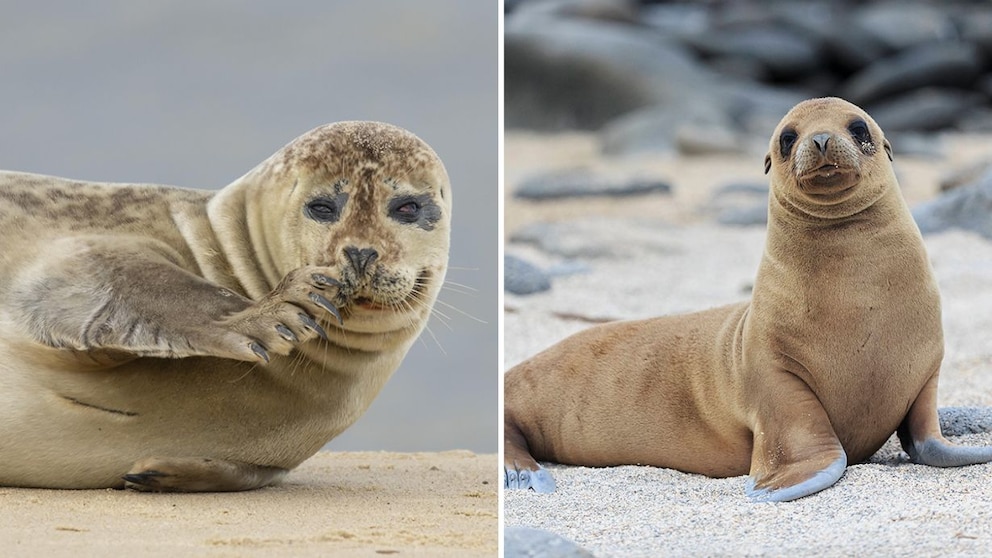
If you take a walk along the North Sea or the Baltic Sea, you might be lucky enough to spot a seal—but not a sea lion. Despite this, the two are often confused, and many people wonder: What exactly is the difference between seals and sea lions? It gets even more confusing when sea bears, walruses, or even elephant seals come into play. They all belong to the large family of pinnipeds. But why do they have names of land animals, simply with the prefix “sea”? PETBOOK explains.
Not Uncreative, but Associative
Modern taxonomy (with scientific family and genus names) only emerged in the 18th century. Before that, animal names were everyday terms—descriptive, sometimes poetic or folkloric. You could say: not “uncreative,” but very associative in thought.
The names for the various pinnipeds mostly come from a time when zoology was not yet systematic. People named animals based on what they knew, what they read about in books, and what seemed (somewhat) similar to them.
- Seal → Head resembles a dog.
- Sea lion → Males with “manes” and loud roaring = lion.
- Sea bear → Strong, “bear-like” stature and dense fur.
- Elephant seal → Trunk-like nose of the males.
- Walrus → In Old Norse, “hvalhross,” meaning “whale-horse.”
The naming of these animals was primarily about associations, not biological precision. The prefix “sea-” was simply used to distinguish marine animals from their related or similarly appearing land animals. You can find the same pattern with seahorses, sea swallows, or starfish—even though they have nothing to do with horses, swallows, or stars biologically.
A Large Animal Group: the Pinnipedia
So what is the difference between a seal, a sea lion, and all the others? First of all, it’s important to note that they are all pinnipeds. That is, marine mammals and part of the carnivores. Their scientific collective name is Pinnipedia, which means “fin-footed.” No wonder—instead of legs, they have flippers, which they use to glide through the water.
The order is divided into three families:
- True seals (Phocidae)—including seals and the gigantic elephant seals, but also gray seals
- Eared seals (Otariidae)—sea lions and sea bears
- Walruses (Odobenidae)—the distinctive tusk bearers
In the following, we will take a closer look at the different animals and clarify the differences within the pinniped family—and also why seals and sea lions can’t really be confused.
Seals (Phoca vitulina)–the “Classics” of the North Sea
The seal is probably the best-known pinniped in Central Europe. It belongs to the true seals and lives along the coasts of the North Atlantic, the North Sea, and the Baltic Sea, as well as along the Pacific coast of North America.
- Characteristics: No external ear flaps, round head with large, round eyes, compact body.
- Size & Weight: Up to 1.8 meters long, 80–100 kilograms.
- Distribution: Coasts of the North Atlantic, the North Sea, the Baltic Sea, and the Pacific coast of North America.
- Lifestyle: Feed on fish, squid, and crabs; like to rest on sandbanks or beaches.
Sea Lions (Otariinae)–the Loud “Acrobats”
Sea lions belong to the eared seals. The California sea lion (Zalophus californianus) is particularly well-known, along with several other species like the South American sea lion (Otaria flavescens).
- Characteristics: Visible ear flaps, movable hind flippers, males often with manes; loud, barking roar.
- Size & Weight:
- California sea lion (Zalophus californianus): 2–2.5 meters, 200–300 kilograms.
- South American sea lion (Otaria flavescens): up to 3 meters, males up to 350 kilograms.
- Distribution: Pacific coasts of North and South America, and other species also in Australia and New Zealand.
- Lifestyle: Very social animals, live in large colonies; skilled and fast swimmers, can “walk” on land.
Sea Bears (Arctocephalinae)–Furry and Compact
Sea bears form a subfamily of the eared seals. The South African fur seal (Arctocephalus pusillus) is particularly well-known, along with about nine other species.
- Characteristics: Dense, soft fur with undercoat; smaller and more delicate than sea lions.
- Size & Weight: 1.2–2.2 meters; 30–80 kilograms, males often twice as heavy as females.
- Distribution: Mainly in the Southern Hemisphere—coasts of Africa, South America, Australia, New Zealand, and subantarctic islands.
- Lifestyle: Form large colonies, feed on fish and squid; they were once heavily hunted for their fur.
Elephant Seals (Mirounga)–the Giants of the Pinniped World
Elephant seals are the largest pinnipeds. There are two species: the northern elephant seal (Mirounga angustirostris) and the southern elephant seal (Mirounga leonina).
- Characteristics: Males with trunk-like noses; extremely pronounced size difference between males and females.
- Size & Weight:
- Southern elephant seal (Mirounga leonina): Males up to 6 meters and over 3,500 kilograms, females about 2.5–3 meters and 400–900 kilograms.
- Northern elephant seal (Mirounga angustirostris): Males up to 4.5 meters and 2,000 kilograms.
- Distribution: Southern species: coasts of South America, South Africa, New Zealand, subantarctic islands; northern species: Pacific coast of North America (California, Mexico).
- Lifestyle: Diving masters–up to 1,500 meters deep and two hours underwater; males defend harems on land with fierce battles.
Walrus (Odobenus rosmarus)–the Tusk Bearers
The walrus is the only species in its family and is unmistakable. Probably for this reason, it doesn’t have a name with a “sea-” prefix.
- Characteristics: Long tusks (elongated canines), thick skin, massive body.
- Size & Weight: 2.5–3.5 meters long, up to 1,500 kilograms; males larger than females.
- Distribution: Around the Arctic—from Greenland to Russia to Canada and Alaska.
- Lifestyle: Mainly feed on clams, which they feel for with their whiskers on the seabed; use tusks for jostling and pulling themselves onto ice floes.
Are There Sharks in the North Sea and the Baltic Sea?
Six facts worth knowing about the world’s largest turtle
Bonus: Gray Seal (Halichoerus grypus)–the Sweet One with the Button Eyes
No overview would be complete without the gray seal native to Germany, which can be observed in the North and Baltic Seas and is a favorite among pinnipeds with its large brown eyes.
- Characteristics: Elongated head with “cone-shaped” snout, hence the name; no external ear flaps; appears overall more massive than the seal.
- Size & Weight: Males up to 2.5 meters and 300 kilograms; females up to 2 meters and 200 kilograms.
- Distribution: North Atlantic, North and Baltic Seas; in Germany, mainly along the coasts of Mecklenburg-Western Pomerania, Schleswig-Holstein, and on Heligoland.
- Lifestyle: Eat fish and squid, can dive for long periods; form colonies on beaches and rocks where they give birth to their pups (“howlers”).
Sea Lion, Seal, and Bear? All Pinnipeds!
Whether it’s a seal, sea lion, sea bear, gray seal, elephant seal, or walrus—all pinnipeds share central characteristics despite their differences. They are perfectly adapted to life between land and water. Their streamlined bodies and strong flippers make them excellent swimmers, while a thick layer of blubber protects them from the cold. They can dive for long periods, slowing their heart rate and metabolism to conserve oxygen. On land, they give birth to their young and rest in colonies before venturing back into the vast ocean. Their diet mainly consists of fish, squid, crabs, and clams.
Yet despite all these adaptations, pinnipeds are threatened in many places today. For centuries, they were hunted for their fur, fat, and meat—sea bears and elephant seals were almost wiped out at times. Today, hunting bans and protected areas have allowed many populations to recover. However, the situation remains tense: climate change, shrinking sea ice, overfishing, and marine pollution are affecting many species. Walruses, for example, are losing important resting places due to ice melt, while elephant seals suffer from declining fish stocks.
International protection agreements, marine protected areas, and targeted research projects are now helping to better protect pinniped populations. But the survival of these fascinating marine mammals ultimately also depends on how responsibly we humans manage the oceans.