


December 29, 2025, 10:30 am | Read time: 5 minutes
When the last wasp nibbles on the jam bread in late summer, many people wonder: Where do these creatures actually go in the winter? While honeybees huddle together, wasps employ a unique and surprisingly effective survival strategy. PETBOOK editor and biologist Saskia Schneider explains how these insects endure the harshest time of the year—and why you might suddenly encounter a “giant wasp” in your living room in the middle of January.
Which Wasp Species Survive the Winter
Of the hundreds of wasp species found in Europe, only 16 species in Germany live in large, social colonies. The most well-known are the German wasp (Vespula germanica) and the common wasp (Vespula vulgaris). These are also the two species that visit us at the breakfast table in summer and are generally considered “pests.” However, the largest native representative is the hornet, which can be up to four centimeters long.
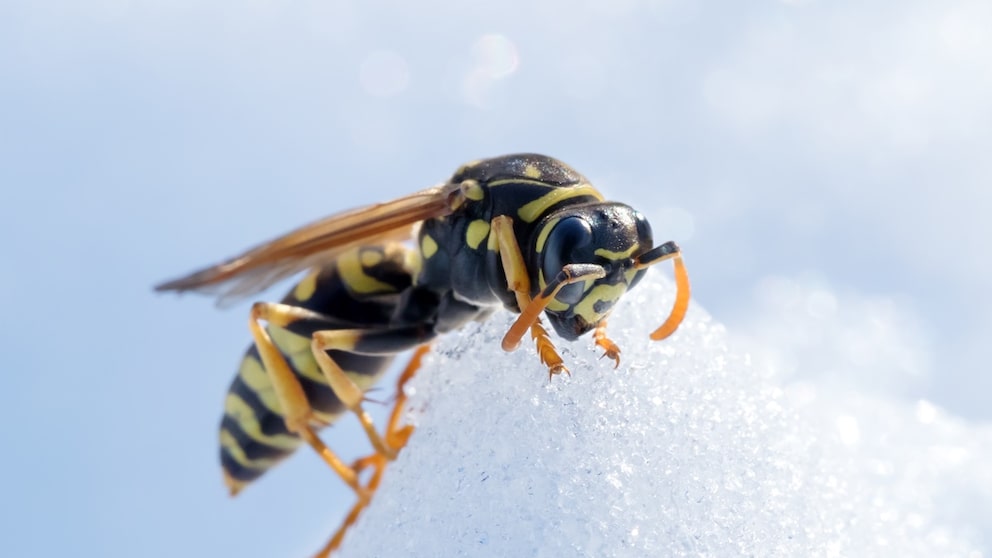
All social wasp species share the trait that only one part of the colony survives the cold season: the young queens. Workers and drones—as experts call male wasps and bees—typically die in the fall. The old colony completely dissolves. Only the young, newly mated queens find refuge in protected hideouts. In spring, usually between March and April, and for hornets from mid-May, they awaken and begin building a new nest—starting a new wasp cycle with them.
Where Wasp Queens Hibernate
As early as the end of August, but no later than mid-September, the young queens leave the nest. Temperatures drop, food becomes scarce, and the old colony is no longer viable. The wasp nest is left behind and will not be reoccupied the following year. Its inhabitants gradually die off.
The young queens, however, now seek well-protected places to spend the winter: attics, cracked tree hollows, rotten wood, or deep crevices in the ground. Some species even hibernate until February.
There, the insects enter a state of winter dormancy, also known as diapause. This is a type of biological deep sleep in which nearly all life functions are reduced to a minimum. This strategy is crucial for cold-blooded insects, as they cannot actively regulate their body temperature.1
How Wasp Winter Dormancy Works
As temperatures drop, the wasp queen reduces her metabolism to an absolute minimum. Breathing, heartbeat, and muscle activity are so significantly reduced that the insects appear almost dead from the outside. However, this is part of a brilliant survival strategy: only in this way can they survive for weeks to months without food.
To protect sensitive body parts, wasp queens assume a special dormant posture. They lay their antennae alongside their heads, tuck their wings tightly under their abdomens, and anchor themselves firmly to the ground with their claws. Many insects also bite down with their mandibles to ensure they are not dislodged by vibrations or slight movements.
Additionally, the queens produce a type of natural antifreeze in their bodies, preventing tissue fluids in the cells from freezing and causing damage. Despite all these adaptations, the winter period remains extremely dangerous for the insects.2
Why So Many Wasps Don’t Survive the Winter
The hibernation phase is the riskiest time in a wasp queen’s life. Most of them die before they awaken in the spring. One of the greatest threats is moisture: if the hiding place is too damp, mold quickly sets in—a death sentence for a defenseless insect in dormancy. Natural predators also pose a threat. For mice, shrews, or birds, a dormant queen is a welcome, protein-rich winter snack.
Humans should not be underestimated either. Many queens are accidentally awakened when firewood is brought into a warm living room, when tidying up a shed, or when working on a roof. The sudden warmth brings the insects out of dormancy—and often into life-threatening situations. Without a protective winter shelter, they have little chance of survival.
Statistically, only about two to four percent of all overwintering queens survive the cold season. Of 1,000 wasp queens entering winter dormancy, only about 20 to 40 manage to establish a new colony in the spring.3
How Wasps Awaken in the Spring
The awakening from winter dormancy does not happen abruptly but over several days. As temperatures rise in spring and the days grow longer, the queen’s organism gradually reactivates. Hormones slowly ramp up metabolism, and breathing and heart activity increase. This transition phase is flexible: if it gets cold again, the queen can revert to a reduced state at any time.
Only when stable temperatures around 15 degrees Celsius persist for several days does the diapause end completely. The queen then leaves her winter quarters and begins searching for a suitable location for her new nest. A new wasp year begins.

Do Hornets or Wasps Actually Make Honey?

Why Can’t I Buy Bumblebee Honey?
Why a Large Wasp Sometimes Appears in the Living Room in Winter
Many people are startled when a giant wasp suddenly flies through the room in January or February. This is almost always an overwintering young queen that was accidentally awakened—often when bringing in firewood or tidying up unheated rooms.
Such a queen is hardly dangerous. She has no colony to defend and is solely focused on survival. It’s best to gently place her in a glass and move her to a cool, unheated area like a garage or shed. There, she can re-enter dormancy and continue her hibernation.
Conclusion: Wasps Survive Winter Thanks to a Brilliant Survival Strategy
Although each wasp colony completely dies off in the fall, nature ensures impressive continuity: the young queens survive thanks to a perfectly tuned winter dormancy, hormonal control mechanisms, and clever hiding strategies. Even though only a tiny fraction endures the hardships of the cold months, these few insects lay the foundation for the next generation in spring.
So if you encounter a “giant wasp” in winter or spring, you’re meeting a true survival artist.