


June 25, 2026, 4:05 am | Read time: 6 minutes
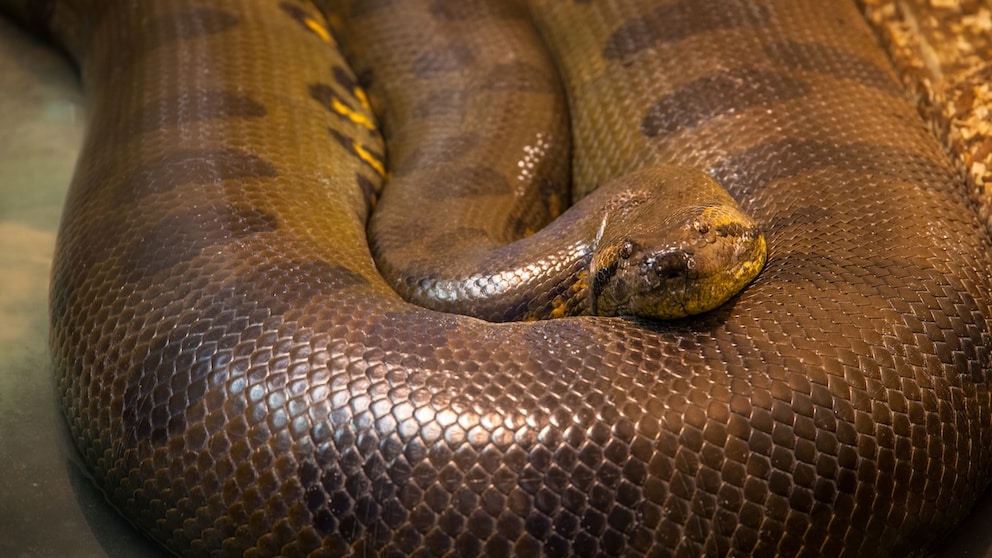
Anacondas are among the largest snakes on Earth. But when did their development toward these massive body sizes actually begin? A new paleontological study now provides clarity—and for the first time, clear fossil evidence: As early as 12.4 million years ago, the ancestors of today’s anacondas reached lengths of over five meters. The study from Venezuela not only shows how early this gigantism emerged but also why anacondas, unlike many other giant reptiles, have remained so large to this day.
The Heaviest Snakes in the World
Today’s anacondas—especially the Green Anaconda (Eunectes murinus)—are impressive even to experienced reptile researchers. They can grow over seven meters long, making them not only among the largest but also among the heaviest snakes in the world.
But how did a snake genus in South America come to reach such extreme dimensions? Until now, there were only assumptions: It was thought they originated in the Miocene, but fossil finds were sparse and provided little insight into early body sizes. At the same time, many other giant reptiles—from mighty caimans to giant freshwater turtles—lived during this period but later disappeared.
The new study aimed to address this: When did gigantism in anacondas arise? What environmental conditions favored it—and why did it persist when many other giant animals went extinct?
Anacondas Were Already Huge Over 12 Million Years Ago
The research team led by Andrés F. Alfonso-Rojas, Jorge D. Carrillo-Briceño, Rodolfo Sánchez, Marcelo R. Sánchez-Villagra, and Jason J. Head tackled a question that has occupied zoologists and paleontologists for decades: How old is the gigantism of anacondas—and what environmental conditions made it possible?
Their work was published on December 1, 2025, in the scientific journal “Journal of Vertebrate Paleontology.” The basis is fossils from the Socorro and Urumaco formations in northwestern Venezuela. From the sediments of the middle and late Miocene there, the researchers reconstructed the body lengths of ancient anacondas and placed them in a modern evolutionary tree.
The result: More than 12 million years ago, these snakes reached lengths that we only know today from the largest living specimens. A finding that sheds new light on the evolutionary history of the genus Eunectes, as anacondas are scientifically known, and simultaneously takes us into the tropical wetlands of a long-lost world.1
Fossil Vertebrae Reveal Evolutionary History
The researchers analyzed 183 fossil vertebrae from at least 32 individuals from a total of 15 sites. The sediment layers of these regions are between 14.5 and 6.8 million years old—a time frame that allows for a broad picture of body size development.
Using precise measurement methods, they determined the dimensions of the vertebrae and applied these to specific models to calculate the total body length. Additionally, the team created a time-calibrated phylogeny of the boas, to which anacondas belong, and reconstructed the probable body size of the fossil ancestors using a special method (“Ancestral State Reconstruction”).
By combining these approaches, an exceptionally detailed picture of the evolutionary line emerged, going far beyond simple fossil measurements.
Fossil Finds Were Already Over Four Meters Long
The analysis makes it clear: Already in the middle Miocene, anacondas reached average body lengths of 5.2 meters. The range of the fossils was between 4.53 and 5.69 meters–almost identical to the sizes of many adult animals today.
It is also interesting to look at the younger layers: In the late Miocene, anacondas became slightly smaller on average, about 3.95 meters. Yet compared to other giant reptiles of their time, they remained impressively large.
While the massive caiman Purussaurus and the giant turtle Stupendemys later disappeared or showed significantly reduced body sizes, the anaconda’s gigantism remained stable.
The phylogenetic reconstruction confirms: Even the early representatives of the genus Eunectes were over four meters long—almost identical to today’s animals. However, fossil finds never reached the extreme seven meters that modern anacondas can achieve in exceptional cases.
Why Did Anacondas Remain So Large?
The study places an important piece in the puzzle of the evolutionary history of tropical reptiles. It shows: Anacondas became large early on—and remained so, even as climate and landscape changed dramatically.
In the middle Miocene, the vast Pebas wetland system covered large parts of the Amazon. The combination of a warm climate (the so-called “Middle Miocene Climatic Optimum”) and water-rich habitats provided ideal conditions for large, semiaquatic predators.
As this landscape transformed and the Amazon River system emerged, many other giants shrank—but not the anacondas. But why?
The study provides several clues:
- Temperature drops had little impact on their body size.
- Landscape changes also did not seem to limit their development.
- A broad prey spectrum, ranging from fish to medium-sized mammals, may have kept their size stable.
- Low competition in their aquatic habitats may have given them an evolutionary advantage.
The exact driver remains unclear—but this very stability makes anacondas a fascinating anomaly among giant reptiles.

The world’s largest sea snake likely ate sharks.

These are the 6 biggest snakes in the world
Study Provides Important Insights into Evolutionary History
The study is based on an exceptionally extensive fossil database from a geologically well-researched region. The methods for reconstructing body lengths are considered established, and the combination with molecular data strengthens the findings.
At the same time, the team points out limitations:
- Most fossil finds consist of isolated vertebrae.
- Not all fossils can be clearly assigned to a species.
- Differences in preservation can cause slight measurement deviations.
- The size reduction observed in the late Miocene only becomes apparent when data from multiple regions are included.
Despite these points, it is one of the most important insights into the evolutionary history of South American large reptiles to date.
Conclusion: Anacondas Were and Are Giants Among Snakes
The study impressively shows: Anacondas were already true giants in the middle Miocene—and have remained so to this day. Body lengths of over five meters are not a new phenomenon but an ancient success strategy of this snake lineage.
While other giants of the prehistoric era disappeared, anacondas maintained their place at the top of semiaquatic predators. Their evolutionary history is an example of how stable evolutionary strategies can be—even over periods that reshape entire ecosystems.
For all those who already admire these fascinating snakes, the study provides another reason to marvel: Anacondas have been masters at being large for over 12 million years—and to this day, there are few reptiles that can match them in this regard.