

July 3, 2026, 6:13 am | Read time: 3 minutes
Imagine this: A snake-like creature as long as a bus glides through the sea–on the hunt. Sounds like a nightmare? Fortunately, it remains just that, as this animal has long been extinct. Fossils of the massive sea snake Palaeophis colossaeus, however, offer a fascinating glimpse into a world where giant snakes not only lived on land but possibly ranked among the most dangerous predators of ancient seas.
Larger Than Any Snake Alive Today
The existence of Palaeophis colossaeus is evidenced by individual vertebrae. Their size suggests a body length between 8.1 and 12.3 meters. “Palaeophis colossaeus is a very large snake with vertebrae larger than those of any known living species,” explain the authors of a 2018 study that described the animal. 1
Fossil remains of sea snakes from the Paleogene, discovered at two sites in northeastern Mali, were examined. During this geological era–about 66 to 23 million years ago–present-day Africa was traversed by a shallow sea arm: the Trans-Saharan Seaway, a remnant of the southern Tethys Ocean.
In the warm, shallow waters that covered parts of today’s Sahara, numerous giant sea snakes lived. Although these animals have been known since the 19th century and are considered highly adapted to life in water, fossil finds remain fragmentary–complete skeletons are still missing.

Twelve Million Years Ago, Anacondas Were Already Giant Snakes

These are the 6 biggest snakes in the world
Possibly a Top Predator of Ancient Seas
Researchers consider it possible that Palaeophis colossaeus preyed on other large predators. This assessment was based on various vertebrae, which were used to analyze anatomical differences along the spine–between the neck, trunk, and tail regions. Today’s snake species, whose body lengths are precisely documented, served as a comparison.
The results clearly show: Palaeophis colossaeus was a true giant. The largest known specimen could have been up to 12.3 meters long, with even smaller vertebrae indicating a minimum length of 8.1 meters.
If the snake’s skull was also highly flexible, “the size of the consumed prey could have been so large that nearly every known contemporary species could be eaten,” the authors write. Potential prey included large fish such as sharks or crocodile-like reptiles called dyrosaurs. The massive body structure alone suggests that Palaeophis colossaeus was at the top of the food chain.
Only Small Relatives Live Today
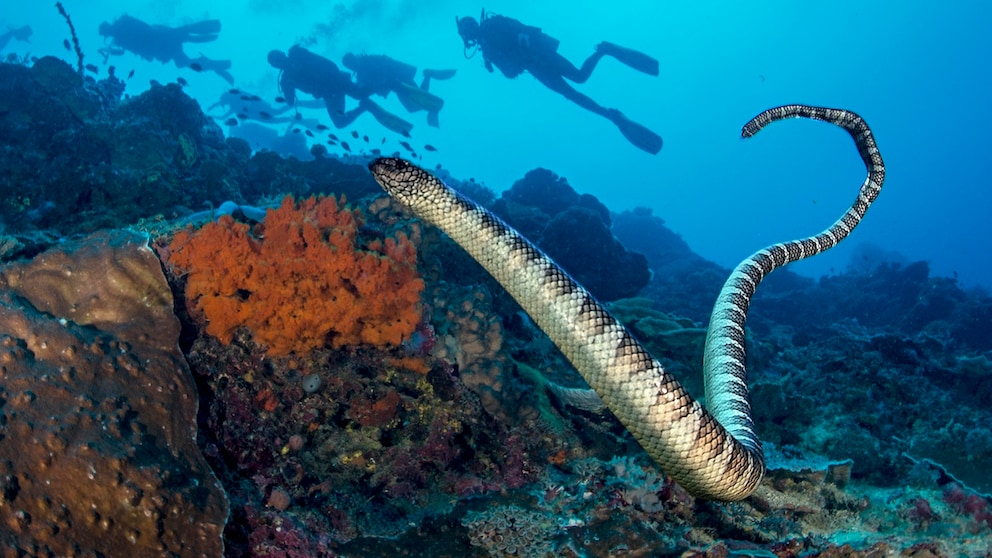
Fortunately for today’s swimmers, such giants are a thing of the past. Modern sea snakes–such as the yellow sea snake (Hydrophis spiralis)–reach lengths of up to three meters. Yet compared to their extinct relatives, they seem almost dainty.
And even Palaeophis colossaeus was not the largest snake in Earth’s history. That title likely belongs to Titanoboa–a giant snake up to 13 meters long, which is also long extinct.