

July 2, 2026, 2:11 pm | Read time: 5 minutes
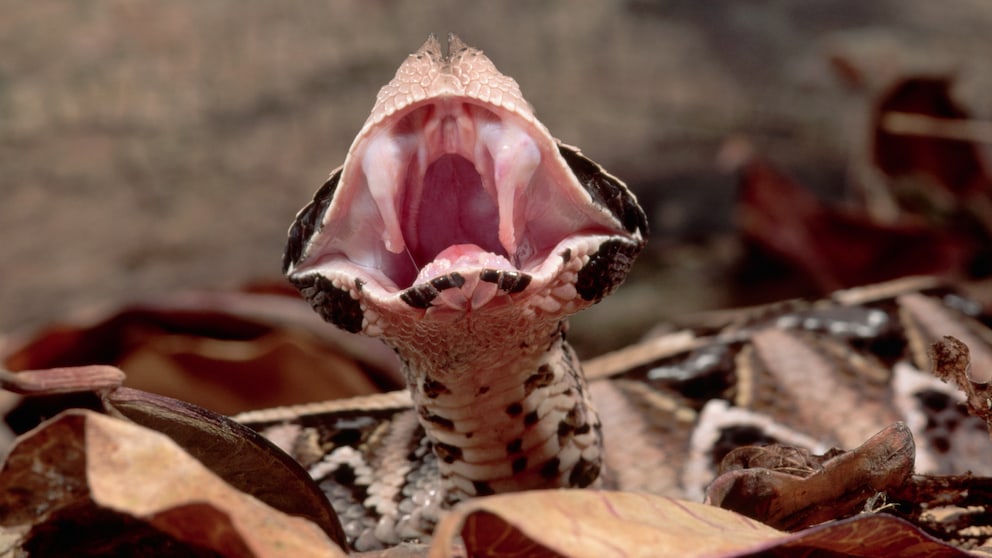
The Gaboon viper holds an extraordinary record: No other snake in the world has longer fangs. With them, it injects enormous amounts of venom. Theoretically, the venom from a single bite would be enough to lethally poison up to six people. But it’s not just its impressive fangs that make this venomous snake so exceptional. It is also one of the heaviest vipers in the world, perfectly camouflaged, and has an unusual hunting behavior. PETBOOK presents the most fascinating features of the Gaboon viper.
The Gaboon Viper Is Perfectly Camouflaged in Leaves
The Gaboon viper is considered a master of camouflage. Among leaves and the forest floor, it is barely recognizable thanks to its extraordinary coloring. This often leads to the impression that the venomous snake is rare. In reality, however, it lives in the rainforests and savannas of Sub-Saharan Africa and can be found in many places—provided you can spot it at all.
There are two subspecies of the Gaboon viper: the Eastern Gaboon viper (Bitis gabonica), found in large parts of Central, East, and Southern Africa, and the Western Gaboon viper (Bitis rhinoceros), which lives in southern West Africa. The latter is especially recognizable by its distinctive, horn-like nasal scales.
Its perfect camouflage is also aided by its body shape: head and body resemble a fallen leaf. This is complemented by a mosaic-like pattern of light and dark brown, pink, and violet areas with diamonds and stripes. The cream-white head makes the Gaboon viper one of the most striking and yet best-camouflaged snakes in Africa.
A Snake of Extremes
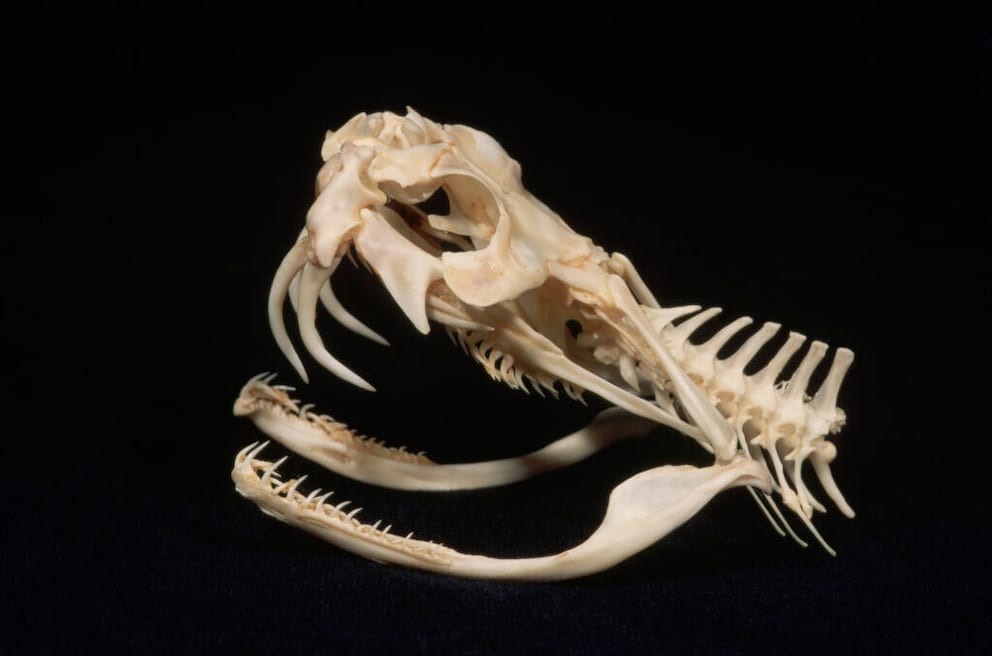
The Gaboon viper is a record holder among snakes in several respects. Adult specimens usually grow up to 1.55 meters long, and in exceptional cases, even more than two meters. With a weight of up to 11 kilograms, it is also one of the heaviest venomous snakes in the world. However, its most extraordinary record is held by its fangs: at up to 5.5 centimeters long, they are the longest of any snake.
During an attack, the Gaboon viper’s front body lunges forward with great force. It can strike its prey precisely from various angles. Although it is not among the fastest snakes, with a bite speed of two to six meters per second, its prey usually has no chance to escape. Even if the first strike misses, the snake can quickly follow up.
Researchers Reveal What Happens When Snakes Bite

‘Zootopia 2’ Sparks Hype Over Dangerous Snake
Length of Fangs Enables Special Hunting Behavior
The venom never runs out of its fangs, as the Gaboon viper produces the second-largest amount of venom among all snakes. This quantity makes its venom so deadly because, compared to the weight of other snakes, its toxicity is relatively low. But why such a large amount of released venom? This has to do with the hunting behavior of this snake species.
The Gaboon viper’s hunting behavior differs from other viper species. Most venomous snakes bite their prey, release it, and then wait for it to weaken due to the venom’s effects. The Gaboon viper, on the other hand, sinks its fangs into its prey and holds it there until it stops moving and dies. This special hunting behavior is facilitated by the snake’s extremely long fangs, as its venom can penetrate deeper tissue where blood circulation is stronger. The comparatively long holding of the prey also supports the release of a larger amount of venom.
This behavior is also related to the fact that the snake requires a relatively large amount of food due to its size. In addition to a variety of birds, mammals, and amphibians, its diet includes larger animals such as rabbits and porcupines. The Gaboon viper occasionally uses its venom to hunt tree monkeys and antelopes to satisfy its hunger. In the past, cattle were also frequently bitten and died—here, however, researchers suspect more of a defensive action by the snake than an attack on prey.
A Single Bite from a Gaboon Viper Would Kill Six People
With a single bite, the Gaboon viper injects five to seven milliliters (450 to 600 milligrams of dry mass) of venom into its prey. The maximum reported wet venom amount was a full 9.7 milliliters, containing 2,400 milligrams of dry venom. Experts assess the potency of this snake venom on humans based on the sensitivity of monkeys to its toxicity. Accordingly, 90 to 100 milligrams of dry venom would be lethal for a human. Therefore, the venom released in a single bite from the Gaboon viper would be enough for six people.
Fortunately, it is rare for humans to be bitten. This venomous snake is generally not aggressive toward humans, and its habitat is limited to regions away from densely populated areas. Often, Gaboon vipers remain still when encountering a person, relying on their camouflage. Attacks are more likely to occur when people accidentally step on the snakes. In such cases, prompt medical treatment is necessary to prevent lasting damage or death.
- Marsh, N. & Whaler, B. C. (1984). The Gaboon viper (Bitis gabonica): its biology, venom components and toxinology. Toxicon, 22(5), 669–694.
- Foerster, S. (2008). Two incidents of venomous snakebite on juvenile blue and Sykes monkeys (Cercopithecus mitis stuhlmanni and C. M. albogularis). Primates, 49(4), 300–303.
- Technology.org, “Everything You Need To Know About The Gaboon Viper: Its unique fangs and a potent bite like no other” (accessed on June 2, 2026)