


November 5, 2025, 4:17 pm | Read time: 6 minutes
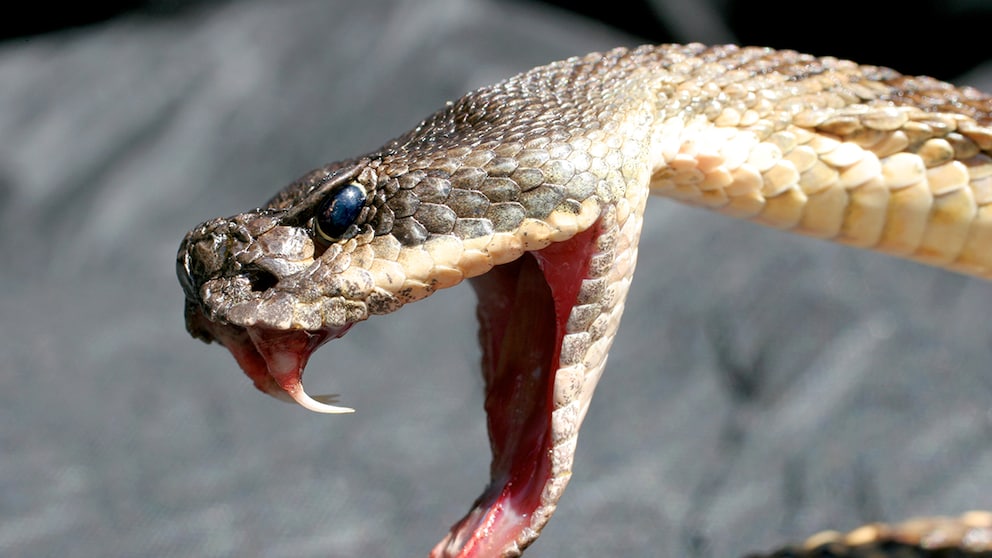
How fast is a venomous snake really when it strikes? A study provides the most accurate high-speed footage to date of 36 venomous snake species–and impressively shows how lightning-fast, precise, and varied their attacks are. One group of snakes particularly surprised researchers with their effectiveness. For the first time, what exactly happens during a snakebite could be deciphered in three dimensions.
Snakes are deadly hunters. Some kill their prey by constriction–others use venom, which is injected into the prey through long fangs. The entire process takes only fractions of a second. But what exactly happens during this? The research team led by Silke Cleuren and Alistair Evans from Monash University in Australia wanted to find out.
For the first time, they comprehensively analyzed the strike behavior of 36 venomous snake species from three families in 3D. The study was published in 2025 in the journal “Journal of Experimental Biology.” Using high-speed cameras (1,000 frames per second) and ballistic gel as a prey substitute, the movements of the snakes were recorded in a controlled environment. The goal was to document and compare differences in kinematics–the movement processes–between the species and families (Viperidae, Elapidae, Colubridae). Ecological factors such as hunting behavior, activity times, body size, and prey type were also considered.1
Behavior after the bite was scarcely documented until now
Previous studies had mostly examined only a few species and relied on one-sided camera angles. Most available data came from well-known vipers like rattlesnakes or puff adders. Only with modern high-speed cameras and 3D tracking can the lightning-fast movements of these animals be accurately captured.
Previous findings about differences in strike speed between snake families–such as vipers being faster than elapids or colubrids–often relied on limited data sets. The behavior after the bite, such as the targeted adjustment of the fangs, was scarcely documented until now. The new study aimed to fill these gaps and also examine the role of environmental factors, prey type, and body characteristics in strike performance.
Gel as prey substitute
In a complex experimental setup, 36 venomous snake species (31 vipers, four elapids, one colubrid) were tested in Paris (at Venomworld) in a standardized arena setup. The animals were conditioned to attack an artificial prey object made of medical gel (also called ballistic gel).
For each animal, three successful strikes were recorded from two perspectives (90° and 60°) with high-speed cameras. The resulting 3D coordinates allowed for precise analysis of movement parameters such as speed, acceleration, jaw opening, prey distance, and fang angle.
Additionally, ecological characteristics such as hunting strategy, activity rhythm, habitat, and preferred prey types were compiled from literature data. The study was conducted in accordance with animal ethical standards and approved by Monash University (Project 18428).
Video: Journal of Experimental Biology // CC BY 4.0
Vipers reached their “prey” within 90 milliseconds
Vipers showed on average the fastest and most powerful strikes in snake bites. Their peak speed reached up to 3.53 m/s (Bothrops asper), with the highest acceleration over 330 m/s².
Particularly noteworthy: 84 percent of vipers reached their “prey” within 90 milliseconds, 55 percent even under 60 ms–faster than many prey animals can react to a stimulus.
Elapids also showed high performance in some cases, such as Acanthophis rugosus (2.21 m/s), while Walterinnesia aegyptia was significantly slower at 0.98 m/s. The studied colubrid species (Boiga dendrophila) moved at 1.82 m/s, placing it in the middle range.
Viper snakebite is particularly precise
In addition to speeds, a wide range of behaviors was observed: Vipers struck precisely and could adjust their fangs. Elapids showed multiple bites with repeated clamping. The colubrid Boiga effectively sliced the prey with its rear-positioned fangs.
Especially in large snakes, larger head size and starting distance correlated with higher speed and larger fang angle. The type of jaw contact with the prey varied greatly but was associated with jaw size and opening.
Also interesting: The 6 largest snakes in the world
Study provides new insights into the behavioral ecology of venomous snakes
This study is the first large-scale comparative analysis of strike kinematics in venomous snakes in 3D. The results partially refute previous assumptions about the superiority of certain snake genera. Instead, it shows that strike speed and bite behavior strongly depend on lifestyle, preferred prey, and body size.
Particularly vipers, which specialize in fast prey like mammals, showed superior strike performance. The results help to better understand the biomechanics of snake bites. This is important not only for ecology but also for medicine–such as in treatments for snakebites–and for biotechnology, which takes inspiration from the fang mechanisms of snakes.
The observation of different bite strategies within and between families also provides new insights into behavioral ecology. For example, “fang walking” in vipers was documented in high resolution for the first time–a process where the fangs are deliberately repositioned after the first contact to inject optimally.

This Snake Has the Longest Fangs in the World
The 7 Native Snake Species of Germany and How to Identify Them
Size of artificial prey can lead to biomechanical distortions
The study represents an important methodological advancement: Thanks to 3D tracking and a uniform experimental setup, direct comparisons between 36 species could be made for the first time. However, only one to two individuals per species were examined, which limits the ability to capture intra-individual variations.
Additionally, the size of the artificial prey was constant, which could lead to biomechanical distortions in extremely small or large snakes–such as in the contact area between fang and prey. The significance of the findings for the colubrid group is also limited, as only one species (Boiga dendrophila) could be kinematically analyzed.
Conclusion: Study provides fascinating and fact-rich insight
This investigation offers a detailed, comparative look at the strike behavior in snake bites of 36 venomous species for the first time. Vipers show on average the fastest and most dynamic bites, with larger animals being particularly powerful. The study also documents for the first time the finest behavioral patterns, such as the targeted adjustment of fangs or the slicing of prey by colubrids.
For herpetologists, biomechanists, and anyone interested in snakes, this work provides a fascinating and fact-rich insight into one of the fastest movements in the animal kingdom.