


September 24, 2026, 9:56 am | Read time: 5 minutes
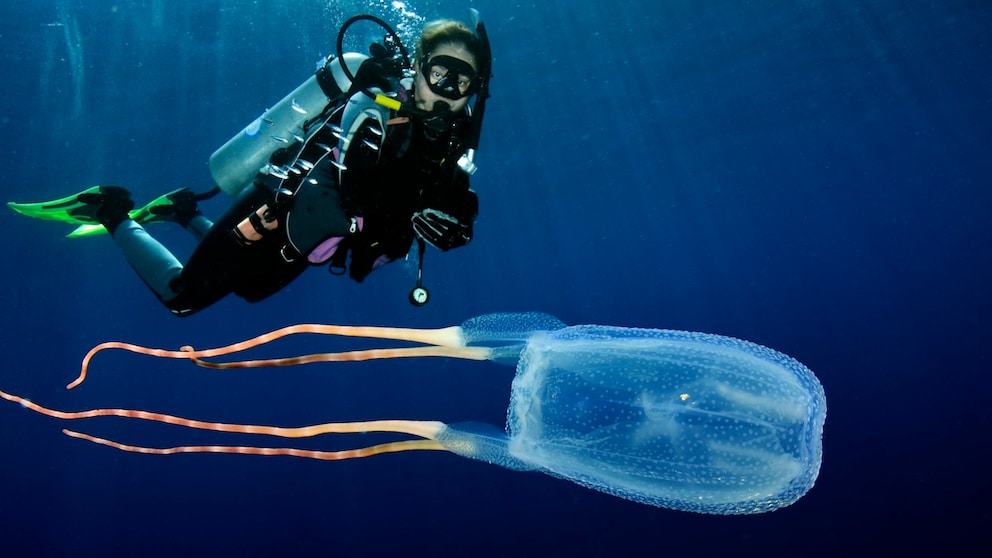
It is nearly transparent, barely visible in the water, yet it carries one of the world’s most potent animal toxins: the box jellyfish (Chironex fleckeri). The neurotoxin of this jellyfish can become life-threatening within minutes. However, the box jellyfish is not a bloodthirsty sea monster but a fascinating creature with highly developed sensory organs and remarkable abilities. PETBOOK editor and biologist Saskia Schneider introduces the world’s most venomous animal.
Overview
Why the Box Jellyfish Is Considered the World’s Most Venomous Animal
The box jellyfish is considered the world’s most venomous animal due to the incredible potency and speed of its venom–and the amount a single jellyfish carries. A fully grown box jellyfish can store enough toxin in its body to theoretically kill up to 250 adult humans. The stinging cells on its tentacles–tiny, highly developed venom units–react to the slightest touch and release their venom within milliseconds. A harpoon-like barb is shot into the skin with enormous pressure, allowing the neurotoxin to enter the bloodstream directly.
The extremely potent venom occasionally leads to fatalities from box jellyfish stings. In 2021, a 17-year-old died in Queensland, Australia, after contact with a box jellyfish, as reported by the “Spiegel.” However, it was likely the first time in about 15 years that someone in Australia died from a sting by this sea creature, according to the report. Estimates suggest that around 70 people in Australia have died from contact with large box jellyfish. Thus, while the box jellyfish is the world’s most venomous animal, it is by no means the deadliest.
Animal of Superlatives
The box jellyfish is not only the world’s most venomous animal–it also impresses with a range of biological superlatives. As one of the largest box jellyfish, its bluish shimmering bell can reach a diameter of up to 30 centimeters. Each of the four corners of its cube-shaped body has up to 15 tentacles, each up to three meters long–combined, a single specimen can have over 60 meters of tentacle length. Millions of stinging cells–called nematocysts–on these tentacles are equipped with fine sensors that react to touch and shoot the venom into the victim with a pressure of up to 150 bar–equivalent to 80 times the air pressure of a car tire.
But the box jellyfish is impressive not only for its venom apparatus: It has 24 eyes, including eight highly developed lens eyes that provide sharp color images. Despite lacking a brain, it processes visual stimuli directly in its nervous system–each eye likely has a specialized function. Its swimming ability is also record-breaking: At up to nine kilometers per hour, it is one of the fastest cnidarians and even faster than top human swimmers. This combination of visual orientation, active movement, and deadly precision makes the box jellyfish a masterpiece of evolution–fascinating, efficient, and unique. 1
How Does the Box Jellyfish’s Venom Work?
The box jellyfish has tentacles up to three meters long with millions of highly sensitive stinging cells. These function like tiny harpoons and inject one of the strongest known animal venoms upon contact. Just a few milligrams can be fatal to an adult. The venom immediately attacks the heart, respiratory muscles, and nervous system. Paralysis and cardiac arrest can occur within two to five minutes–such rapid action is unique in the animal kingdom. 2
The toxin also damages red blood cells, leading to a sudden release of potassium into the blood. The result is a condition known as hyperkalemia, which quickly leads to circulatory collapse. Therefore, the box jellyfish is rightly considered the world’s most venomous animal. 3
Is There an Antidote?
Yes, there is now an antidote for the box jellyfish’s venom–a significant advancement in emergency medicine. However, it must be administered within 15 minutes of contact to be effective.4 First aid is therefore crucial: The affected areas should be immediately rinsed with household vinegar (5–10%) to prevent further venom release.
Important: Never use fresh water or alcohol! They can further activate the stinging capsules.
Where Does the World’s Most Venomous Animal Live?
The box jellyfish lives in the warm, shallow coastal waters of the Indo-Pacific region–most commonly off northern Australia, Papua New Guinea, Indonesia, and Malaysia. It is most active during the jellyfish season from October to April. Because it is nearly transparent, it is often recognized too late in the water–one of the main causes of dangerous encounters. 5
The Most Poisonous Animals in the World
Which Jellyfish Are Dangerous in the Mediterranean?
Avoiding Encounters with Box Jellyfish
Although the box jellyfish is considered the world’s most venomous animal, dangerous encounters can largely be avoided. In Australia, beaches are secured with warning signs and jellyfish nets. Additionally, jellyfish protection suits help minimize the risk.
If stung, remain calm, apply vinegar immediately, remove tentacles (e.g., with tweezers), and call an emergency doctor as quickly as possible. Symptoms–burning pain, shortness of breath, unconsciousness–can intensify rapidly. 6
Conclusion
The box jellyfish is rightly known as the world’s most venomous animal–but also a fascinating creature of nature. Its transparent appearance, highly developed eyes, and speed of up to 9 km/h make it an extraordinary marine being.
Thanks to modern research, there is now an antidote and effective protective measures. Those who act cautiously and heed warnings can safely navigate its habitat.