

June 5, 2026, 2:40 pm | Read time: 3 minutes
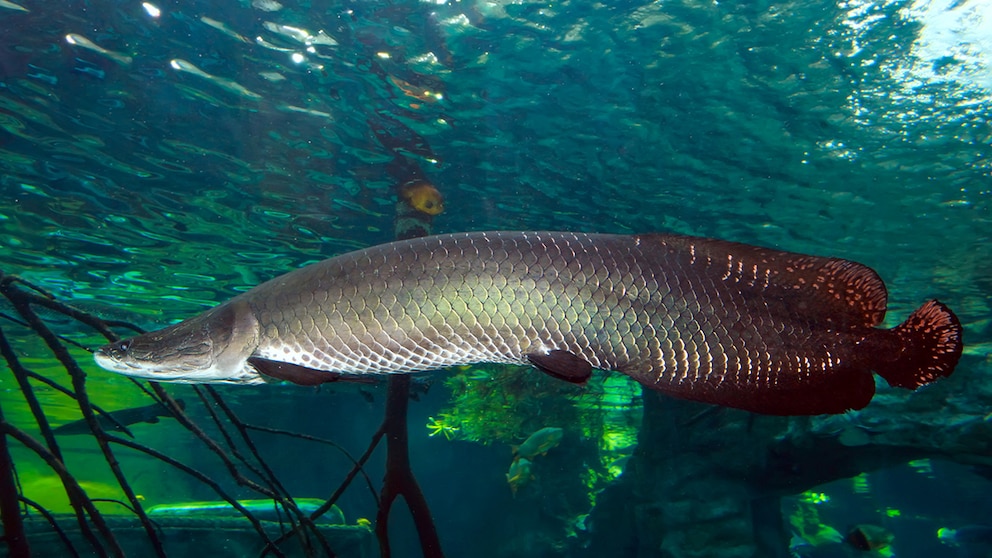
In the Amazon Basin lives one of the largest freshwater fish in the world, the Arapaima gigas. Also known as Paiche or Pirarucu, this creature is reported to grow up to 14.8 feet long and doesn’t shy away from feared predators: its diet includes piranhas, among others. Numerous stories and legends surround this giant fish, named after a fierce warrior.
Fish Named After Fierce Warrior
The large predatory fish is nicknamed Pirarucu after a Brazilian indigenous legend. Due to the extreme cruelty of the warrior Pirarucu, he was condemned by the gods and driven away with thunder and lightning. Cornered, he is said to have transformed into a giant fish with thick, red scales in a river.1
These hard scales are also why piranhas can’t harm the Arapaima. The smaller predatory fish can’t bite through its scales with their much sharper teeth and quickly end up in the large mouth of the Paiche. The Arapaima gigas has the red scales described in the legend mainly on its tail and is considered the largest freshwater fish in the world since the extinction of the Chinese paddlefish.
Also of interest: The mystery of the pink dolphins of the Amazon
True Size of the Pirarucu Not Yet Definitively Determined
The actual size of the elongated fish with the flat snout cannot be determined with certainty. Some reports mention lengths of 6.5 to 8.2 feet, while others even mention lengths of 9.8 feet or up to 14.8 feet. However, it is clear that with an average live weight of 440 pounds, it needs quite a few piranhas in its stomach to be satisfied.2
However, it also feeds on other fish, mammals, and water birds when it can catch them. The Arapaima gigas is a predatory fish found mainly in the Amazon and Orinoco rivers, where it has no natural enemies. It can thus feed on the stocks in the large waters and adjacent river courses.
How Dangerous Are Catfish Really for Dogs and Humans?

These Predatory Fish Live in the Swimming Lake, and Here’s How to Behave Properly
Arapaima gigas Makes Loud Smacking Sounds When Breathing
Another fascinating fact about the largest predatory freshwater fish is that it can breathe air–like many other fish living in oxygen-poor waters. The waters it inhabits are sometimes quite acidic, with a pH value of 6 to 6.5, which is not conducive to oxygen saturation.
If it doesn’t get enough “air” in the water, it surfaces every 10 to 20 minutes to breathe, making loud smacking sounds that are often quite audible. In the first days after the birth of a young Arapaima gigas, it must learn to transition from water breathing to air breathing.
However, this frequent surfacing also makes it vulnerable to the only enemy it has in the countries of Peru, Guyana, and Brazil, as well as in Bolivia. The Arapaima gigas is increasingly ending up on people’s menus. In Bolivia, it is considered an invasive species that threatens native animals with its large appetite.
Also of interest: These piranhas can be dangerous to humans
Giant Fish Is Repeatedly a Source of Conflict
But that’s not the only reason the large fish was long hunted uncontrollably. Industrial fishers and indigenous residents of the Amazon region have long disputed fishing rights. Although the Arapaima gigas is predatory, it is very shy. It retreats to secluded lagoons when stressed. However, these areas were granted to the indigenous residents, leading to repeated disputes over hunting the giant fish.3
However, there are now efforts to protect the large fish. In Brazil, fishing was completely banned for several years. In Peru, there are now closed seasons during which the Pirarucu cannot be caught. This is because, especially during the rainy season, it is busy raising its offspring.