

August 23, 2026, 12:19 pm | Read time: 12 minutes
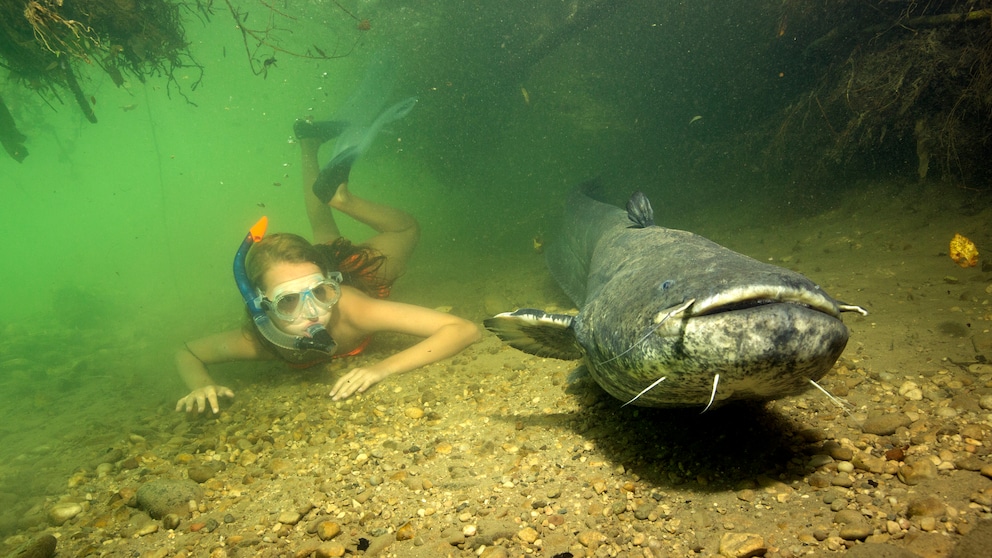
Up to three meters long, weighing more than 220 pounds, and equipped with a massive mouth: European catfish reach impressive sizes. Almost as large are the stories surrounding these giant fish. But how dangerous do these fish become to pets and humans when defending their territory or offspring? PETBOOK spoke with experts to uncover the truth behind tales of dog-eating catfish and attacks on swimmers.
Giant Catfish Frequently Make Headlines
The extent to which such discoveries fuel the imagination was evident in 2025 at Lake Garda. Headlines warned of “giant fish” and a supposed “monster fish” in the popular vacation region. Since a British angler caught a 115-kilogram, over three-meter-long specimen there in 2019, reports of unusually large catfish have increased.
A local fisherman also reported in 2025 about an approximately two-and-a-half-meter-long and around 220-pound animal. The reports caused unrest among fishermen and vacationers. Some freedivers even hunted the supposed “monster fish” with harpoons. But do the size and appearance of these animals truly justify the fear of them?1
Also interesting: After photos with giant catfish! PETA: “Trophy hunting for large fish is a pathetic power play”
The Legend of the Dog-Eating Giant Catfish
The story of the swallowed small dog persists. Whether in Cologne, Berlin, or Munich: In many cities, the tale of a dachshund or a similarly small dog being grabbed and dragged into the depths by a catfish while swimming or sniffing at the shore is well-known. Swimmers occasionally report bites from large catfish as well.
The idea that a three-meter-long, over 220-pound fish might suddenly appear while swimming is likely to frighten many people. But do catfish really have an appetite for dogs, and do they deliberately attack humans?
More Than Two Meters Long and 220 Pounds
In fact, the European catfish, as the animal is precisely called (also known regionally as Waller), impresses mainly with its large body and wide mouth. The animals, whose zoological name is Silurus glanis, are the largest freshwater fish in Europe. Depending on their habitat, they can easily reach more than two meters in length and weigh over 220 pounds. However, most fish are at most one and a half meters long and weigh around 110 pounds. Despite their size, the animals are generally considered shy and are rarely seen at the water’s surface.2
“Catfish live in the lower water layers, at the bottom, not at the top,” explains Dr. Michael Möhlenkamp, a biologist and managing director of the Westphalia and Lippe State Fisheries Association. Catfish have an elongated, usually black or gray, scaleless body covered with a layer of slime. The belly is lighter than the back. The large, flat head with a very wide mouth is striking. Around the mouth, on the upper and lower jaw, catfish have three pairs of antenna-like sensory hairs, called barbels, which they use to detect prey in murky water.
Catfish Can Live Up to 80 Years
The eyes are small, and catfish have poor vision. However, they have a very good sense of smell and touch, so they don’t need to see well. Under optimal conditions, they can live up to 80 years, as they have no natural predators once they reach a certain size. Catfish mainly live in rivers and lakes and prefer water temperatures of at least 64 degrees Fahrenheit. Their spawning season begins in spring and ends in July. The animals are mostly active at dusk and at night, resting during the day in the muddy to sandy bottom of their waters.
Adult catfish are solitary and considered territorial: They actively defend their territory. Catfish lay their eggs in shallower shore areas, where they are guarded by the male. If the animals or their eggs feel threatened, they chase away intruders and, if necessary, do not shy away from attacks. Disturbers can expect to be bumped or, in rare cases, bitten. However, they would not be seriously injured or swallowed, assure two fish experts when asked by PETBOOK. Above all, dogs and humans need not fear being in danger from a catfish attack.
Catfish Prefer to Eat Fish
Catfish feed by opening their mouths and practically “sucking in” passing prey, as Dr. Michael Möhlenkamp, a biologist and managing director of the Westphalia and Lippe State Fisheries Association, explains. “This happens due to the suction created when the mouth opens.” The animals are fast predators and not very picky about their prey. “They are opportunistic feeders; they take what swims in front of their mouths,” says Möhlenkamp. However, this is usually fish.
In 2018, a video published by the news magazine “Spiegel Online” caused a stir, showing catfish from a southern French river hunting pigeons. The birds were bathing in the shallow shore water when catfish approached and, to snap at the pigeons, even came ashore for a short time, risking stranding. However, this behavior has only been observed in the Tarn River and is described by experts as “highly unusual.”
Also interesting: These are the 9 largest animals in Germany
Do Catfish Also Eat Small Dogs?
Fish expert Möhlenkamp also says this. “To my knowledge, such behavior has never been observed here, and I am not aware of it from other regions either.” Birds are not part of the usual diet of catfish. Occasionally, a small water rat or a waterfowl chick might be swallowed.3 This is confirmed by a spokesperson for the Berlin Anglers Association when asked by PETBOOK. He once found the bones of a small duck in a catfish’s stomach: “That can happen, but it’s more of an accident.”
Catfish have poor vision, and if a group of small ducks is paddling around the lake, the catfish might mistake them for roach or other small fish. “Then it surfaces with its mouth open among the supposed fish and might accidentally swallow a small duck,” says the spokesperson for the state association. However, ducks and other birds are not the preferred prey of a catfish. And dogs, both experts confirm, are absolutely not part of the catfish’s diet.
“Even smaller dogs are too large for native catfish,” says a spokesperson from Berlin. The stories of swallowed dachshunds belong, the experts agree, “to the realm of myths.” And humans simply do not fit into the prey pattern.
Catfish Protect Their Eggs
So where do reports that people have allegedly been attacked by catfish come from? In 2016, a swimmer from Bavaria reported being attacked by a catfish while swimming.4 The woman suffered a few scrapes and a fright. In June 2025, five people at Brombachsee in Weißenburg, Bavaria, reported to the water rescue service within two hours that they had been bitten by a large catfish.5
The approximately two-meter-long and about 200-pound fish was then shot by a police officer. The decision sparked criticism, as experts suspected that the animal had not attacked out of a hunting instinct but was merely defending its offspring and territory during the spawning season.6
What’s Behind the “Bite Attacks” on Humans
Because not only do both fish experts interviewed by PETBOOK rule out that the catfish had an appetite for swimmers. Aside from the fact that humans fit even less into the prey pattern than dogs, the catfish cannot really bite with the blunt, small teeth in its mouth, let alone tear pieces out of a person. It remains with scrapes and scratches. If catfish really do bite humans, “it is related to the territorial behavior of the animals when they protect their eggs,” says Dr. Michael Möhlenkamp.
As already described, catfish can indeed attack if they believe their offspring are threatened. If an unsuspecting swimmer gets too close to the catfish’s eggs, the defensive animal might snap at them if it becomes too much. With the number of bathers at Brombachsee and the pounding beats on the shore, the catfish was apparently so stressed that it bit anything that came too close to it and its spawning area. However, the innate protective instinct for its offspring cost the animal its life.
More Likely to Win the Lottery Than Be Attacked by a Catfish
The bathers who startled the catfish, meanwhile, got off lightly. Even after the incident with a swimmer in 2016, fish experts reassured the media: Even the angriest catfish would leave it at a brief attack and would not engage in a fight with a competitor as large as a human. And even a simple defense, reassures the spokesperson for the Berlin Anglers Association, “is very rare, as catfish do not lay their eggs on busy beaches where people gather daily.” The animals are too shy for that.
However, those who enter the water in remote areas or use lakes not designated for swimming may encounter a catfish or other animals defending their habitat. Just like at Brombachsee. The countless guests of the techno festival who used the lake to cool off had simply disturbed the resident catfish during the spawning season, as Robert Arlinghaus from the Leibniz Institute of Freshwater Ecology and Inland Fisheries explained in an interview with BILD.
As early as 2024, he described the likelihood of being attacked by a catfish in a contribution for the MDR television station with a striking comparison: “You’re more likely to win the lottery than for that to happen.” But if it happens that a catfish bites, it naturally spreads, says the spokesperson for the Berlin Anglers Association.
The Thing About the Legends
Therefore, he attributes the legend of the dog-eating catfish primarily to exaggerations and a lack of knowledge. “If a small dog perhaps didn’t make it back to the shore while swimming and drowned, it’s still said that it was the catfish. If a swimmer gets injured while swimming, it was the catfish.” Whether that’s true is rarely checked, but the story is always embellished, “until finally a huge monster devours an entire lake.”
And some anglers themselves contribute to the legend: “When they land a catfish, it’s barely a meter long. On the way home, it’s already two, and in the evening at the angler’s club, their arms aren’t long enough to show the length of the animal.”
Fishermen See Catfish as a Threat to Their Existence
For fish experts, it is clear despite numerous reports and rumors: “Neither dogs nor humans are in danger from catfish.” Not while swimming, not while paddling, and certainly not while walking along the shore. “Catfish do not come ashore,” says the Berlin Anglers Association. Their spokesperson has never experienced a catfish grabbing a dog. Nor has he ever found dog bones in a catfish’s stomach or heard of such a find.
However, catfish do indeed have a large appetite. They devour what lives in their pond, and in large quantities. That is the real problem with catfish and especially for fishermen, who–like at Lake Garda–see their existence threatened as a result. Environmental experts also fear that larger catfish populations could harm biodiversity in affected waters. Smaller fish species such as roach and rudd, as well as young predatory fish like pikeperch and pike, could be endangered by the catfish.7
Catfish Are Tough Fish
Catfish could also negatively impact the population of some endangered amphibians. Incidentally, catfish originally from the Danube region and Eastern Europe were not native to most of the waters where they are now found. However, as they are considered popular and tasty food fish, they have been increasingly introduced by anglers into numerous lakes and ponds since the 1970s.
There, they found very good living conditions, not least due to increasingly warm summers and mild winters, and multiplied rapidly. The animals are also considered quite resistant to water pollution and can cope with lower oxygen concentrations than other fish. Catfish especially appreciate waters with low currents that warm up quickly, as their comfort temperature is between 77 and 81 degrees Fahrenheit.

These Predatory Fish Live in the Swimming Lake, and Here’s How to Behave Properly

This Snake, Which Can Grow Up to 1.5 Meters Long, Lives in German Lakes
Catfish as Winners of Global Warming
The catfish could thus become a winner of global warming. Studies indicate that the animals grow faster and larger in warmer waters and reach sexual maturity earlier. This allows them to reproduce better than other, less adaptable fish species. Additionally, their habitat is shifting to higher, once cooler, and now also warmer regions where they were not previously widespread.
Since the catfish, unlike other native predatory fish, is not particularly picky about its food, it finds food almost everywhere. Conveniently for it, numerous weirs, locks, and fish ladders can be found in local waters, as Robert Arlinghaus from the Leibniz Institute of Freshwater Ecology and Inland Fisheries explained to the MDR television station.
The catfish only needs to wait there until salmon, trout, and other migratory fish species pass by. In some places, there are “high feeding losses. Currently, trout, eels, and salmon are being reintroduced with great effort to compensate for past environmental destruction. Here, the catfish can cause significant losses, thwarting conservation efforts.”
Catfish Are Spreading More and More Here
Conclusion: Catfish are spreading more and more here as well. Rising temperatures, their frugality, and few natural enemies make them winners of climate change. The animals can grow very large, eat a lot of fish depending on their size, and they don’t look particularly pretty. However, none of this makes them the monsters they are often portrayed as.
That catfish hunt dogs belongs to the realm of fairy tales, as fish experts assure. And if the shy catfish do attack humans while swimming, it’s due to the bathers, not a supposedly dangerous and aggressive fish. The swimmers were simply careless and got too close to the catfish’s eggs. The animal is merely defending its offspring.
More than a few bleeding scratches are not sustained by the attacked, as catfish teeth are small and blunt, unable to bite pieces out of human skin. Catfish are only life-threatening to fish and other aquatic creatures, but not to dogs or even humans.