

July 31, 2026, 3:26 pm | Read time: 4 minutes
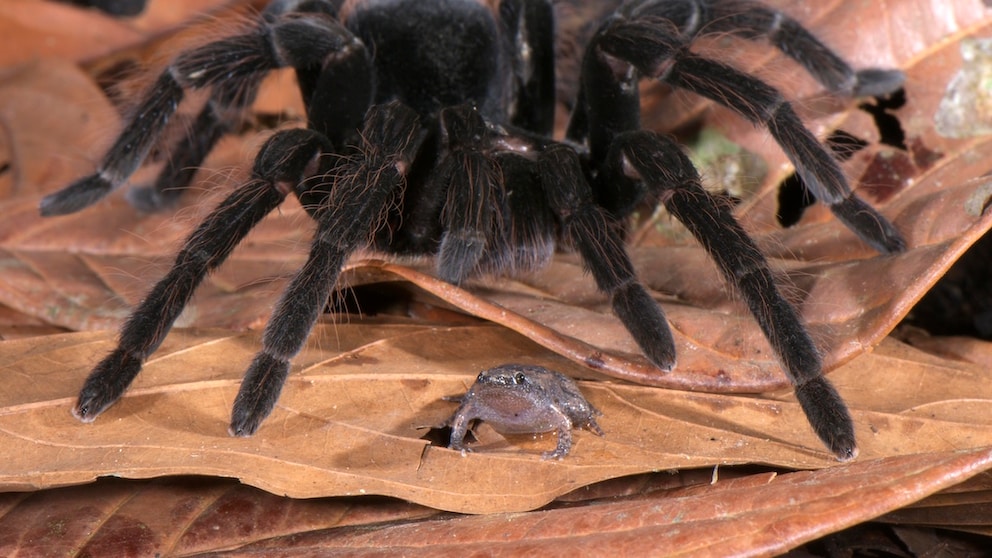
A frog and a tarantula share a cave—without one eating the other? Sounds like a fable, but in South America and Asia, this is reality. Why these contrasting animals form a living arrangement is an astonishing natural phenomenon with clever benefits.
They share caves, seem to tolerate each other—even protect each other: In Sri Lanka, Paraguay, and Peru, researchers documented a close relationship between ground-dwelling frogs and giant tarantulas. These unlikely cohabitations raise the question of whether this is mere coexistence or true mutualism—a living arrangement that benefits both species.
Tarantula and Frog Actually Fall into Predator-Prey Spectrum
Symbiosis—the coexistence of different species—can take many forms. While parasitism benefits only one side and harms the other, mutualism is characterized by mutual benefit. Such relationships are particularly fascinating when they occur between animal groups that usually have a predator-prey relationship—such as spiders and frogs.
In tropical habitats, ground- and tree-dwelling amphibians and spiders regularly encounter each other. Yet instead of competition or attack, in some cases, a quiet cooperation seems to establish itself, the benefits of which are only partially understood so far.
Researchers observed a remarkable partnership of this kind between the Sri Lankan bullfrog (Kaloula taprobanica) and the ornamental tarantula Poecilotheria fasciata. Similar observations were made in 1989 in the Peruvian rainforest—where the small narrow-mouthed frog Chiasmocleis ventrimaculata lived in a shared habitat with the theraphosid spider Xenesthis immanis.
Most recently, the phenomenon was also described in 2021 in Paraguay between the tarantula Eupalaestrus campestratus, also known as the “pink zebra beauty,” and another narrow-mouthed frog (Chiasmocleis albopunctata).
Spider Protects “Its” Frog
But what advantages do these different species actually gain from living together? In Sri Lanka, an unusual coexistence in tree hollows was documented as part of a conservation project: There, the tarantula and frog not only shared the habitat but also displayed noticeable behavior. When the frog was uncovered by researchers, the spider jumped onto its back—without any sign of aggression. The authors interpreted this as protective behavior and suggested classifying the relationship as mutualism. 1
As early as 1989, researchers in Peru observed a similar community. Over three months, they tracked the nocturnal activities of frogs and spiders in shared caves. Here, too, frogs were not eaten—even when the spiders actively hunted other frog species. The authors attributed this to chemical protective substances in the frog’s skin and classified the relationship as commensalism—a one-sided beneficial but harmless coexistence. 2

Are Cats “Parasites of Our Society”? Biologist Weighs In
106 Square Meters! World’s Largest Spider Web Discovered
Frog Protects Spider Eggs
Most recently, the phenomenon was also observed in Paraguay: In two ground caves, several frogs even lived together with a spider. Upon contact, the spiders showed no aggression. However, another component of the behavior was revealed here. The frogs feed on ants and protect the spider’s eggs from being eaten by these insects.
The spider, in turn, could offer the frog protection from predators like snakes or geckos through its presence. As with the study in Sri Lanka, researchers here assume a symbiosis that is beneficial for both (mutualism). They also believe that the frogs deliberately seek shelter in the spider’s caves—probably also due to the stable microclimate in the cave. 3
Three Studies–A Global Pattern?
Central to the hypothesis is that certain microfrogs are recognized by the spiders through chemical signals—and classified as “inedible.” At the same time, these frogs consume ants, which are considered the main threat to spider eggs. For the frogs, living with a predator offers protection from others—such as snakes or birds. Spiders, in turn, benefit from nest protection and perhaps from a reduced density of egg predators.
These frog-spider communities also raise intriguing questions: Are they isolated cases or more widespread than previously thought? How do spiders recognize “their” frogs? What role does the amphibians’ diet play in their chemical defense? And: Could such interactions be an underestimated factor for the survival of both species in disturbed habitats?
All three studies show: Such relationships arise independently on different continents, with different species—an indication of convergent evolution. They are also a striking example of how little we know about the hidden dynamics of tropical ecosystems.