


August 6, 2026, 11:12 am | Read time: 6 minutes
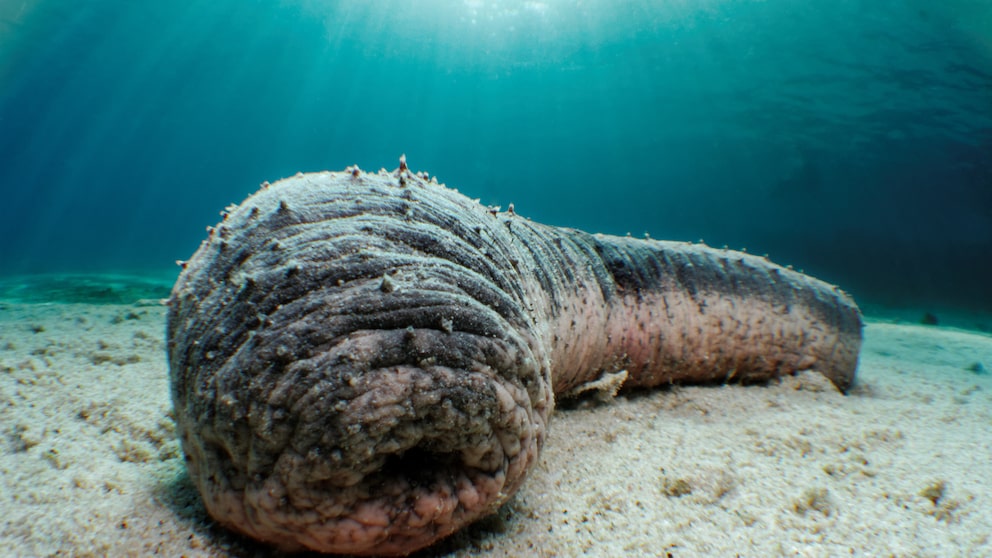
At first glance, sea cucumbers look like sluggish sausages on the ocean floor. But their unassuming appearance is deceiving: These creatures can fend off predators with sticky innards, harden their skin in an instant, and even clean the seabed. PETBOOK presents 12 facts that make sea cucumbers one of the ocean’s most curious animals.
1. Sea Cucumbers Produce a Caustic Toxin
Sea cucumbers produce toxins in their bodies, particularly a substance known as holothurin. Skin contact causes severe, burning pain. If ingested, for example, when animals eat sea cucumbers, the toxins can lead to paralysis, muscle cramps, and digestive issues, and in larger amounts, death from respiratory paralysis. As a result, most marine creatures avoid them.
Only highly specialized predators like the large mollusks Tonna galea and Tonna perdix can overpower sea cucumbers by paralyzing them with their own potent venom before swallowing them whole.1
Also interesting: Are slow worms actually snakes?
2. Sea Cucumbers Throw Their Guts at Enemies
Some other, less specialized marine predators also occasionally hunt sea cucumbers. These include crabs, starfish, and mussels. If a sea cucumber feels threatened by them, it ejects its innards through sudden contraction of its skin muscle tube, hurling them at the predator.
These are not just simple innards but a sophisticated defense system of white, sticky threads that immobilize the enemy. While the attacker struggles to free itself from the sticky threads, the sea cucumbers slowly crawl to safety. The missing organs can be regenerated by the sea cucumber within a few weeks. Until then, it must forgo this defense tactic.
Also interesting: 7 bizarre facts about animal mating behavior
3. They Are the Ocean’s Garbage Disposal
In the marine ecosystem, sea cucumbers play important roles. With their tentacles located on their heads, they clean the seabed. They take in calcium residues, dead reef material, and even the excretions of other marine animals.
With the help of microorganisms and algae living in their digestive tract, they clean the ingested sediment and enrich it with substances like phosphorus and nitrogen. These, in turn, nourish important soil bacteria.
4. The Animals Are Related to Starfish
Even though the cylindrical animals don’t look it, they have a five-rayed symmetry. Like starfish or sea urchins, sea cucumbers belong to the echinoderms. Over the course of evolution, sea cucumbers have adapted to a crawling life on the ocean floor, developing what’s known as secondary bilateral symmetry.
While starfish or sea urchins have no front or back, sea cucumbers have developed a muscular, elongated body with a front and back end over their evolutionary history.
5. Some Sea Cucumbers Host Gut Fish
Sea cucumbers almost form their own little ecosystem. Up to 200 symbionts and parasites live on and in them. One of these is the gut fish. These elongated fish resemble eels in appearance but lack pelvic and dorsal fins.
Thanks to their shape, they can slide backward into the sea cucumber’s anus. Inside the animal’s intestines, they feed on what the sea cucumbers take up from the ocean floor, helping with the sedimentation of substances.
6. They Are Also Called the Penis of the Sea
The Italian term for sea cucumbers is “cazzo di mare”–the “penis of the sea.” This name likely comes from the shape of the animals. This is probably also why some cultures attribute aphrodisiac properties to the animals, leading us to the next fascinating fact.
7. Sea Cucumbers Fetch High Prices in China’s Markets
They are said to taste like tofu and are listed for high prices on the menus of upscale restaurants in China. Traditional Chinese medicine attributes miraculous powers to the animals, claiming they can boost potency, cure cancer, and even dementia. None of this is medically proven.
Nevertheless, dried sea cucumbers fetch exorbitant prices on the Chinese market. The magazine “Spiegel” reported that according to a report by the Food and Agriculture Organization (FAO), up to 3,000 U.S. dollars per kilogram are paid for the Japanese spiky sea cucumber. The most valuable tropical species still fetch between 140 and 1,670 dollars per kilogram of dry weight.
8. Sea Cucumbers Have No Brain
Sea cucumbers do not have a brain like vertebrates but a simple nervous system with a nerve ring and longitudinal nerves. Five main nerves run along the length of the body. However, the nerve ring does not seem to play a central role in the coordination of the animals. If surgically removed, sea cucumbers remain functional and mobile.
The remarkable independence of sea cucumber tissue was recently demonstrated by an unusual case of the cold-water sea cucumber Psolus fabricii: Detached tissue pieces remained biologically active for years, healed wounds, and continued to respond to touch–all without a brain or complete body, as PETBOOK reported.
9. The Animals Pump Water into Their Feet
Even though sea cucumbers look like large worms, they have small feet with which they crawl along the ocean floor. Since they lack bones or skeletal elements, they use another method to provide stability in their stubby extremities. They pump water into their feet using their water vascular system, also known as the ambulacral system, allowing them to move quite effectively.
10. Some Sea Cucumbers Look Like Jellyfish
Sea cucumbers from the order Elasipodida do not crawl on the ground but float through the water. Their body structure differs significantly from that of other sea cucumbers. They have almost no feet. Instead, they have a fringe along the longitudinal axis of their body or a collar-like fringe on the front body, which allows them to swim through wave-like movements. This makes them resemble jellyfish. Additionally, the animals are usually reddish or violet in color.
No Brain, No Heart, but Alive–The Mystery of the ‘Zombie’ Sea Cucumber
Sea Cucumber Extract as a Beauty All-Rounder–How Effective Is It?
11. Sea Cucumbers Have No Sexual Organs
Sea cucumbers do not have complex external sexual organs but usually have a gonad that releases eggs or sperm into the water. They are also dioecious–meaning there are male and female animals. Depending on the sex, the gonad of the sea cucumbers produces either eggs or sperm, which are released into the seawater. The current then distributes them. Fertilization does not occur within the animals themselves but in the open water.
12. They Can Change Their Skin Structure in Seconds
The skin of sea cucumbers has a very special structure. Its texture can vary between three states: soft, medium, and firm. The animals can control this through specific fibers in their skin, which they can actively intertwine or loosen. This allows them to make their skin soft as wax or hard as a board within minutes–or even seconds. This makes the animals incredibly flexible and enables them to squeeze into the smallest crevices–for example, to escape predators.