


May 22, 2026, 4:19 am | Read time: 6 minutes
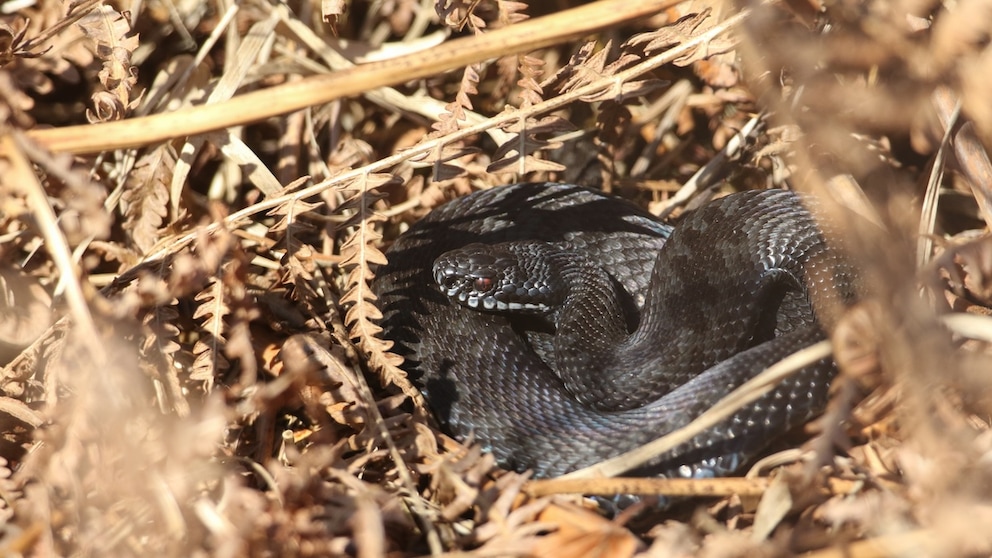
A pitch-black snake in the moor or at the forest edge is often enough to trigger fear. However, behind the mysterious black adder, also referred to as the “hell viper” (Höllenotter in German), is usually not a dangerous monster, but a rare color variant of the native adder. Why some animals are completely black, why this doesn’t make them more dangerous, and why these shy reptiles urgently need protection today is explained by PETBOOK editor and biologist Saskia Schneider.
Why Are Some Adders Black?
The black adder is not a separate species of snake but a melanistic form of the adder (Vipera berus). “Melanism” means that the body produces an especially large amount of dark pigment—melanin. As a result, the snake appears almost entirely black.
This phenomenon is also known from other animals, such as black squirrels or panthers. In adders, the dark coloration likely even provides a significant advantage: Black animals warm up faster.1
Black Color Has Advantages
At first, this sounds unspectacular, but it is extremely important for reptiles. Adders are cold-blooded and rely on solar energy to become active. Especially in cool regions such as moors, mountain heaths, or low mountain ranges, black coloration can be a real advantage.
That’s why black adders are particularly common in Germany in the Black Forest, on the Swabian Jura, in the Allgäu, or in northern German moorlands. In some regions, the dark animals are even more common than the classic gray-brown specimens with a zigzag pattern.
However, the black color also has disadvantages: The animals are more easily spotted by predators—and unfortunately, they are also more frequently pursued by humans. Yet, these rare snakes are strictly protected.
Are Black Adders More Dangerous?
In short: no. Black adders possess the same venom as normally colored adders and do not behave more aggressively. In fact, the animals are extremely shy. Anyone who has seen an adder in the wild has usually been lucky—because the snakes typically disappear as soon as they sense ground vibrations.2
Nevertheless, the adder is one of the few venomous snakes in Germany, alongside the asp viper. A bite should therefore always be treated by a doctor. Symptoms range from pain and swelling to circulatory problems. A bite can be particularly dangerous for children, the elderly, or allergy sufferers.3

Bites Are Extremely Rare
The good news: Adder bites are extremely rare. The animals usually only bite when they are cornered, held, or accidentally touched.
Moreover, they are remarkably frugal with their venom. In many defensive bites, they release little or no venom at all. After all, they primarily need it for hunting mice, frogs, or lizards.
The black color does not make the animals more dangerous—it just makes them appear more threatening to many people.
How Should You Act When Encountering Adders?
The most important rule is to stay calm. Adders do not actively attack humans. If you keep a safe distance, you will usually see the snake slowly disappear into the grass or between blueberry bushes.
Especially in known adder areas—such as moors, heathlands, or open forests—simple precautions help:
- wear sturdy shoes
- do not blindly reach into bushes or under wood
- stay on paths
- do not touch or corner snakes
Especially when berry picking or hiking, it can be useful to lightly tap the ground with a stick. Adders are sensitive to vibrations and usually retreat before we even notice them.
It is also important: Adders are protected. They may not be captured or killed.
If a bite does occur, you should:
- stay calm
- move the affected area as little as possible
- seek medical help immediately
- do not suck out or bind the wound
Where Do Black Adders Live?
Adders are among the most adaptable snakes in the world. Their range extends from Scotland to almost Japan. Nevertheless, they have become rare in Germany and are now considered highly endangered.
They feel particularly comfortable in:
- moors
- heathlands
- wetlands
- open forests
- forest edges
- mountain heaths
- structured landscapes with sunspots and hiding places
Unlike many other reptiles, adders—whether black or normally colored—prefer cooler regions. Therefore, they are mainly found in the Black Forest, low mountain ranges, the Allgäu, or northern German moorlands. There, they play an important role in the ecosystem. They regulate the populations of small rodents and serve as food for birds of prey, foxes, or wild boars.4
Their biggest problem today is the loss of suitable habitats. Drained moors, intensive agriculture, road construction, and the climate crisis are putting massive pressure on the animals. Added to this is the fear many people have of snakes.
Snakes That Live in the Garden and How to Identify Them
The 7 Native Snake Species of Germany and How to Identify Them
These Other Black Snakes Exist in Germany
Not every black snake in Germany is automatically an adder. In fact, dark color variants also occur in other native species.
This is particularly common in the grass snake. The usually gray-green snake can also be completely black. Many people mistakenly consider these animals to be dangerous, venomous snakes—although grass snakes are completely harmless and non-venomous.
Black smooth snakes have also been observed, although much less frequently.
If you want to distinguish snakes, you should mainly look at the eyes:
- Adders have vertical, slit-shaped pupils
- Colubrids have round pupils
Additionally, the adder appears more robust and has a rather triangular head.
But whether adder, grass snake, or smooth snake: All native snakes are important components of our nature, and are much less harmful than many people believe.
Conclusion
The black adder is not a monster of the native forests but an impressive example of how adaptable nature can be. It does not deserve the name “hell viper.”
Its dark coloration helps it survive in cool habitats. At the same time, this unique appearance causes many people to fear it. Yet, encounters with adders are rare—and actually something special. Where adders live, there are usually still intact moors, heathlands, and near-natural forests.
Instead of causing panic, black adders should primarily inspire one thing: respect and wonder for an endangered native wildlife species that relies much more on our protection than we do on fear of it.