


April 30, 2026, 6:47 am | Read time: 4 minutes
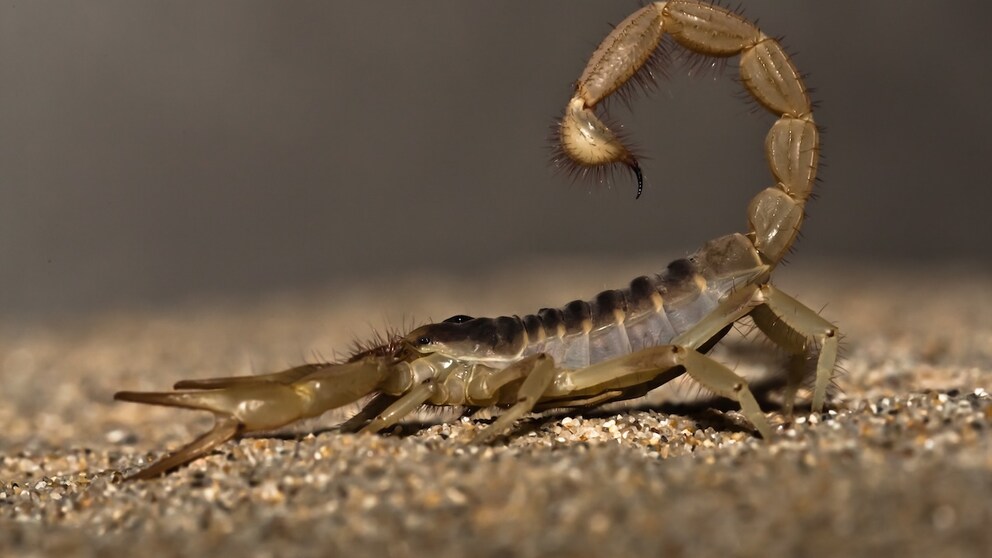
Scorpions appear to be perfectly equipped hunters: powerful pincers, a venomous stinger, and a hunting style that has worked for millions of years. But what exactly makes these “weapons” so effective? A new study shows it’s not just the shape but also the material. More specifically: embedded metals.
Small Creatures, Big Engineering
It has long been known that scorpions incorporate trace elements into their pincers and stingers, making the material harder and more resilient. However, only a few of the approximately 3,000 species had been closely examined until now.
A research team from the Smithsonian’s National Museum of Natural History and the Museum Conservation Institute has expanded on this: A total of 18 scorpion species were analyzed in detail, revealing surprisingly clear patterns.1
“Scorpions are incredible hunters, and although we knew that metals enhance the weapons in the arsenals of some species, we don’t know if all weapons contain metal and, if so, whether this metal enrichment is related to their hunting,” said Sam Campbell, a doctoral student at the National Museum of Natural History at the time of the research’s completion, in an article on the science website “Phys.Org.”
To find out, the team used high-precision microanalytical methods to make the metals in the animals’ weapons visible.
Hunting Strategy Determines Design
Not all scorpions hunt the same way. Some primarily use their powerful pincers to catch prey, while others rely more on their venomous stinger. These differences are also reflected in their body structure—and, as the study shows, even in the material of their weapons.
The researchers suspected that the distribution of metals varies according to hunting strategy. They were able to confirm this. This is likely why they chose the fitting title “Heavy Metal Predators” for their study, which appeared in April 2026 in the science journal “Journal of the Royal Society Interface.”
Zinc, Manganese, and Iron—Perfectly Placed
An especially intriguing finding: The metals are not randomly distributed but are precisely located where they are needed.
In the venomous stinger, for example, a clear structure was revealed:
- Zinc is concentrated at the tip—where the sting occurs
- Manganese is located directly beneath it
- A clearly recognizable boundary runs between the two areas
The pincers are also strategically “reinforced”: In the movable part, either pure zinc or a mixture of zinc and iron was found—exclusively along the cutting edge. Precisely where the greatest forces act when grasping and breaking down prey.
The microscopic examination methods used by the researchers allowed them to identify individual transition metals in extreme detail and showed how nature has cleverly constructed these metals in the scorpion’s weapons, co-author Edward Vicenzi is quoted as saying on “Phys.Org.”
Iron Surprises Researchers
However, one scientific assumption did not hold up under scrutiny: It was expected that particularly strong pincers would also contain a lot of iron. But the opposite was true.
Iron was mainly found in species with long, slender pincers—in other words, in scorpions that rely less on brute force and more on overpowering their prey with the venomous stinger.
“This suggests a role for iron that goes beyond hardness; perhaps it plays a greater role in durability,” Campbell explains. “After all, long claws must grip prey and prevent it from escaping before it is injected with venom.”
In other words, iron may contribute less to hardness and more to resilience—a benefit for more delicate tools that need to last longer.

Why This Frog Doesn’t Die From Its Own Poison

Why Some Snakes Thrive Without Venom
A Look into the Evolution of Weapons
The results impressively show how closely construction, material, and behavior are linked in scorpions. The distribution of metals is no accident but part of an evolutionary fine-tuning.
“Our work not only illustrates the material properties of scorpion weapons but also establishes a new approach to analyzing the role of metal enrichment across the tree of life,” says study leader Hannah Wood on “Phys.Org.”
Not Only Scorpions Rely on Metal
The findings could extend far beyond scorpions. Other arthropods—such as spiders, wasps, or ants—use similar strategies to enhance their tools.
With the new methods, it could be possible to more precisely investigate how materials and behavior are interconnected in the animal kingdom—and how nature continues to optimize its “tools.”