

March 19, 2026, 4:47 pm | Read time: 7 minutes
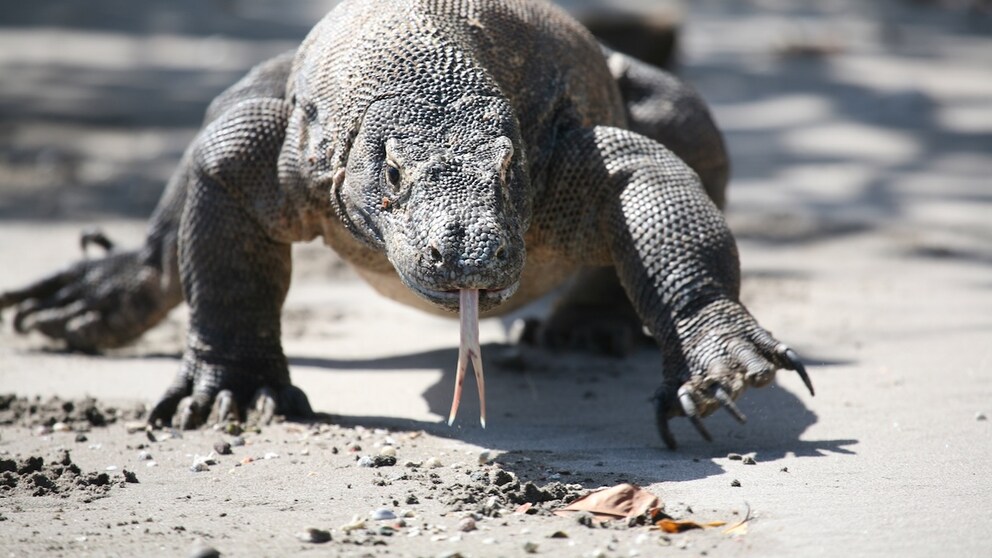
The Komodo dragon (Varanus komodoensis) is considered the most impressive reptile of our time. But the more researchers study it, the clearer it becomes: This animal is not just large and dangerous–it is a biological powerhouse full of unusual adaptations. Many of its traits–including its peculiar methods of killing prey–seem more like something from the world of extinct dinosaurs or mythical dragons than from that of a modern reptile.
Its Teeth Are Precise Tools–Not Just Sharp
At first glance, the teeth of the Komodo dragon appear to be classic tools of a predator: long, serrated, and menacing. But research shows they are much more than that. Studies from 2024 have proven that the cutting edges and tips of the teeth are reinforced with iron-rich material. This has a crucial effect: The teeth stay sharper longer and are more resistant to wear. 1
Such structures are primarily known from fossil predators–such as dinosaurs. That a living land animal today has a comparable “material reinforcement” is extraordinary.
There is also a second mechanism: a biological replacement system. Behind each functional tooth are several replacement teeth ready to grow in–about every 40 days. The Komodo dragon essentially carries an “inbuilt tooth conveyor belt.” Combined with the serrated edges, this creates a precise tool, ideal for particularly large pieces of meat. 2
Killing by Strategy–Why One Bite Is Often Enough
For a long time, it was believed that Komodo dragons killed their prey primarily through bacteria in their mouths. This explanation persisted for decades until modern research disproved it. An influential study by Fry and colleagues in 2009 showed that Komodo dragons actually have a functional venom system. In their lower jaw are venom glands, whose secretion specifically interferes with physiological processes.
The venom does not kill immediately but works strategically:
- It inhibits blood clotting
- promotes severe blood loss
- and can lower blood pressure
For the prey, this means: Even if it initially escapes, its condition continuously worsens, like being poisoned by a mythical dragon. This is one reason the dragon is called “Komodo dragon” in English. Due to its slow-acting venom, its prey loses strength, becomes slower, and eventually collapses. The dragon does not need to win by being faster or stronger. It is enough to bite successfully once and then calmly follow the prey. 3
Not a Power Biter–But a Specialist in Tearing
It is also surprising that the bite of the Komodo dragon, when it begins to feed, is not particularly strong. Analyses of skull mechanics show that its bite force is relatively moderate compared to other large predators. This initially contradicts the expectation that such a large animal would primarily rely on pressure.
But this is where the real specialization lies: The body of the Komodo dragon is designed to withstand enormous tensile forces. When feeding, it anchors its teeth in the flesh and then uses its head, neck, and body to tear pieces out. The skull is biomechanically built to withstand these stresses. It is more of a “tearer” than a “biter.” 4
A Reptile with Surprising Stamina and a Strong Stomach
Reptiles are often considered rather sluggish animals with limited performance capabilities. Here, too, the Komodo dragon is an exception. At up to three meters long and over 90 kilograms in weight, it is not only the largest living lizard but also quite fast, reaching speeds of up to 20 km/h when necessary. Genome studies show that many of its genes related to energy production, cellular respiration, and cardiovascular functions are altered.
These adaptations suggest that its body works more efficiently with oxygen and can provide energy more quickly. This fits with observations in nature: Komodo dragons are significantly more active and enduring than many other lizards and are physiologically surprisingly capable. 5
Komodo dragons also regularly eat carrion, exposing themselves to a variety of potentially dangerous germs–a high risk for infections. But here, too, another peculiarity is evident. Researchers have identified numerous antimicrobial peptides in the animals’ blood–molecules that specifically attack and neutralize bacteria. 6
This natural defense seems so effective that it has even sparked medical interest. Based on these substances, a synthetic peptide called DRGN-1 was developed, which in experiments accelerated the healing of infected wounds. The Komodo dragon is thus not only a successful hunter but also potentially an inspiration for new therapies. 7
Armored, Even Under the Skin
Beneath the rough, scaly skin lies another protective mechanism that has long been underestimated. CT analyses show that adult Komodo dragons–especially in the head area–are interspersed with so-called osteoderms: small bone plates in the skin. 8
This structure is surprisingly complex. Researchers have identified several different types of these bone plates. The result is a kind of biological armor that provides additional protection–for example, in fights with conspecifics or during hunting.
Young Ones Live in a Different World
Particularly fascinating is how much Komodo dragons change over their lifetime. When a female lays her eggs, a risky life begins for the offspring. Up to 20 eggs are buried and incubated for several months before the young hatch.
Radio-tracking studies show that these newly hatched animals lead a completely different life than adult dragons. They immediately flee to trees after hatching–not out of preference, but necessity. On the ground, they would be easy prey, especially for larger conspecifics. Cannibalism is common among Komodo dragons.
In the first years of life, the young therefore remain mostly in the branches. There, they feed on insects, small reptiles, and other easily accessible prey. Their movement patterns also differ significantly: They are more active, lighter, and much more cautious.
Only when they reach a body weight of about 18 to 20 kilograms does a fundamental change occur. As they grow larger, they become less vulnerable to their conspecifics–and simultaneously potential hunters themselves. This transition is so comprehensive that it almost seems like a “species change.” From a hidden, tree-dwelling small predator, they become a dominant apex predator. Within a single species, two completely different lifestyles emerge–a phenomenon rarely observed with such clarity. 9
Reproduction Under Extreme Conditions
The reproduction of the Komodo dragon is also characterized by adaptation to extreme conditions. Females often do not lay their eggs in nests they build themselves but use existing mound nests of other species–particularly those of megapodes. Studies show that a large portion of the nests are precisely such structures that offer stable temperatures.
Long-term studies also highlight how fragile the population can be: The number of reproducing females fluctuates, as does the annual offspring rate. A special role is played by the ability to parthenogenesis, the ability to reproduce without males.
This is especially advantageous for Komodo dragons on isolated islands–even though only male animals are produced. This is due to the unusual sex chromosome system of Komodo dragons: Females have the combination ZW, males ZZ. During egg cell formation, either Z or W egg cells are produced. Without fertilization, however, there is no combination, and the existing chromosome is simply doubled. A Z egg cell thus becomes ZZ–a male animal. A W egg cell would lead to WW, but this combination is not viable.
Why Some Snakes Thrive Without Venom
These Animals Eat Their Own Kind—for Good Reason
Islands Full of Differences
Komodo dragons live on only a few Indonesian islands–primarily Komodo, Rinca, and Flores–and this geographical isolation has far-reaching consequences. Especially in Komodo National Park on the islands of Komodo and Rinca, tourists can observe the animals, but only in the company of rangers.
Early genetic studies already showed that populations on different islands differ from each other. Newer genomic analyses confirm that these groups have their own evolutionary histories. This is crucial for species conservation: There is not “one” Komodo dragon, but several genetically distinct populations that each need to be preserved.
Even though there are many reports of sightings of Komodo dragons on Bali, the animals are not native there. Tourists would mainly encounter the water monitor (Varanus salvator) there.
Conclusion: A Modern “Dragon”
The Komodo dragon seems like a creature from prehistoric times–but in fact, it is a highly specialized hunter of our present. Its teeth, venom, and strategy show how precisely evolution can work. At the same time, it is an animal with clear boundaries: It lives on only a few islands and is therefore particularly worthy of protection. Those who encounter it see more than just a large lizard–but one of the most extraordinary predators of our time.