

February 11, 2026, 5:12 am | Read time: 6 minutes
They hunt at high speeds, live partly in cities–and technically, they are not birds of prey. Various species of falcons are native to Germany, from the common kestrel to the lesser-known red-footed falcon. But how can you identify them, and what biologically distinguishes them from true birds of prey? PETBOOK spoke with Ferdinand Baer, a falconer and the scientific director of the LBV Bird Station in Regenstauf at the Bavarian Society for the Protection of Birds (LBV), about the unique characteristics of these fascinating animals.
Falcon Species Found in Germany
Three species of falcons are regularly found as breeding birds in Germany. Additionally, two other species can be observed, but only as migratory or winter guests.
Kestrel (Falco tinnunculus): Germany’s Most Common Falcon
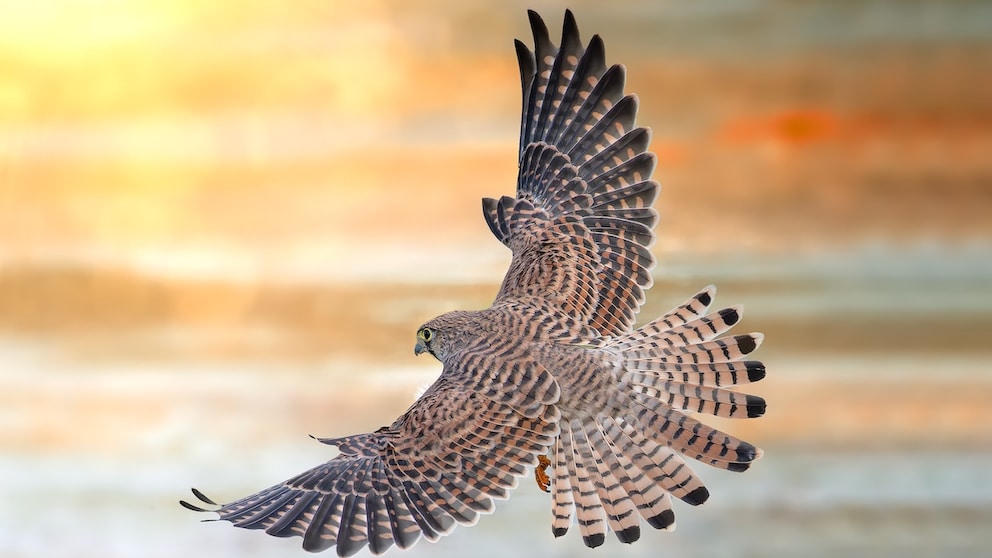
The kestrel is the most widespread member of its family and has adapted excellently to life near humans. It inhabits both urban and rural areas. Its so-called “hovering flight,” where it appears motionless in the air while searching for prey, is particularly striking.
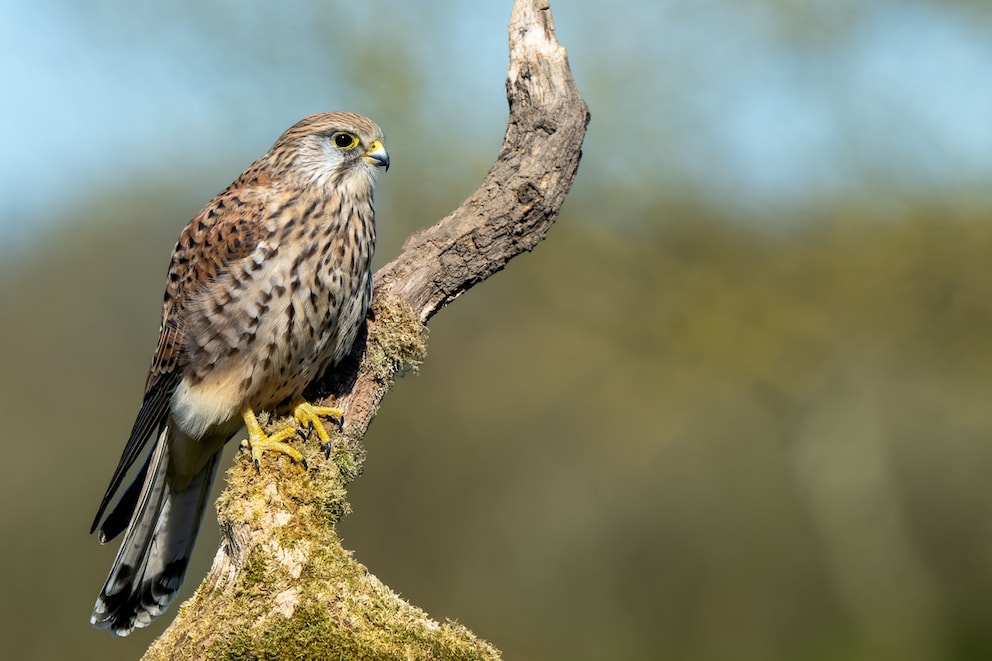
“The kestrel is the most common falcon in Germany, being an absolute cultural follower and mouse hunter,” explains LBV expert Ferdinand Baer. Typical features include its rust-colored plumage, fine streaking on the chest, and cross-banding in females and juveniles. Males can be identified by heart-shaped spots on their backs.
Hobby (Falco subbuteo): Unobtrusive Summer Guest
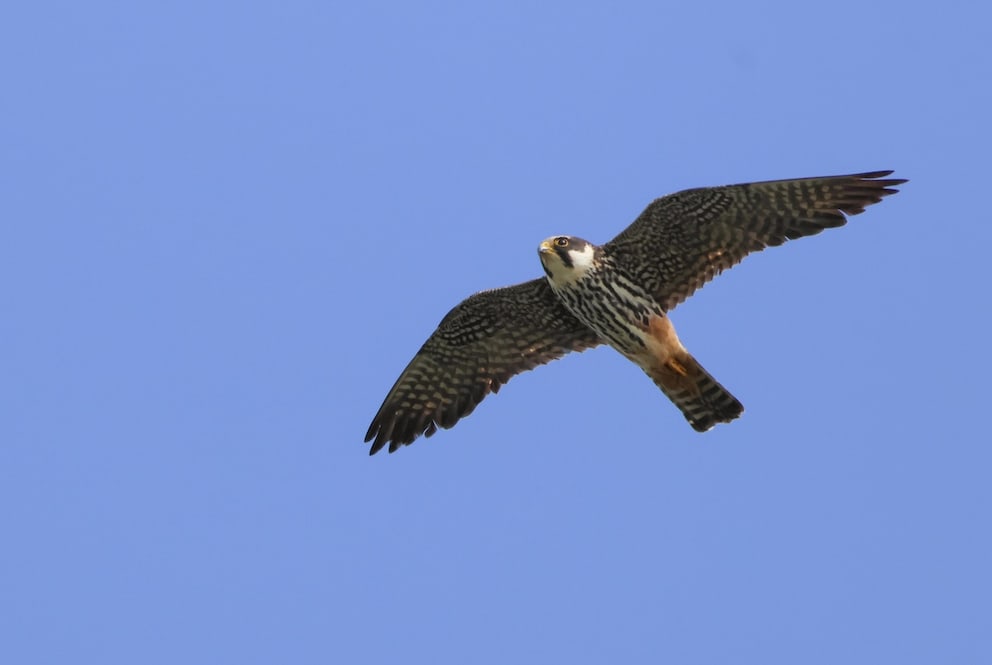
The hobby is much less common. According to the LBV, around 6,000 breeding pairs nest in Germany. It is only seen here from April to September, as it migrates long distances to overwinter.
The hobby primarily hunts insects and smaller birds in flight. Its appearance is reminiscent of the peregrine falcon: a dark head, prominent mustache stripes, and a dark gray back. Due to declining populations, it is on Germany’s warning list (Red List Category 3).
Peregrine Falcon (Falco peregrinus): Record Holder of the Skies
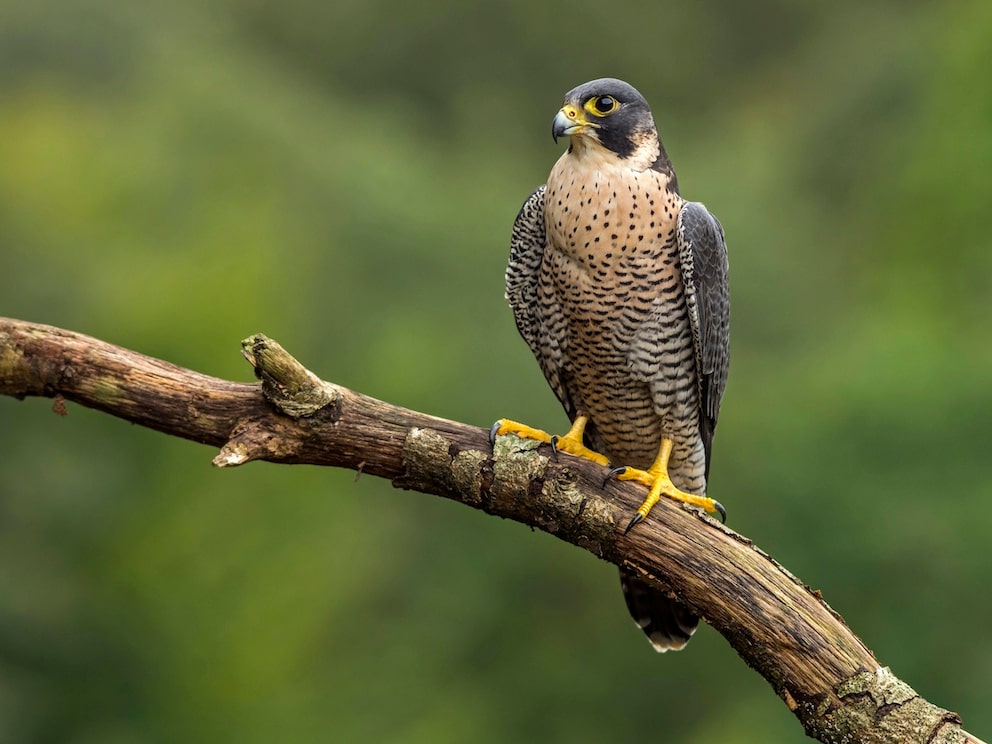
The peregrine falcon is present in Germany year-round. With around 1,500 breeding pairs, it is much less common than the kestrel. “The peregrine falcon has recovered well after its population collapse in the 1960s due to the pesticide DDT,” says Baer. Today, it no longer only nests on cliffs but also on urban structures such as church towers or skyscrapers.
Merlin (Falco columbarius) and Red-footed Falcon (Falco vespertinus)–Just Passing Through
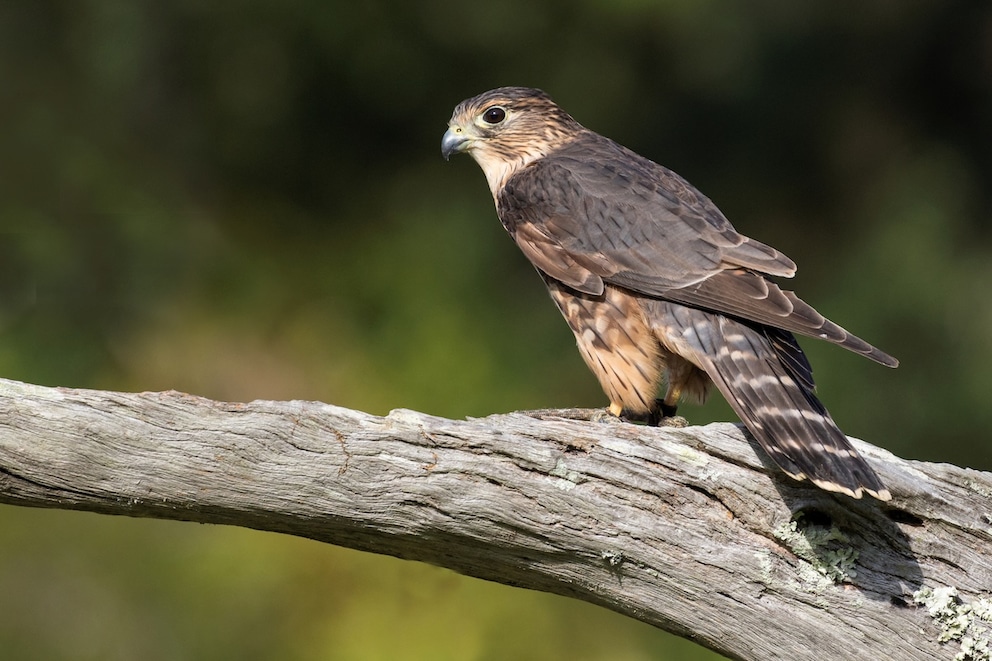
In addition to the typical breeding birds, two other falcon species appear in Germany as guests:
- Merlin: a winter guest from Scandinavia, observed in various regions of Germany between October and April.
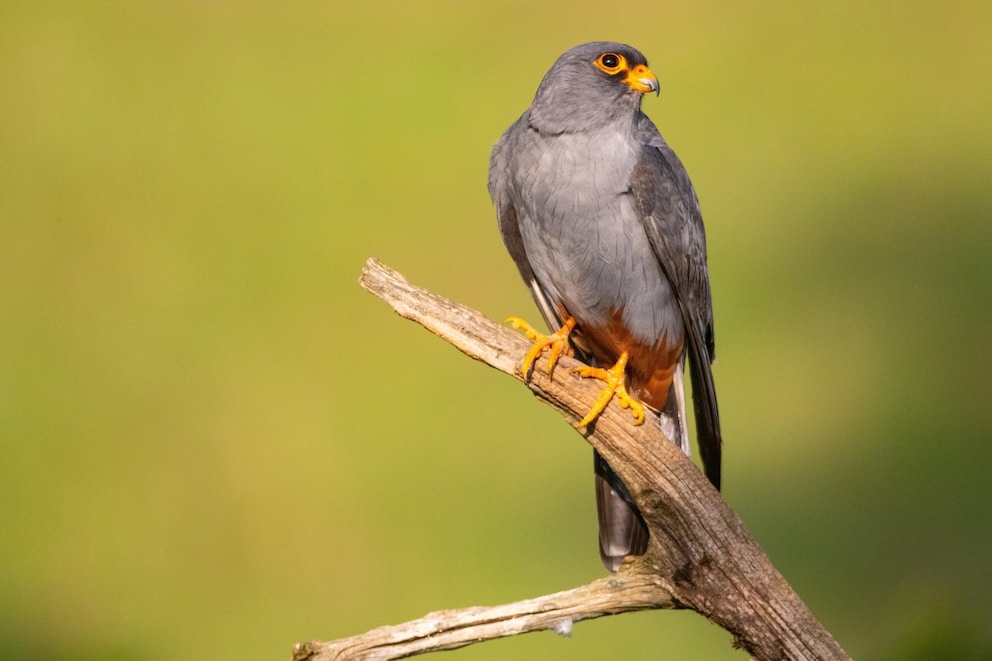
- Red-footed Falcon: mainly seen during spring and autumn migration, occasionally in larger groups. It is considered endangered in Europe and is rarely sighted here.
How to Identify Falcons in the Field
Falcons can be distinguished from other birds by several features, both when perched and in flight.
Kestrels and hobbies are about the size of a pigeon and weigh around 200 grams. The peregrine falcon, however, is significantly larger: males weigh about 600 grams, while females in Central Europe can weigh up to 800 grams.
Distinctive features include the head and back: peregrine and hobby falcons have dark heads with characteristic mustache stripes. The back is black-gray. The peregrine falcon also shows cross-banding on the chest as it ages—known as “sparrow-hawking.”
In flight, falcons are recognized by their long, pointed wings. This makes them appear slimmer and more aerodynamic than broader-built birds of prey like buzzards or hawks.
Why Falcons Are Not Birds of Prey
Although falcons are almost always classified as birds of prey in everyday life, this classification is not scientifically accurate.
“Molecular genetic studies have shown that falcons are not closely related to the Accipitriformes, such as eagles, buzzards, etc.,” explains Baer. “Instead, they are evolutionarily closer to parrots and songbirds.”
Despite these genetic findings, falcons are often still categorized under “birds of prey” for practical reasons. Biologically, however, there are significant differences: falcons kill their prey with a precise bite, not with their talons. Another typical distinguishing feature is a round nostril with a cone-shaped projection.
Also remarkable is their vision: falcons can see particularly well at dusk and can even perceive UV light.
Risk of Confusion with Hawks and Sparrowhawks
Although they differ in appearance and flight style, the peregrine falcon is often confused with hawks or sparrowhawks. “Falcons always have dark eyes, while hawks and sparrowhawks always have yellow–rarely red–eyes,” emphasizes Baer. They also differ in flight style: falcons have pointed wings, while birds of prey have broad, fingered wings.
Another identifying feature is the so-called “grip nodules” on their toes. Falcons use them to hold their prey before killing it with a bite—a behavior that differs significantly from the prey capture with the talons of true birds of prey.

“Misused Weapons” or “Fair Hunt”? Here’s What an Expert Says

Up to 200 Miles Per Hour! The Fastest Animals in the World
Hunting Behavior and Reproduction
Falcons are highly specialized hunters, usually hunting in open airspace. Their hunting flights are considered spectacular, especially the peregrine falcon’s dive, which reaches extreme speeds.
Kestrels also hunt with the hovering flight over meadows. A special ability helps them: they can see UV light and thus detect mouse urine, which is reflected in the grass.
Unlike many birds of prey, falcons do not build their own nests. “They lay their eggs either directly on the ground or use old nests,” explains Baer. Hobbies often use old crow nests. Kestrels nest in wall niches or church towers.
Conclusion: Precise Hunters with Unique Ancestry
From the widespread kestrel to the rare red-footed falcon passing through, several species of falcons are present in Germany. Due to their special hunting techniques, distinctive appearance, and adaptability, they are among the most impressive birds that can be observed here.