


August 19, 2026, 9:28 am | Read time: 6 minutes
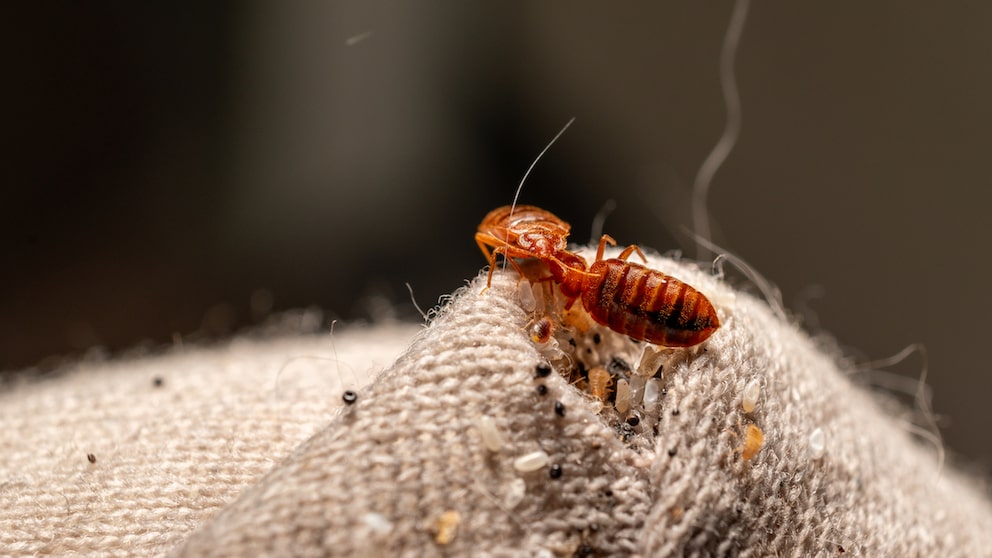
Bedbugs are considered persistent pests that spread in homes and are difficult to eradicate. But ironically, they seem to fear something quite ordinary. New research now reveals for the first time what seriously affects these insects. The discovery could even have implications for pest control, as PETBOOK editor and biologist Saskia Schneider explains.
Bedbugs Fear Something Everyone Has at Home
Bedbugs give many people the creeps—and rightly so. Not only do these insects crawl under the covers at night to suck blood, but they are also hard to get rid of. If you discover an infestation, you need to call an exterminator to professionally combat the pests with strong poison.
Now a new study shows: There might be an easier way. They have found something that bedbugs seem to fear, and everyone has it at home: water!1
Study Documents Bedbugs’ Aversion to Water for the First Time
Yes, you read that right. Bedbugs don’t seem to like getting wet feet, as researchers from the University of California, Riverside (UCR), found. They describe for the first time a clear aversion of bedbugs to water and moist surfaces. The results were published in the journal “Journal of Ethology.”
Entomologist Dong-Hwan Choe, a professor at UCR and co-author of the study, sees an obvious anatomical explanation for this: Bedbugs have extremely flat bodies and small breathing openings—called spiracles—on the sides of their abdomens.
Water “Sticks” to Bedbugs
“When they come into physical contact with water, they get stuck on its surface, blocking their breathing openings,” Choe is quoted in the science magazine “Phys.Org.”
Sticking to water? Yes, that’s possible—at least if you’re as tiny as a bedbug. Because then the surface tension of water has a completely different physical effect than on larger bodies.
Adhesion Likely Causes Avoidance Behavior
This is due to the so-called surface tension, which arises from the special charge of water molecules. You might know the phenomenon: A full glass of water can be filled beyond the rim. The molecules “stick” to each other and hold together—until the force (in this case, gravity) becomes too great and the glass overflows.
This “sticking together” of molecules is called cohesion in physics. But it doesn’t just work among the molecules; it also occurs between water molecules and surfaces of all kinds, which physicists then refer to as adhesion. And this could be why bedbugs fear water. When a drop touches the bug’s body, it “sticks” to it. But why is this a problem?
Bugs Could Drown in Tiny Drops
Unlike us, insects don’t breathe through a mouth and lungs but by actively pumping air into their bodies with their abdomens. This air enters the insect’s tracheal system through spiracles. These breathing openings are located on the sides of the abdomen—very close to the ground.
So if there’s water on the ground and it touches the bug’s abdomen, the droplets can cover these breathing openings. The bedbugs would then have no chance to remove them and risk suffocating—at least that’s the researchers’ theory.
Also interesting: Are Stink Bugs a Danger to Pets?
Accidental Observation in the Lab
The insight came rather accidentally in Choe’s lab. Bedbug colonies are usually kept in containers there. For feeding, researchers attach an artificial feeder to the top of the containers. The bugs crawl up and pierce their mouthparts through a membrane to take in blood.
One day, however, this membrane was slightly damaged, causing blood to leak and soak the paper in the container, which served as a substrate for the bugs. “I thought the bedbugs would like to drink the blood from the paper,” Choe reports in “Phys.Org.” “But what I saw was quite different. They actively avoided the part of the paper that became wet with blood. They didn’t even want to go near the moist areas.”
Experiments with Water Confirm Aversion
To verify the observation, the researchers additionally moistened the paper with water. The insects consistently avoided these wet areas as well. This prompted further experiments.
Postdoctoral researcher Jorge Bustamante from Choe’s team then developed an experimental design using a special infrared camera with a magnifying lens. Because, as Choe explains in “Phys.Org,” observing bedbugs is not that easy. Especially the young stages are tiny—just about two millimeters in size.
Using video analysis software, Bustamante was able to evaluate color differences between insects and the background to accurately capture movement patterns. He examined the speed and distance with which the bugs moved away from wet surfaces. He also analyzed differences in terms of gender and age.
Young Bedbugs React Particularly Sensitively
The result: All bedbugs—male and female, older and younger—avoided wet surfaces. It was also noticeable that the bugs moved away from water faster than they approached it.
Particularly young, smaller bedbugs showed a pronounced reaction. They quickly made an abrupt U-turn as soon as they approached a wet spot. This suggests that younger bugs are more sensitive to moisture than older ones. Given that they are significantly smaller, this makes sense, as the surface tension of water would have an even greater effect on them than on larger, adult bugs.
Danger to Humans and Animals! This Ant Species Becomes a Nightmare Indoors

Can Earthworms Cough?
Implications for Pest Control
But does this mean you can simply get rid of bedbugs by spraying bed frames and walls with water? To answer this question, more research is needed. However, Choe and his colleagues are already certain that the results of their work will have practical implications.
Companies developing or testing water-based insecticide sprays should consider this behavior, according to the researchers. Since bedbugs actively avoid wet areas, they could leave treated areas and temporarily retreat to other parts of an infested property—with consequences, as Choe warns: “If the insecticides don’t kill the bedbugs immediately, they leave the treated areas and spread elsewhere.”
A Simple Tip if You Suspect Bedbugs
For those who fear bedbugs might be on their clothes or body, Choe has a tip: “Take a bath. That will solve the problem,” he said. “Of course, bedbugs in the room or on the bed will require other approaches.” But at least it’s not necessary to treat clothing or skin and hair with pesticides, as is done with head lice—water is entirely sufficient here.