

April 8, 2026, 2:50 pm | Read time: 5 minutes
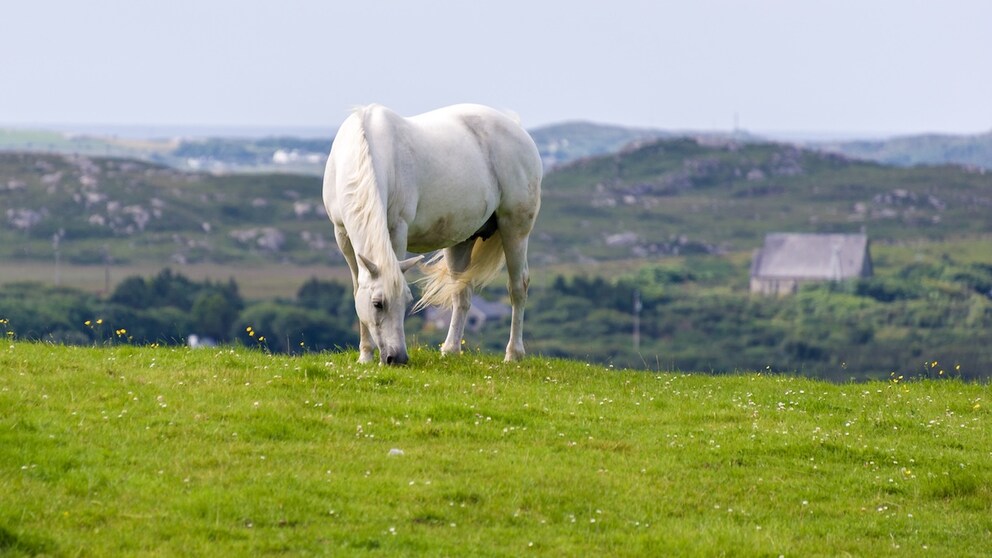
Are you familiar with Connemara ponies? Among horse enthusiasts, they are one of the most popular pony breeds worldwide. Their home is in the rugged west of Ireland, in the Connaught region—a landscape shaped by wind, moors, and barren soils that continue to influence the breed today. PETBOOK provides an overview of their origin, character, and care.
Origin
Their exact origin is not fully clarified. Various myths surround the ponies’ origins. It is often said that Vikings brought horses to Ireland—though this is not documented. What is certain, however, is that Irish breeders have deliberately crossbred other breeds over centuries. A well-known episode comes from the 16th century: After the Spanish Armada sank, Andalusian horses reached the Irish coast. Later, Arabians and English Thoroughbreds followed, among others.
Originally, the Connemara pony was a working animal for the rural population. Standing about 140 to nearly 150 centimeters tall, it pulled carts, helped with road construction, and had to endure difficult conditions. Systematic breeding began in the early 20th century: The Connemara Pony Breeders Society was founded in 1923, and the first studbook appeared in 1926.
Appearance
Large, robust, and surprisingly elegant: The Connemara pony is one of the largest pony breeds in the world. Many animals reach the upper limit of the pony height of 148 centimeters, and some even grow beyond that. Nevertheless, they do not appear bulky but rather compact and sporty—a true all-around pony with charisma.
Particularly striking is the noble head with large, dark eyes that give the Connemara its alert and friendly expression. The slightly curved nasal line, broad forehead, and small ears complete the typical appearance. Added to this are a sloping shoulder, a strong back, and hard, resilient hooves—ideal features for life in Ireland’s harsh climate.
The breed also shows versatility in coat colors: Grays are most common, but bays, blacks, duns, or chestnuts are not uncommon.
Character & Temperament
Anyone who has spent time with a Connemara pony quickly realizes: This breed stands out primarily for its personality. Connemaras are considered friendly, curious, and people-oriented. They seek human companionship and often build a close, trusting relationship with their caregivers.
At the same time, they have a clever mind. The ponies are eager to learn, attentive, and surprisingly adaptable. They usually understand new tasks quickly—and they visibly enjoy participating. This combination of intelligence and motivation makes them true all-rounders.
They are also highly valued for their calmness: Even in unfamiliar or hectic situations, many Connemaras remain composed. This makes them reliable partners in everyday life—and ideal teaching ponies for children and beginners.
Gait & Discipline
Whether in the arena, on the course, or in the field: The Connemara pony proves to be a true multi-talent. In movement, the breed impresses with a clear rhythm and good reach. The trot is lively without being exaggerated, and the ponies also show good ability in the canter. Overall, the movements appear harmonious and efficient—ideal conditions for a variety of disciplines.
They particularly excel in trail riding: Surefootedness, endurance, and calmness make them reliable partners. Many Connemaras show great enthusiasm for groundwork, liberty work, or working equitation—as long as they can think and be active.
Proper Care & Maintenance
The Connemara pony is uncomplicated and adaptable. The key factors are sufficient exercise and social contact with other horses. A setting with plenty of space, such as an open stable with daily pasture access, is particularly suitable.
In terms of care, the breed is generally low-maintenance. The hooves are robust but should still be regularly checked and maintained, as with all other horses. The mane and tail should also be regularly detangled and cleaned of dirt to keep the hair healthy and prevent matting.

Drum Horse: These Horses Can Carry Up to 330 Pounds

How the Trakehner Evolved from Military Horse to Dressage Star
Nutrition
The Connemara pony is considered frugal—but still requires a balanced diet. The foundation should always be high-quality roughage such as hay. Depending on the level of work, the feed ration can be supplemented with concentrated feed, though usually in rather small amounts.
Since Connemaras are good feed converters, they quickly tend to become overweight with too rich a diet. Therefore, an adjusted feeding plan and sufficient exercise are particularly important. Fresh water and minerals should always be available.
Susceptibility to Certain Diseases
The Connemara pony is considered a robust breed. However, a known hereditary disease is Hoof Wall Separation Disease (HWSD), where the hoof wall can detach. Only animals that inherit the gene from both parents are affected—carriers usually show no symptoms.
When purchasing, it is worth examining the hooves and, if in doubt, conducting a genetic test. Generally, healthy, resilient hooves are the norm for Connemaras.
The Connemara Pony at a Glance
- Character: friendly, curious, and eager to learn
- Height: 138 to 153 centimeters
- Coat color: all, mostly gray
- Gait: spacious and lively
- Discipline: Dressage, jumping, working equitation
- Special features: Susceptibility to HWSD