

February 4, 2026, 3:54 pm | Read time: 4 minutes
Majestic, powerful, and remarkably calm: The Drum Horse immediately draws all eyes. Once it carried kettledrums through the clamor of military parades, today it fascinates riders and spectators alike. PETBOOK explains what makes this breed so special.
Origin
The Drum Horse is a relatively unknown breed, although the history of these horses is rooted in the English royal household. Centuries ago, they were used in the royal guard, carrying a fully equipped rider and two heavy kettledrums. This is where the name Drum Horse (German: Trommel- or Paukenpferd) comes from.
This task required extraordinary strength, absolute nerve strength, and great composure. Initially, the horses were bred from Shire Horses, later supplemented by Clydesdales and Irish Cobs (Tinker), which contributed endurance and a calm temperament.
An important impetus for modern breed development was the stallion Galway Warrior, originally owned by Queen Elizabeth II. He came to the U.S. through his second owner, Jeff Bartko, in the 1990s and was introduced as the first “Drum Horse” at the Breyer Fest in 2003.
In 2012, the International Drum Horse Association (IDHA) was founded for the Drum Horse and established a binding breeding standard. This defines a combination of Shire Horse, Clydesdale, and Irish Cob, with no breed making up more than 75 percent and the Tinker portion being at least 12.5 percent. The main breeding areas today are in Great Britain, North America, and Europe. Additionally, there is a minimum height requirement of 163 centimeters to qualify as a breeding horse.
Appearance
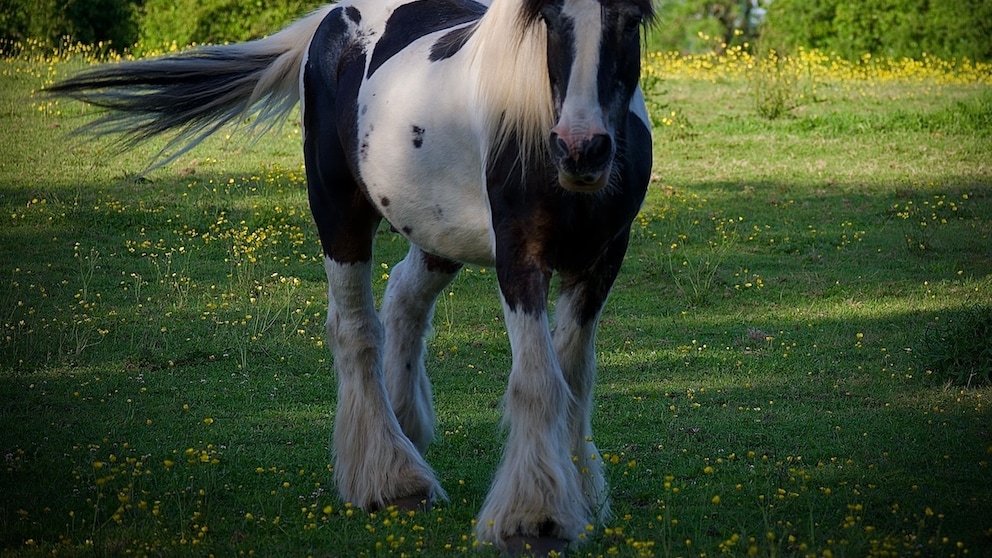
The Drum Horse is a large-framed, heavy horse with an impressive yet elegant appearance. The height ranges from 154 to 180 centimeters, with smaller animals being rather atypical. Despite its massive build, the Drum Horse does not appear clumsy but rather athletic and well-proportioned.
Characteristic features include a broad chest, strong bones, stable joints, and a pronounced mane, tail, and feathering. The breed is versatile in color: all base colors and patterns are allowed.
Character & Temperament
Strength like a draft horse, nerves of steel: The Drum Horse impresses not only with its imposing appearance but especially with its composure–even in challenging situations. The breed is considered extremely strong-nerved and approaches unfamiliar or stressful moments with calmness and poise.
At the same time, the Drum Horse is a friendly, people-oriented, and eager-to-learn partner that builds a close bond with its handlers and is considered reliable and trustworthy.
Gait & Discipline
Despite its heavy build, the Drum Horse has expansive, rhythmically secure, and surprisingly elastic basic gaits. Particularly, the walk is calm and powerful, the trot is lively and balanced, while the canter has a rocking horse character.
Originally bred for use as a kettledrum and cavalry horse, it is now versatile: suitable for leisure riding and dressage work from basic to intermediate levels, as well as for driving.
Proper Care & Maintenance
Due to their size and body weight, Drum Horses require ample space in the stable and paddock. Spacious stalls, regular pasture time, and a secure footing are fundamental requirements for appropriate care.
Special attention is needed for the abundant feathering, especially on the legs. Regular grooming and inspection are important to prevent skin irritations. Despite their calm temperament, Drum Horses are active and benefit from varied work–whether under saddle or in harness.

How long do horses live?
Shire Horse–The Largest Horse Breed in the World
Nutrition
The Drum Horse is considered robust and relatively undemanding, yet feeding should be carefully adjusted to size, weight, and workload. A diet rich in roughage with high-quality hay forms the basis.
Concentrated feed is only necessary with corresponding exertion, as the breed can otherwise tend to become overweight. A balanced supply of minerals and trace elements primarily supports the health of bones, joints, and hooves.
Susceptibility to Certain Diseases
Breed-specific hereditary diseases are not known in the Drum Horse. Overall, the breed is considered resilient and long-lived. As with all heavy horses, attention should be paid to the load-bearing capacity of the joints as well as hoof and skin health. With appropriate care, regular grooming, and a balanced diet, the Drum Horse generally remains healthy and capable for a long time.
The Drum Horse at a Glance
- Character: strong-nerved, calm, friendly
- Height: 153–180 centimeters
- Coat Color: all
- Gait: lively, rhythmically secure
- Discipline: riding and driving horse
- Special Features: size and heaviness