

August 27, 2025, 9:13 am | Read time: 6 minutes
2.19 meters—that’s how tall the largest horse in the world was. Sampson, a Shire horse gelding from England, holds this title to this day. Few other breeds possess such impressive power while simultaneously being so gentle. Their history is a series of ups and downs, yet these horses have found their way into the hearts of many horse owners. Since the Middle Ages, these magnificent creatures have captivated the world—PETBOOK provides an overview of this fascinating breed.
Origin
The history of the Shire horse goes back almost 1,000 years. We travel to the middle of the 11th century in England. In 1066, the so-called “great horse” was mentioned for the first time. This term was primarily used to highlight the impressive size of the already powerful horse. However, one should not imagine the horses of today, which can reach up to two meters. In the Middle Ages, horses were much smaller. At that time, contemporaries were very proud that some of their “great horses” had a withers height of 150 cm, although this was more common in the late Middle Ages.
Primarily, Shire horses were used as knight horses. As knighthood slowly gave way to modern technology, they increasingly served as draft and work horses in agriculture and forestry.
Their name is deeply connected to British history. They were mainly bred in the English counties of Leicestershire, Staffordshire, and Derbyshire. These counties are translated as “Shires,” hence the name Shire horse. However, as England was in a depression and had a correspondingly poor economic situation, many of the counties were sold to Scotland—along with the breeding stock. This led to a decline in the Shire horse population. However, these acquisitions led to the development of other breeding lines. Thus, Shire horses are an integral part and foundation when discussing the history of the Clydesdale breed.
In 1878, the “English Cart Horse Society,” now known as the “Shire Horse Society,” was founded, which resumed the breeding of the beloved English breed. The heavy draft horses were still popular in agriculture at this time—to such an extent that they were even exported to the United States, Canada, Australia, South America, Germany, and Russia.
With the further progress of industrialization, the number of horses as working animals decreased significantly. The Second World War also reduced the overall number of these giants. In 1958, the studbook recorded only five stallions and eleven mares. However, breeding continued to preserve this special breed. The Shire Horse Society was extremely committed to its preservation. Now, Shire horses are found worldwide as show and leisure horses.
Appearance
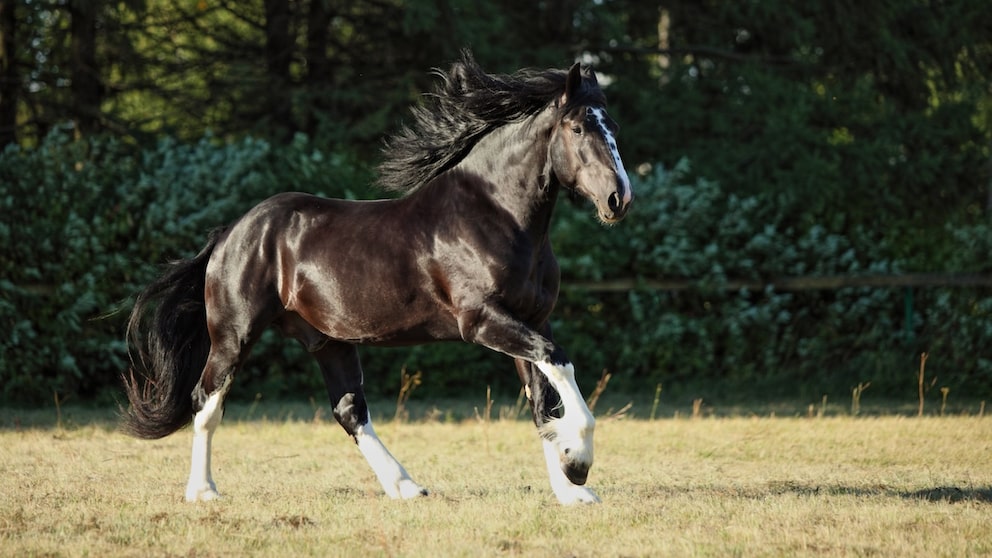
First, the most important feature of the Shire horse: It is the largest horse in the world, with a height of up to 2 meters. They usually weigh between 900 and 2,000 kilograms.
Shire horses belong to the draft horse category—a strong forehand and hindquarters are therefore standard. Strong shoulder areas and a large, broad back are also characteristic of the breed. The head is relatively slim and elegant and is often covered with a bushy forelock. The mane is also lush, hanging down the long, strong neck.
Another special feature is the beautiful feathering on the horse’s fetlocks. The coat colors vary—typical are black, bay, and gray. They are often adorned with markings on the head and legs.
Character & Temperament
If you ask Shire horse enthusiasts how they would describe these magnificent animals, a quick answer would be: “Gentle giants.” And there’s a lot of truth to that. Despite their size, or perhaps because of it, they are very gentle in their interactions. On one hand, they appear balanced, calm, patient, and impressive with their strong nerves. On the other hand, they are not lethargic—they move forward alertly, characterized by their intelligence and eager-to-learn nature.
In summary, the Shire horse is a versatile partner. This raises the question of whether it is suitable for beginners: It’s not easy to say definitively, but there are tendencies. In terms of character, there is no obstacle. However, each person must assess whether the horse’s impressive size is intimidating or causes fear.
Gait & Discipline
Like its counterparts, this draft horse masters all three basic gaits. It moves confidently and energetically in all gaits, though perhaps a bit heavily. Due to the large hooves and weight, it’s no surprise that the ground sometimes vibrates when a Shire horse gallops.
In principle, you can do anything with the Shire horse that is enjoyable. It’s important to plan individual gradations in training. As driving and leisure horses, the large horses are excellently suited. Many Shire horse owners describe extensive rides through nature as one of the many highlights in everyday life with the gentle giants.
Shire horses are often seen at shows—decorated and groomed, they then run in teams and represent the old traditions of England. They are also open to groundwork or liberty dressage, making them true all-rounders.
Proper Care & Maintenance
Here, sensitivity is required. An open stable is recommended. It’s important to regularly check the ground for moisture, as a wet surface risks mud fever. The facility should be adapted to the needs of the animals according to their size. Plenty of exercise is particularly important to the horses. They enjoy being in good company—size is not of utmost importance, but companions should not be too small.
Of course, the same applies to large horses: Thorough grooming before each training session is paramount. The feathering should be routinely cared for—as should the thick and dense mane: The easiest way is with care products for the forelock, mane, and tail.
Nutrition
Shire horses are considered easy keepers but tend to gain weight quickly. Adequate roughage of high quality is a good foundation. The coordination of concentrated feed and minerals must be agreed upon with a veterinarian in any case.
How long do horses live?

Drum Horse: These Horses Can Carry Up to 330 Pounds
Susceptibility to Certain Diseases
Actually, these impressive horses are quite robust animals. Due to their dense and long feathering on the fetlocks, they carry a higher risk for mud fever. Unfortunately, Shire horses are also prone to chronic progressive lymphedema (CPL) due to breeding. There have been frequent incidents of chronic progressive lymphedema (CPL) in the past. This often results in the legs thickening with edema-like swelling. If symptoms appear, a veterinarian should definitely be consulted.
The Shire Horse at a Glance
- Character: strong nerves, patient, gentle, intelligent
- Height: approx. 170–200 cm
- Type: draft horse
- Coat color: black, bay with markings, exception: gray
- Gait: energetic, sure-footed, heavy
- Discipline: leisure, driving, and show horse
- Special features: largest horse breed in the world