

August 4, 2025, 4:46 am | Read time: 5 minutes
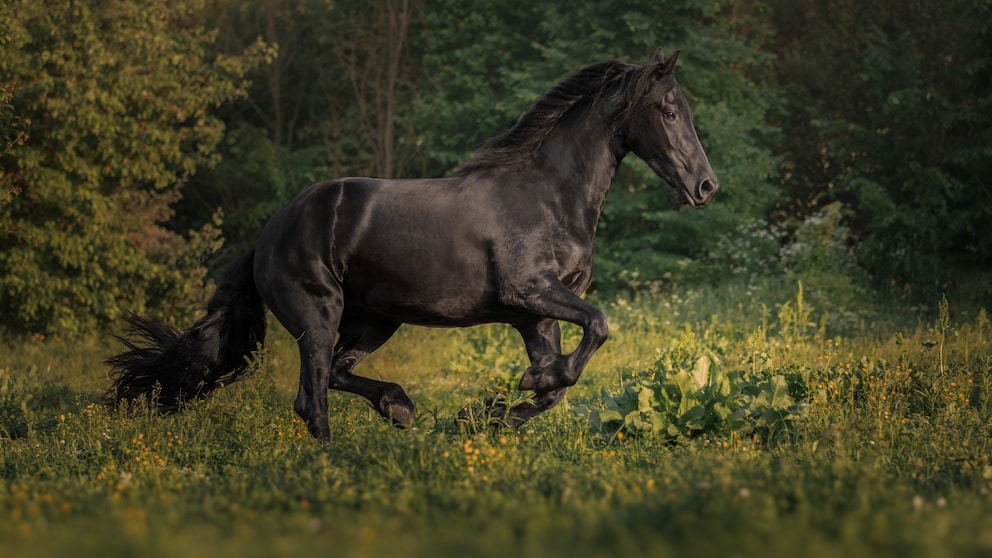
Black elegance on four hooves—the Friesian captivates with its majestic appearance, gentle nature, and a gait that seems to float. No wonder this warmblood breed is popular not only in film and show but also in dressage. Yet behind the beauty lies more: a rich history, a strong character—and special requirements for care and maintenance.
Origin of the Friesian
The Friesian originates from the Dutch province of Friesland and is considered one of the oldest horse breeds in Europe. Horses of the “Friesian type” existed there as early as Roman times. Over the centuries, the Friesian evolved from a robust cold-blood to an elegant warmblood—primarily through the targeted crossbreeding of Iberian horses, especially the Andalusian, in the 16th and 17th centuries. This gave it, among other things, the typical arched neck and distinctive knee action.
In the 18th and 19th centuries, the breed lost significance, so that by 1913, only three breeding stallions remained. Intensive breeding efforts to save the Friesian led to the establishment of the official studbook in 1879. Today, the Friesian is kept in strict pure breeding, with particular attention to health and breed type. Worldwide, over 60,000 Friesians now live in more than 50 countries—a success largely thanks to dedicated breeders.
Appearance & Coat
The Friesian is a large-framed, rectangular-built warmblood with a height of 155 to 175 cm and a weight between 520 and 770 kilograms. Stallions must reach certain minimum sizes for breeding approval: 158 cm from the third year and 160 cm from the fourth year. Mares are usually somewhat smaller.
Typical of the Friesian are the strong, arched neck, a rather small, noble head with expressive dark eyes, and the distinctive silhouette with a broad chest, muscular back, and sloping croup. Particularly striking are the long, flowing mane, the lush tail, and the dense feathering.
Breeding allows only black horses—deep black without white markings. Exceptions are made only for mares with a small forehead star. Interestingly, foals are often born brown and only fully darken over time. There are distinctions between glossy black, winter black, and matte black Friesians.
Character & Temperament
Friesians are described as friendly, people-oriented, intelligent, and reliable. They possess pronounced nerve strength and are considered patient in handling. Their gentle nature makes them popular with leisure riders, while their intelligence and sensitivity also make them valued partners in dressage.
Despite their good-naturedness, some Friesians have an independent temperament and can react stubbornly if led carelessly. A calm, consistent hand and sensitive training, however, encourage their willingness to cooperate. The high learning ability of this breed is another reason why they are often used in film productions.
Training a Friesian
Training a Friesian requires patience, consistency, and keen observation. Due to their intelligence, Friesians quickly understand new tasks—but sometimes exploit gaps in leadership. Early and consistent training, combined with positive reinforcement, is therefore essential.
Their sensitivity demands calm training, while their nerve strength makes them composed partners. Despite their good nature, inexperienced riders may encounter problems, particularly due to their complex movement patterns. A solid basic education for the rider is therefore recommended.
Proper Care & Maintenance
Friesians are active and social—thus, open stable housing in a herd is particularly suitable. It is important to have enough space for daily movement, as their urge to move is high. Box housing with regular pasture access is also possible, provided social contacts are maintained.
Especially intensive care is required for the long mane, tail, and feathering. These must be regularly brushed and trimmed as needed to prevent skin problems. In summer, attention should be paid to shade, as the black coat heats up significantly. Friesians, however, tolerate cold well.
Nutrition
Friesians require a balanced diet with sufficient roughage, supplemented by individually adjusted concentrated feed. Their energy needs are generally lower than other warmbloods, which must be considered in feeding to avoid overweight.
Essential are minerals, vitamins, and trace elements—especially for healthy coats and stable hooves. An overly one-sided or excessive diet can cause skin problems or digestive disorders. Regular weight checks and feed adjustments are advisable.
How the Trakehner Evolved from Military Horse to Dressage Star

Andalusians: Proud Spaniards with Fire and Grace
Susceptibility to Certain Diseases
Friesians show a genetic predisposition to certain health issues. Skin conditions like mud fever are particularly common, encouraged by the dense feathering. Regular care of these areas is therefore essential.
Orthopedic issues such as patellar luxations (dislocated kneecaps) are known, which are associated with the high knee action. Additionally, the baroque stature can lead to problems with the back muscles if the horse is not ridden correctly. Regular veterinary checks and appropriate training are preventive measures.
The Friesian at a Glance
- Type: Warmblood, formerly carriage and war horse, now dressage and show horse
- Size: 155–175 cm height (mares usually smaller than stallions)
- Weight: 520–770 kg
- Color: Exclusively black; no white markings allowed
- Character: Friendly, sensitive, nerve-strong, eager to learn
- Movement: Lively gaits with high knee action
- Care: Demanding due to mane, tail, and feathering