

November 9, 2025, 3:11 pm | Read time: 5 minutes
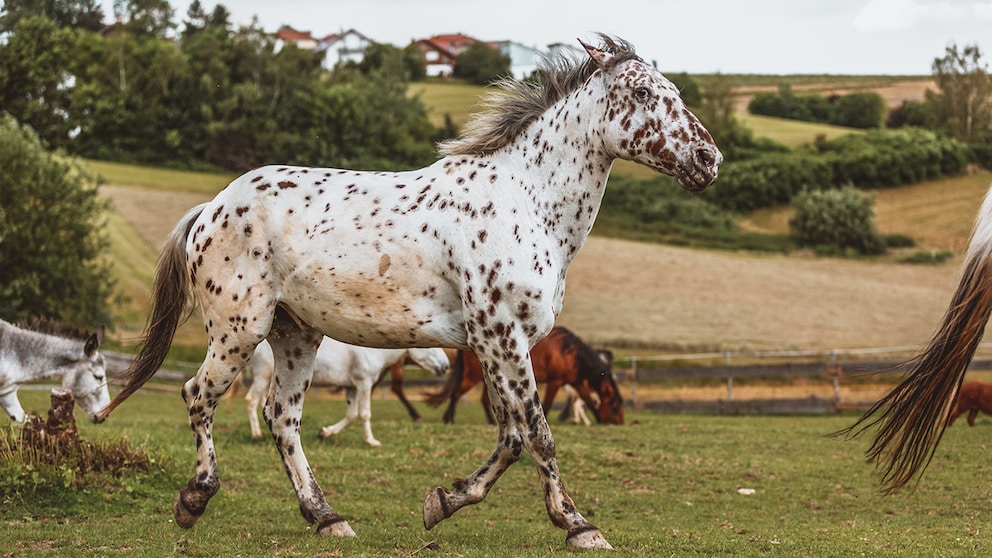
Are you familiar with the Knabstrupper? This extraordinary horse breed, with its spotted coat, resembles Pippi Longstocking’s famous horse, “Little Uncle.” PETBOOK takes a look at the fascinating history, unique character, and proper care of these charming spotted horses.
Origin
To explore the origins of this now rare breed, we must trace its roots back to Denmark. We find ourselves at a royal stud farm. Since the mid-16th century, Frederiksborg horses have been bred here–one of the most significant horse breeds. Over many years, they were crossed with Spanish breeds, leading to the creation of breeds such as the Lipizzaner. This breed was particularly attractive to the nobility: The royal studs trained the horses and used them in wars. Frederiksborg horses came in many different coat colors–but one stood out.
The white horses with dark brown spots also appealed to wealthy private individuals–today we know these horses as Knabstruppers. This is thanks to Major Villars Lunn. In the early 19th century, he bought a mare with a distinctive coat color from a royal stud. On his estate, Knabstrup, he began breeding with this mare. Many were captivated by the pattern that was passed on. At the annual auctions at Knabstrup estate, visitors and bidders came from all over the world. The breed is now named after its place of origin–Knabstrup estate.
Knabstruppers were used as show horses, but not only there: As very versatile animals, they were also used in agriculture and as dressage horses. In the early 20th century, the population declined. The reason was a fire in 1840 at the stud farm, which significantly reduced the already small population. The remaining small population of Knabstruppers mostly descended from the major’s mare. To prevent inbreeding, not much breeding was done. In the 1940s, the breeding line was revived, and similarly looking Appaloosas were crossed in. Today, Knabstruppers are one of the rarest breeds–they are now mainly bred in Germany, Denmark, and the USA.
Appearance
The Knabstrupper is a medium-sized, robustly built yet elegant horse–with a height of 147 to 165 centimeters–depending on the source, the size may vary. Its physique appears compact and harmonious. It is characterized by a muscular neck, a well-developed croup, and a pronounced withers. The back is relatively short, and the tail is set low. Notable are also the long legs with defined joints and strong hooves, making it sure-footed on uneven terrain. The head usually shows a straight or slightly curved profile with alert, expressive eyes.
The unmistakable feature of this breed, however, is its extraordinary coat pattern–the so-called spotted coat. Five different variants are distinguished:
- Full Leopard: evenly spotted on a light base color
- Blanket: solid-colored front body, spotted croup
- Solid: brown, black, without spots
- Born White: born white, but without the gray gene
- Snowflake: dark base color with light spots
Character & Temperament
The spotted horses are especially known for their strong nerves and calmness–although, like us humans, this can sometimes depend on the day. Their friendly and curious nature makes them ideal partners, even for beginners or those returning to riding. Knabstruppers are considered balanced, intelligent, and motivated, although their interest sometimes–quite typically for horses–focuses on food before the rider becomes exciting again.
And anyone who thinks this breed lacks fame is greatly mistaken: The most famous Knabstrupper in the world was Pippi Longstocking’s loyal horse–Little Uncle. Even though he appeared in the films as a white horse with painted black spots and is also referred to as a gray in the stories–strictly speaking, a gray with “Knabstrupper ambitions”–he perfectly embodies the typical character of this breed: strong, independent, friendly–and always up for an adventure.
Gait & Discipline
Knabstruppers have a spacious, light-footed gait. They walk elegantly, trot rhythmically, and have a smooth canter. This makes their gaits comfortable to sit.
Those who enjoy dressage, groundwork, gymnastic work, and trail rides will be happy with Knabstruppers. They are versatile and up for almost any fun. Learning new lessons brings them joy–the animals enjoy being challenged.
Proper Care & Maintenance
Due to the different coat types, care also varies. Especially horses with a light coat color sometimes have a harder time in summer: keyword sunburn. When the sun is high again, you should ensure the animal has enough shaded areas. Otherwise, as with all other horses: groom before training, regular dental care, deworming, and vaccination.
Since horses are social animals, Knabstruppers should also be able to enjoy their leisure time extensively with their peers. Equally important are regular, sufficient pasture outings on large fields.
Appaloosa: This Horse Breed Has the Most Spots in Its Coat
The “Golden” Horse Breed: The Kinsky Horse
Nutrition
Knabstruppers should always have enough roughage and water available. When transitioning to grazing in the spring, you should plan enough time for the horse’s body to adjust. Any additional concentrated feed or mineral feed should always be discussed with the veterinarian.
Susceptibility to Certain Diseases
Knabstruppers often exhibit the so-called “human eye”–a white-rimmed iris prone to recurring inflammation. Without timely treatment, this can lead to vision damage or blindness. In severe cases, injections in the eye are necessary, so a veterinarian should always be consulted.
Hyperpigmentation, a hereditary disorder causing skin, hoof, eye, and dental defects shortly after birth, is less common. Mares are usually viable, but male foals die in the womb. Affected animals should not be used for breeding.
- Character: intelligent, friendly, strong-nerved
- Height: 147 to 165 centimeters
- Coat Color: spotted
- Gait: elegant, light-footed
- Discipline: leisure, dressage
- Special Features: coat color and susceptibility to “human eye,” hyperpigmentation