

November 28, 2025, 3:37 pm | Read time: 5 minutes
Few horses catch the eye like the Appaloosa–its unique markings make it unmistakable. But the spotted star has much more to offer than an extraordinary appearance. PETBOOK provides insights into the appearance, temperament, and care of these special horses.
Origin
The history of the Appaloosa begins in the 16th century when Spanish horses with distinctive spotted markings arrived in North America. There, they were adopted by the Nez Percé people in the northwest of what is now the United States. During violent conflicts and displacements in the 19th century, the Nez Percé lost a large portion of their horses. Many Appaloosas were confiscated, sold, or killed, nearly leading to the breed’s extinction. However, some animals survived and later formed the foundation for their preservation.
In 1938, Dr. Francis Haines and Claude Thompson founded the Appaloosa Horse Club, which spearheaded the breed’s revival. In 1950, the Appaloosa was officially recognized and developed into a globally widespread horse breed in the following decades. Since the 1970s, Appaloosas have also been found in Germany; the European studbook is now maintained by the APHCG, founded in 1994. The name traces back to the Palouse region–over time, “A Palousey Horse” became “Appaloosa.”
Appearance
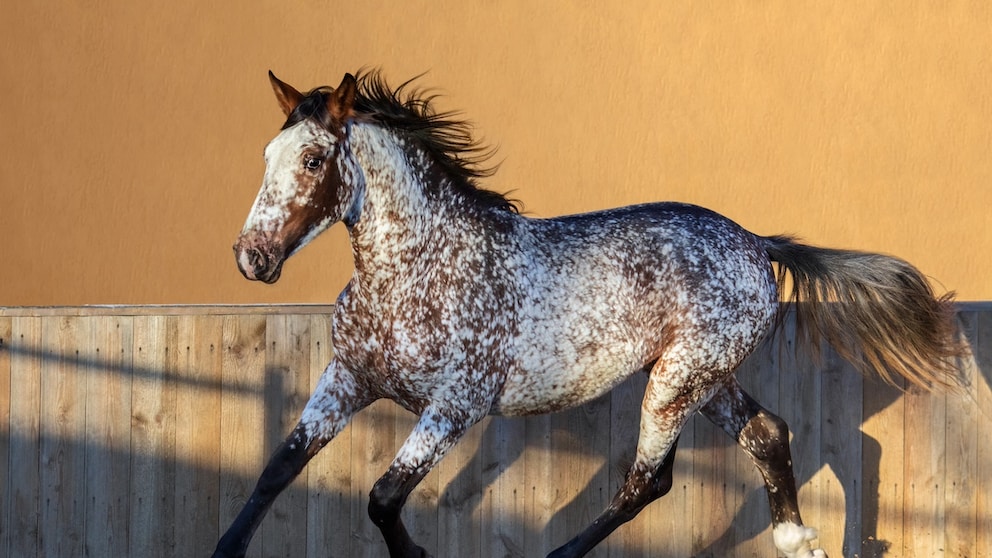
The Appaloosa is a medium-sized, athletic horse with a height of 142 to 165 centimeters. Its compact, well-muscled build and short back make it particularly agile. The head appears refined with a straight nasal line, broad forehead, and especially expressive eyes, which are one of the breed’s typical features. Normally, horses’ eyes are completely brown. However, Appaloosas have what is called “human eyes”: the iris is outlined in white. Other breed characteristics include striped hooves and black-pink mottled skin around the mouth and eyes.
The coat pattern is among the most striking of all–each Appaloosa displays its own unique variant, from subtle spots on the croup to prominent dot patterns across the entire body. But beware: some Appaloosas closely resemble Knabstruppers. Usually, the spots on Appaloosas are somewhat lighter than those on Knabstruppers.
Character & Temperament
Appaloosas are known for their calm, good-natured disposition. They are considered to be strong-nerved, balanced, and exceptionally people-oriented, making them reliable partners in leisure and Western riding. Their high willingness to perform and endurance are as notable as their eagerness to learn: many Appaloosas quickly grasp small tricks, respond well to signals, or even fetch items on command. Despite their calmness, they are agile, nimble, and versatile–qualities that make them valued family and riding horses.
Gait & Discipline
The Appaloosa possesses the three basic gaits of walk, trot, and canter–and additionally, a special, breed-specific intermediate gait: the “Appaloosa Shuffle,” also known as the “Indian Shuffle.” This comfortable, ambling four-beat gait lies between a walk and a trot, moves significantly faster than a normal walk, and remains exceptionally smooth and flat. The shuffle can be performed diagonally or laterally and is particularly comfortable for riders, making it ideal for covering longer distances quickly and efficiently.
Thanks to its agility, endurance, and intelligence, the Appaloosa shows talent in many disciplines. It is suitable for light dressage tasks, small jumps, and is a reliable partner in leisure activities. However, its particular strength lies in Western riding: with pronounced “cow sense”–the ability to quickly react to the movements of cattle–it excels in reining, cutting, trail, or Western pleasure and has long been popular in Western films.
Proper Care & Maintenance
Appaloosas are considered easy to care for and primarily need ample space. Whether in an open stable with weather-protected shelter or in box housing–regular, extended pasture or paddock outings are crucial. Since Appaloosas–like all horses–are highly social animals, they should never be kept alone.
They are low-maintenance in terms of grooming. Regular brushing before training and careful inspection of coat, skin, and hooves are usually sufficient in daily care. Due to their light skin areas, owners should ensure there are enough shaded areas in the pasture during summer to prevent sunburn.
The Knabstrupper: The Spotted Horse Breed Behind Pippi Longstocking’s “Little Old Man”
What Makes the American Quarter Horse the Most Popular Breed in the World
Nutrition
As with all horses, high-quality roughage forms the basis of a healthy diet for the Appaloosa. Hay and fresh water should always be freely available to support digestion, metabolism, and well-being. Depending on the workload, the diet can be supplemented with mineral feed or small amounts of concentrated feed–always in consultation with a veterinarian or nutritionist.
Since Appaloosas are robustly built and sometimes prone to efficient feed utilization, keeping a watchful eye on their condition and weight is worthwhile. Individually tailored feeding plans help avoid overfeeding and meet energy needs optimally. This way, the Appaloosa remains fit, balanced, and healthy.
Susceptibility to Certain Diseases
Appaloosas are more prone to sunburn due to their often light skin–a shaded shelter in the pasture is therefore essential. Also typical is periodic eye inflammation, an incurable condition that can lead to blindness without regular treatment.
Genetic diseases can also occur in Appaloosas. These include EMH (Equine Malignant Hyperthermia), HYPP (Hyperkalemic Periodic Paralysis), PSSM (Polysaccharide Storage Myopathy), and HERDA, a rare connective tissue disorder. Since some of these defects stem from past crossbreeding, risks can now be well identified through specific genetic tests–an important step in early identification and targeted management of affected horses.
Appaloosa at a Glance:
- Character: calm, reliable, people-oriented, strong-nerved, eager to learn
- Height: 142–165 cm
- Coat Color: all base colors possible, typical leopard spotting
- Gait: walk, trot, canter, “Appaloosa Shuffle”
- Discipline: Western riding, leisure
- Special Features: “human eye,” striped hooves, prone to sunburn and certain genetic diseases