

November 12, 2026, 3:57 pm | Read time: 4 minutes
How do horses actually see the world? Do they really see seven times larger than humans? And can these animals look forward even though their eyes are on the sides? These are questions that intrigue not only laypeople but also long-time horse enthusiasts. PETBOOK delves into these very questions.
How Do Horses See?
Horses always have their surroundings in view. For a prey animal, this is crucial for survival. But does this mean horses see better than humans? And what colors can they actually perceive? Of all the horse’s senses, vision has been the most thoroughly researched. Researchers Lina Roth and Paul McGreevy compiled a comprehensive review in 2025 detailing what we know about how horses perceive their environment.
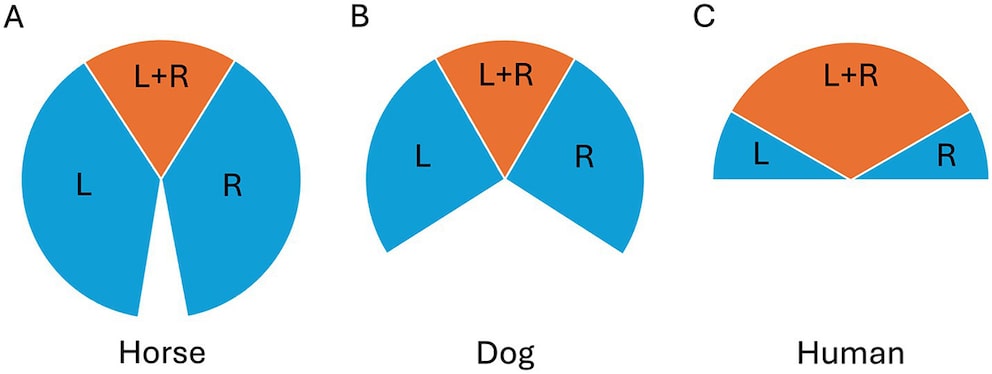
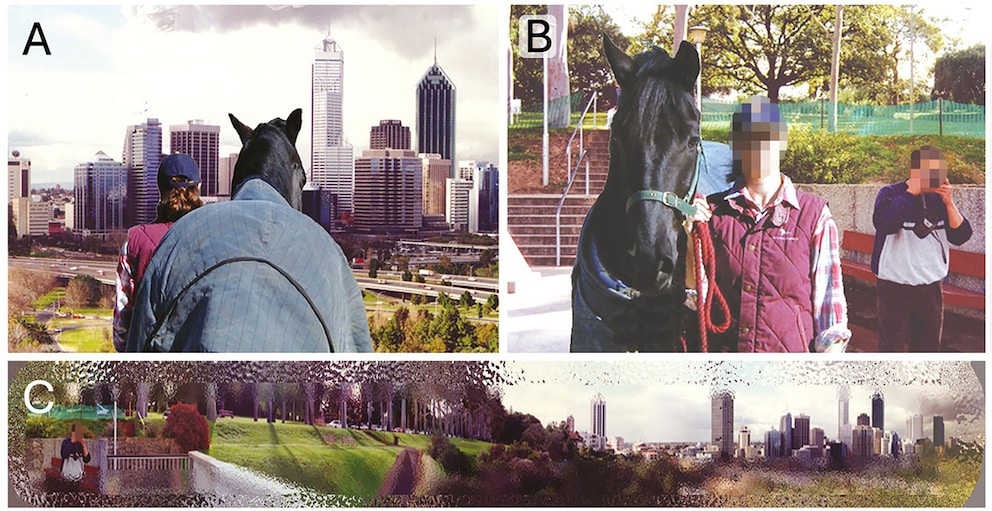
Particularly impressive is their nearly complete panoramic view. Because their eyes are positioned on the sides of their heads, horses can take in a large portion of their surroundings without having to turn their heads. Movements beside them and even partially behind them rarely go unnoticed. This is especially advantageous for a prey animal: potential danger can be detected early. 1
Can Horses Look Forward?
Because a horse’s eyes are on the sides of its head, there’s a misconception that horses can hardly see in front of them. That’s not entirely true. In fact, the position of their eyes allows for an almost complete panoramic view. Horses can look forward with both eyes.2
Also interesting: Why do some horses wear masks?
And this has an important advantage: They can see spatially and judge distances. The claim that horses have poor depth perception due to their side-positioned eyes is, according to Roth and McGreevy, a myth.
However, there are blind spots. Directly in front of the head and behind the horse are areas it cannot see directly. By moving its head, the horse can compensate for these blind spots.
Do Horses Really See Seven Times Larger?
It’s hard to say where the myth that horses see seven times larger comes from. The question often appears in forums and is frequently met with confusion by horse enthusiasts. Scientifically, this theory has never been confirmed.
Also interesting: How this horse fooled everyone

Can Dogs Watch TV?

The 8 Most Common Cat Eye Colors and How They Develop
Can Horses See in the Dark?
This question also intrigues the horse community. And the answer is quite clear: Yes, they can!
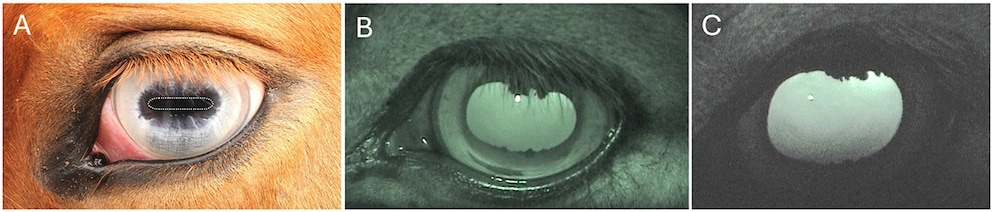
When it gets dark, a horse’s pupil dilates significantly. Its area can become about seven times larger than when constricted in sunlight. This allows much more light into the eye, helping horses see surprisingly well even in low-light conditions.
How well is demonstrated by an experiment cited by Roth and McGreevy: Horses could still recognize different shapes and move confidently in the test environment even in extremely low light. At this point, it was already so dark that the humans involved could no longer see the horses.
Can Horses Recognize Colors?
Those who believe horses see the world only in black and white are mistaken. Horses do see colors, but not in the same way humans do. While humans typically have three different types of color receptors, horses have only two. They are known as dichromats. Simply put, their color perception mainly ranges between blue and green and yellow. Certain blue-green hues can be difficult for them to distinguish from gray.
Red also doesn’t appear the same to a horse as it does to us. Researchers believe it is likely perceived as a darker shade of green. This is not only an intriguing feature of the horse’s eye. Colors and contrasts can also influence how horses assess their surroundings. Studies show, for instance, that the color of an obstacle can affect how a horse approaches a jump.