

October 13, 2025, 2:43 pm | Read time: 7 minutes
Cat eyes have always held a special fascination. Their gaze is mysterious, expressive, and often reveals more about mood or health than one might think. But it’s not just the shape of their eyes that’s intriguing—the variety of colors ranges from sparkling sapphire blue to intense green to bright orange. Discover which eye colors are most common in cats, which are rarer, and which breeds are associated with them at PETBOOK.
The 8 Most Common Cat Eye Colors—Facts, Rarities, and Breeds
Their eyes seem like small windows into another world—mysterious, shimmering, and sometimes almost supernatural. Few other animals captivate humans as much with their gaze as cats do. In ancient cultures, cat eyes were considered symbols of magic, protection, or transformation. Especially the vertically slit pupil, which narrows to a fine line in daylight and opens wide in the dark, has always had a hypnotic effect.
Many fantasy and science fiction authors have drawn inspiration from this: From mysterious shapeshifters with cat-like eyes to mystical night creatures to dark rulers sitting in their towers depicted only as an eye with a slit-shaped pupil—the distinctive cat iris became a symbol of instinct, grace, and a touch of wildness.
When dusk falls, cat eyes glow in a fascinating way. This is due to the tapetum lucidum, a reflective layer behind the retina that reflects incoming light and enables cats to see in the dark. This mysterious glow that shines back at us at night contributes significantly to their reputation as magical beings.
Which Eye Colors Can Cats Have
But cat eyes are not only special because of their shape—their color variety is also astonishing. From icy sapphire blue to bright emerald green to warm amber: Every cat seems to have its own unique eye color. Learn which shades are most common, which are particularly rare, and which breeds they appear in below.

Cat’s Fur Color Changes in Heat – Biologist Explains Phenomenon

Do you know all the different colors and patterns of cats?
How Common Each Eye Color Is
Common eye colors include blue, green, yellow, orange, gold, copper, brown, and various mixed forms like hazel or even two differently colored eyes. Some cats even have dichromatic eyes, where two colors are visible in one iris.
Cats with green or yellow eyes are the most widespread—they make up about 50 to 60 percent of all cats. Cats with variations of these colors follow with 10 to 15 percent. Blue-eyed cats are significantly rarer, accounting for only about 3 to 5 percent. Cats with two differently colored eyes (heterochromia) make up less than 1 percent of the entire cat population.
How Eye Color Is Formed
The coloration depends on the melanocytes in the eye, which are cells that produce the pigment melanin.
- A high number of melanocytes leads to orange or gold eyes.
- An average number of melanocytes usually results in yellow or green eyes.
- If melanocytes are absent, the eyes appear blue or pink in albinos.
According to current research, fur color often does not play a direct role, although some traits like silver fur and orange eyes frequently appear together in certain breeds. Blue eyes are also more common in white or colorpoint cats. Generally, purebred cats have more intense colors, while domestic cats without pedigrees often show lighter shades of yellow, green, or hazel.
Yellow Eyes in Cats
Yellow is one of the standard colors and appears particularly striking in black cats. This eye color is often found in:
- Bombay–an elegant, deep black cat with bright golden-yellow eyes reminiscent of a mini-panther.
- Burmese–with its dark, silky coat and amber eyes, it is considered sacred in its native Myanmar.
- Bengal–striking leopard markings and strong yellow to golden eyes.
- American Shorthair–robust, friendly, and often with warm yellow eyes.
- Maine Coon–one of the largest cat breeds, whose yellow or golden eyes perfectly complement its thick fur.
Cats with Green Eyes
Green eyes are also common. They are typical in:
- Russian Blue–with its blue-gray coat and intense emerald green eyes, it is one of the most elegant breeds.
- Egyptian Mau–the only naturally spotted cat breed, whose characteristic “gooseberry green” almost seems to glow in the sun.
- Somali, Norwegian Forest Cat, and Abyssinian also often show green to yellow-green eyes—depending on the light, they shimmer in fascinating nuances.
Cats with Blue Eyes
All kittens are born with blue eyes. From about the fourth to sixth week of life, the final color begins to develop, usually settling between two and four months of age.
Blue remains permanent only in some cat breeds. The color is not created by pigments but by light refraction in the iris. Breeds particularly known for their blue eyes include:
- Siamese–a traditional point cat from Thailand, with a lively voice and slightly limited vision.
- Ragdoll–a large, affectionate breed from California, bred since the 1960s.
- Balinese–a long-haired variant of the Siamese, sometimes described as hypoallergenic.
- Burmese–the “Sacred Cat of Burma,” whose legend says it owes its deep blue eyes to a goddess.
- Himalayan–a mix of Persian and Siamese with long fur and blue eyes.
- Tonkinese–known for aqua-blue eyes, resulting from Siamese and Burmese cats.
Special Case: Ojos Azules
A true rarity among cats is the Ojos Azules (“blue eyes” in Spanish). This breed was first discovered in the 1980s in New Mexico when breeders found a free-roaming cat with strikingly light blue eyes—and the remarkable thing: It did not have pure white fur. The Ojos Azules carries its own dominant gene that produces intense, almost glowing cobalt blue eyes independent of fur color.
Orange Eyes
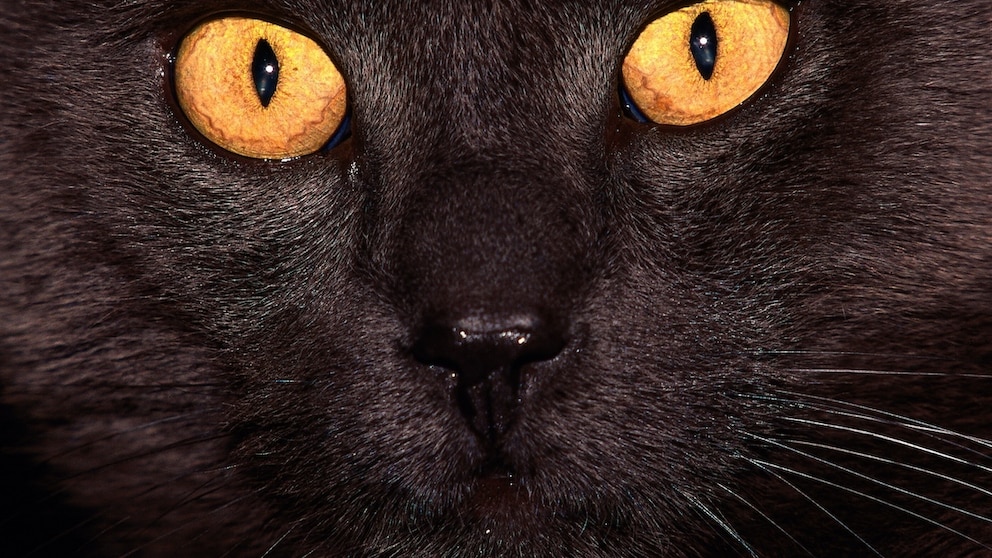
Orange or amber eyes are among the rarer but particularly striking variants of cat eye colors. They are created by a high content of melanin in the iris, resulting in a warm, glowing tone that shifts between light honey yellow and deep amber depending on lighting conditions.
This color is most famously seen in the British Shorthair, whose strong orange eyes often contrast fascinatingly with dense gray or blue fur. But the Turkish Van, with its white fur, and the Bombay, which resembles a small black panther, occasionally have amber to orange eyes. This intense coloration gives the cat a special depth in its gaze—calm, yet glowing and expressive.
Cats with Golden Eyes
Golden eyes are closely related to yellow but differ by having denser pigmentation, giving them a richer, almost metallic sheen. Their color ranges from light golden yellow to an intense, almost bronze shimmer.
This eye color is typical in Abyssinians, Burmese, Bengals, and Somalis. In these breeds, the gold often shines particularly vividly when light falls on the iris, highlighting the elegant facial shape and the short-haired, glossy coat.
Copper Eyes
Cats with copper eyes appear as if they carry sunlight in their pupils. This intense color is created by a particularly high concentration of melanin in the iris and appears as a deep, almost metallic, glowing orange, with a hint of red. It is typical in Persian cats, British Shorthair, and Scottish Fold. Some Bombay cats also show this impressive tone. Combined with dark fur, the copper gaze is particularly striking and majestic.
“Brown” Eyes
Strictly speaking, true brown eyes do not exist in cats, as their iris does not form pure brown pigment. Instead, the impression is created by a mix of golden, copper, or amber pigments that combine into a warm, dark tone. This effect is particularly evident in the Ocicat, whose eyes shimmer from gold to deep brown depending on the light. Under certain lighting conditions, cats with golden eyes can also have an almost chocolate-brown expression—a fascinating play of colors that remains rare.
Incidentally, there are no black cats with black eyes–despite reports to the contrary. The impression is again created by the pupils dilating in darkness, making the eyes appear almost black.
Hazel Green Eyes–The Play of Yellow and Green
Hazel eyes are color-wise between yellow and green and can—depending on the light—appear more golden or more greenish. This versatile, warm color is often found in domestic cats, but also in breeds like American Shorthair, Maine Coon, or Norwegian Forest Cat. Hazel green eyes often radiate a special softness and give the cat a friendly, open expression.
Two Differently Colored Eyes
Particularly striking are cats with heterochromia, meaning differently colored eyes. This effect is especially seen in white breeds like Turkish Angora, Foreign White, or Khao Manee. Even rarer are dichromatic eyes with two colors in one iris.