


July 28, 2025, 4:11 pm | Read time: 4 minutes
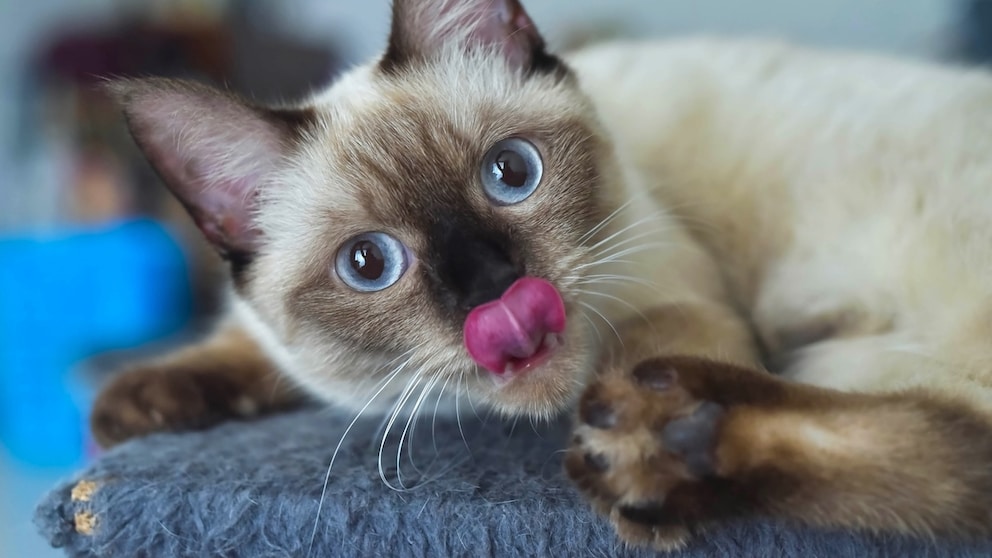
After a heatwave in China, a cat owner from Henan province suddenly noticed that his Siamese cat’s face looked quite different. The dark mask around its blue eyes had almost disappeared. But how is this possible? In fact, some cats can change their fur color during prolonged heat. PETBOOK editor and biologist Saskia Schneider explains how this phenomenon occurs, which cats are affected, and whether it also influences their personality.
Behind the color change is a genetic phenomenon known as acromelanism or temperature-sensitive darkening. This is caused by a mutation in the so-called tyrosinase gene, which occurs in certain cat breeds—most notably the Siamese cat. This mutation causes the enzyme tyrosinase, responsible for the production of melanin (the dark pigment), to work in a temperature-dependent manner.
This means: In warmer body regions, the enzyme is inactive—there, the fur remains light. In cooler areas like the ears, paws, face, and tail, melanin production is activated, and the fur appears significantly darker. These contrasting dark markings are referred to as “points”—a hallmark of the Siamese cat and related breeds. 1
Under What Circumstances the Fur Color Can Change
Kittens with this mutation are born almost white—the body temperature in the womb is too high for melanin production. Only when the temperature drops after birth does pigmentation begin in the cooler body areas. But the color change is not complete: The color of the points can change several times over the course of a lifetime—depending on the ambient temperature.
In summer or during heatwaves, this can indeed result in these cats changing their fur color. Because the temperature then rises even in the normally cool areas, the enzyme no longer works there—the fur lightens. In winter, however, when the environment is cooler, the points become darker and more intense. Even minor interventions like a shave at the vet can temporarily lead to color changes if the regrowing hair returns darker during a cooler phase.

Does the Cat’s Personality Change with the Color?
Many owners ask themselves this question—after all, light colors often seem “friendlier” or “gentler,” while dark animals are sometimes considered “more mysterious.” However, scientifically, there is no connection between fur color and character. Although some breeders and owners report subjectively perceived differences—such as between Blue Points and Seal Points—these differences are not genetically or behaviorally substantiated. 2
A cat’s personality is more influenced by its genes, early life experiences, social environment, and experiences—not by the color of its fur. You can learn more about this in this PETBOOK article: Do Cat Fur Colors Say Anything About Their Personality?
These Cats Can Change Their Fur Color
The genetic peculiarity of temperature-dependent fur coloring originally comes from South Asian domestic cats and has been selectively bred into several breeds. In addition to the Siamese cat, other breeds also show this characteristic point pattern:
- Burmese cat
- Ragdoll
- Burmese cat
- Himalayan cat
- Tonkinese
- Mixed-breed cats with the appropriate genetics
These cat breeds carry the so-called Himalayan mutation, named after a similar fur pattern in Himalayan rabbits. Other animal species, such as certain rabbits, cattle, or even martens, show comparable temperature-sensitive color distributions.

The 8 Most Common Cat Eye Colors and How They Develop

Do you know all the different colors and patterns of cats?
Health Risks of the Point Pattern in Cats
As aesthetic as the special coloring may be—it comes with visible risks. Cats with this unique coloring may face health issues such as eye problems:
- Strabismus (crossed eyes): The eyes are not correctly aligned, which can impair depth perception.
- Nystagmus: Uncontrolled, rhythmic eye movements that can disrupt vision.
Additionally, there may be increased risks of health issues such as digestive problems or even cancers (e.g., mammary tumors). Therefore, it is especially important to breed cats with this genetic makeup responsibly—ideally through reputable breeders or adoption from animal shelters.
The 8 Most Common Cat Eye Colors and How They Develop
Do you know all the different colors and patterns of cats?
Health Risks of the Point Pattern in Cats
The unique coloring may be aesthetically pleasing, but it is important to remember that it is a result of the interplay between genetics and the environment. For cat lovers, the vibrant coat patterns are a real eye-catcher, and for biologists, a source of endless fascination. Those who welcome a point cat into their home can look forward not only to a fascinating color display but should also be aware of the special care these animals require to ensure their beauty and health are maintained for a long time.
Dr. Saskia Schneider holds a Ph.D. and is a biologist. She is an editor at PETBOOK and has a keen interest in the intersection of genetics and animal behavior. She is passionate about educating others on the fascinating world of animals.