

April 22, 2026, 2:46 pm | Read time: 5 minutes
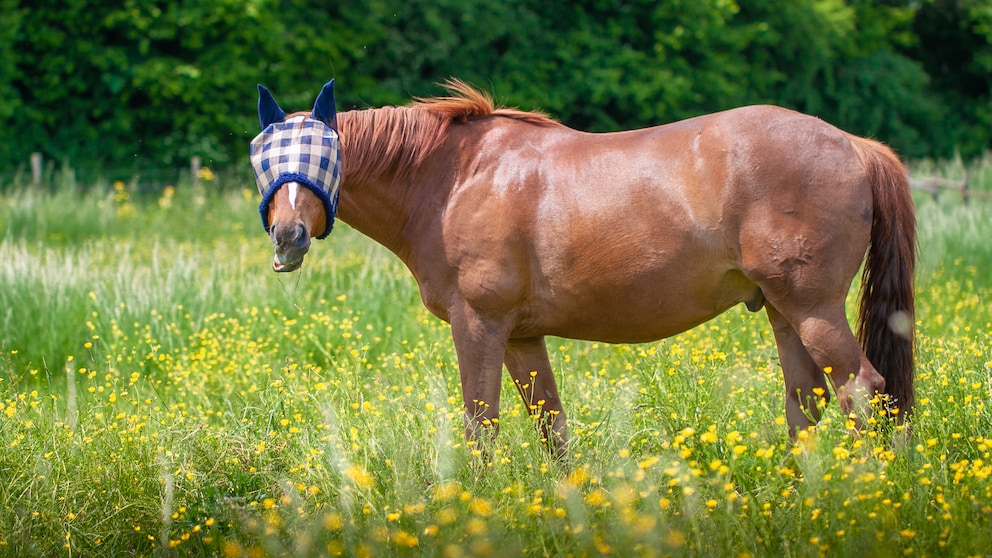
Anyone driving past horse pastures in spring or summer might notice an unusual sight: large animals with patterned blankets and striking masks on their heads. At first glance, it almost looks like a mix of zebra and science fiction—and quickly raises questions. Why do horses seem to be “wrapped up” in the warm season?
Why Do Horses Wear Masks?
These striking masks are not an unusual trend but a targeted protective mechanism. They are called fly masks, specifically designed to protect sensitive areas like the eyes and face from insects.
Especially in the warm months, horses are increasingly exposed to flies and horseflies, which prefer to stay around the head area and not only annoy but can also cause health problems.
Are Flies a Danger to Horses?
Why do horses need to be “protected” from flies? Flies can transmit various diseases. For example, insects can cause conjunctivitis in horses, which can then spread within the herd.
But that’s not all: Flies can also act as intermediate hosts for eye worms, which can nest in areas like the tear gland or conjunctival sac. In veterinary medicine, this is called thelaziosis.1
Why Are Flies Around Horses’ Eyes?
Anyone who has stood close to a horse in the summer will quickly notice one thing: There’s always at least one fly around the horse’s inner eye corner. And not just that: Often, several flies line up under the eye—but why?2
The tear fluid of horses contains proteins, which apparently attract flies. The closer they sit to the horse’s eye, the higher the risk of transmitting bacteria that can cause conjunctivitis. Once the eye is infected, it becomes very sensitive to wind or UV radiation.
Can Horses See Through the Masks?
The answer is: Yes—and that’s important. Horses are prey animals and constantly keep an eye on their surroundings to quickly react to potential dangers. If their vision is restricted, it can cause stress and panic. That’s why fly masks always have large areas made of mesh-like fabric, allowing the animals to see as usual.
However, if a fly mask doesn’t fit properly and slips, it can become problematic. This was evident in a case from 2025 when a slipped fly mask triggered a major rescue operation. A mare wore a fly mask with an elastic band, which slipped, preventing her from seeing. She panicked so much that she broke through several fences and, as Animal Rescue Essen described on Facebook, even flipped over twice. The owner could hardly approach her horse to remove the mask. This was only possible late at night when Animal Rescue Essen managed to sedate the animal.3
The comments under the Facebook post highlight one thing: Such situations, even if not to this extent, are known among horse owners. Many agree: Choosing the right fly mask for the horse is crucial.

Are zebras actually black- or white-striped?

How to Protect Rabbits From Overheating in Summer
How Should a Fly Mask Fit and What to Consider?
To avoid such critical situations for both horse and owner, it’s helpful to take time when selecting a mask. For a horse mask, it’s essential that the horse is protected but not disturbed by wearing the mask. There should be enough distance between the mask and the eye. It’s also important that the mask’s material is high-quality and breathable to prevent heat buildup. Additionally, the closure is crucial: The mask should hardly slip, but if it does, it should be easy to remove.
Moreover, it’s important for owners to check daily if the mask is chafing or damaged. It should also be washed regularly to remove any dirt. If a horse continuously wears a fly mask (such as in an open stable), it’s important to check several times a day if the mask is still sitting as it should.
Why Do So Many Fly Sheets Have Zebra Patterns?
In summer, you not only see large masks on horses’ heads but also horses wrapped in blankets. But why add an extra layer to horses in the already warm summer? It depends on the blanket’s function: Besides fly masks, there are also fly sheets designed to protect horses from insects like horseflies, whose bites are painful for horses. These sheets are made of thin, breathable material that allows continuous air circulation, preventing the horse from overheating.
You may have noticed that many horse fly sheets come in a zebra pattern—is that just decoration, or is there a purpose behind it? A fly sheet with zebra stripes can indeed serve a function. According to a study by the University of California from 2019, fewer horseflies land on zebras than on horses. The international research team led by Tim Caro observed three zebras and nine horses on a farm in the UK and tested various blanket patterns and the insects’ landing behavior via video.4
The result: Horseflies approach but visibly struggle to land on striped surfaces. This is the potential advantage of the zebra look. However, the findings are limited as only a few animals were studied.