

November 13, 2025, 1:14 pm | Read time: 6 minutes
Graceful, powerful, and full of personality–the Andalusian captures everyone’s attention. But behind its elegant appearance lies much more than beauty: an intriguing history, a sensitive nature, and impressive versatility.
Origin
The roots of the Andalusian–as the name suggests–are in the southern Spanish region of Andalusia. There, their breeding has been closely linked to tradition and culture for centuries. The animals originally descended from the Sorraia horses, whose history dates back to before our era. The Carthusian monks made a significant contribution to the development of the breed. In 1476, they were given the horses and began breeding them from that point on.
Over the centuries, Andalusians were used as work and war horses and were bred and gifted by nobles as symbols of power and wealth. Particularly in the 16th century, King Philip II promoted their breeding, emphasizing that the horse breeding should not be mixed with other breeds. The horses were even popular with Napoleon. After the nationalization of church properties in 1834, the original monastic breeding temporarily came to a halt, but the tradition continued.
Over time, Andalusians developed into elegant, muscular baroque horses, used not only in war but also in classical equestrian art. In baroque riding schools, they impressed with demanding lessons such as piaffes and pirouettes and were considered status symbols for nobility and wealth. They also influenced the development of other breeds like the Lipizzaners, Lusitanos, and Friesians–their impact is still felt today.
In 1912, the breed was officially registered as “Andalusian,” and in 1967, the more precise definition of “Pura Raza Española” (PRE) was established. Today, the term “Andalusian” is considered a collective term for Spanish horses, while PREs must prove purebred lineage and be recognized by official breeding associations.
Appearance
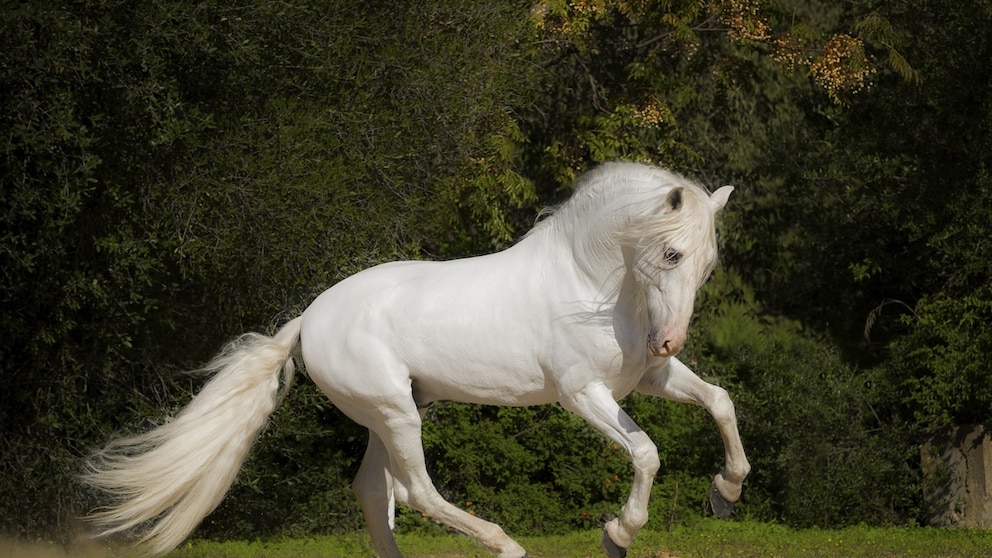
The Andalusian is an elegantly built horse of medium size. With a withers height between 155 and 165 centimeters and a weight of around 450 to 550 kilograms, it appears strong yet finely proportioned. Its head has a straight to slightly concave nasal line, large eyes, and fine ears. The neck is well-muscled, set high, and gives the horse a proud posture. The back is also compact and strong, and the croup is round and muscular.
The Andalusian’s coat is dense and soft, shimmering like silk. Most Andalusians are gray, but there are also bays, blacks, and duns. Particularly striking is the long, thick mane, which usually falls elegantly over one side of the neck, giving the Andalusian a graceful appearance.
Temperament
Andalusians are considered spirited horses–they have a lot of drive, curiosity, and eagerness to learn. To positively channel their temperament, they need plenty of variety and a diverse training program.
Additionally, Andalusians are very people-oriented and friendly. They enjoy the attention and affection of their owners and quickly form a close bond. At the same time, they are extremely sensitive, making a compassionate and patient approach important. Those who take the time to earn their Andalusian’s trust and truly understand its character will be rewarded with fine, harmonious responses both in the saddle and on the ground. Due to their sensitivity, Andalusians are not ideally suited for absolute beginners.
Gait & Discipline
With their strong build and natural energy, Andalusians display a particularly elegant and expansive gait. Their movements appear light and harmonious–the hindquarters actively engage, providing momentum and expression. In the walk, they stride gracefully; in the trot, they show a consistent, rhythmic movement pattern; and in the canter, they impress with wide, flowing leaps. Well-trained Andalusians can be wonderfully collected and show a relaxed posture in forward-downward movements.
Thanks to their baroque build and eager, motivated character, Andalusians are particularly well-suited for classical dressage. They are diligent, enduring, and quickly pick up new lessons, making them popular horses in high equestrian art. However, they are also versatile outside the riding arena–they enjoy groundwork and trail rides.
They are also very popular in the film world–thanks to their elegant appearance and calm, teachable nature, they are perfect for filming. A well-known example is the horse Shadowfax from “The Lord of the Rings,” portrayed by two Andalusian stallions.
Proper Care & Maintenance
Andalusians are active horses that require a lot of movement and variety. Accordingly, not only should the training be varied, but the form of housing should also match their temperament. An open stable with ample pasture access is ideal, allowing them to move freely and expend their energy. Since horses are very social animals, contact with other horses is particularly important–playing together and mutual grooming promote their well-being.
Equally important is a clean and dry environment: The ground in the stable and on the turnout areas should always be well-maintained and hygienic to prevent hoof and skin problems. Coat care also plays a significant role for the Andalusian. Their dense, often silky-shiny coat, as well as the long mane and full tail, require regular care. Time should be taken for this–not only to keep the coat healthy but also to strengthen the bond between human and horse.
Why the Barb Is the Oldest Horse Breed in the World
How the Trakehner Evolved from Military Horse to Dressage Star
Nutrition
A balanced diet is particularly important for Andalusians–as it is for all horses. Roughage and fresh water should always be available to the animal, as they form the basis of healthy digestion. If additional concentrated or mineral feed is given, it should always be done in consultation with a veterinarian.
Also, if signs of deficiencies appear, it is advisable to have observations professionally clarified. In some cases, targeted supplementation may be beneficial, but the exact needs should always be individually tailored. This way, the Andalusian remains healthy, capable, and balanced.
Susceptibility to Certain Diseases
Andalusians are generally considered robust horses but are prone to certain health issues. Some animals struggle with overweight or respiratory problems due to their relatively small nostrils. They are also susceptible to laminitis and hoof abscesses. Regular exercise, an adapted diet, and careful hoof care help prevent these risks.
- Character: intelligent, social, spirited
- Height: 155-165 centimeters
- Coat color: mostly gray
- Gait: full of energy, lively, springy
- Discipline: Dressage, leisure
- Special features: Baroque type