

August 13, 2025, 8:38 am | Read time: 5 minutes
The Tibetan Terrier is a true exotic with a misleading name: not a terrier, but a Tibetan herding dog with an amazing talent for climbing, alertness, and family closeness. Beneath the shaggy coat lies an intelligent, independent companion with origins in the heights of Tibet. There, it once guarded livestock herds at altitudes of up to 16,400 feet—today, it feels just as comfortable in family life. But what truly defines this charming snow lion?
Origin
The Tibetan Terrier originally comes from the highlands of Tibet, which is now part of China. Its roles at home were diverse: On one hand, it guarded livestock herds on high pastures as a herding dog, and on the other, it lived closely with families, also serving as a vigilant household dog. From flat rooftops, Tibetan Terriers reliably announced any approach.
Nomadic peoples took the dogs to great heights, where they herded goats and proved their jumping ability and surefootedness on rocky terrain. Their broad, round paws, which act like natural snowshoes, are an anatomical feature unmatched by any other breed.
Despite the name suggesting otherwise, the Tibetan Terrier has nothing in common with typical terrier breeds. Rather, it belongs to FCI Group 9, Section 5–Tibetan breeds. The journey to Europe began around 1930. In Great Britain, the breed was further developed and officially recognized as the “Tibetan Terrier.” Since then, it has been considered a valued companion and family dog.
Appearance & Coat
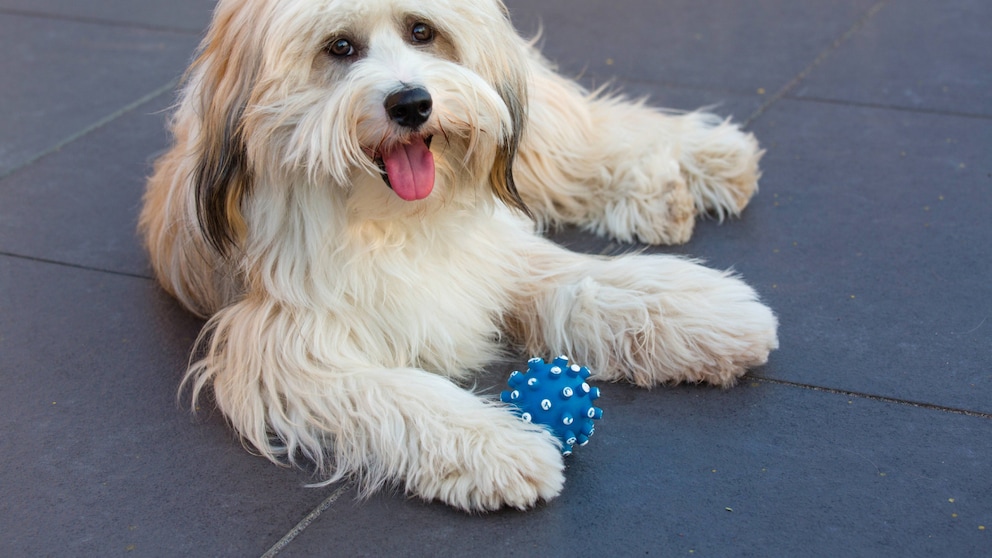
The Tibetan Terrier has a compact, square build with strong musculature. Males reach a shoulder height of 14 to 16 inches, while females are usually slightly smaller. The weight typically ranges between 24 and 31 pounds. Its athletic build allows for remarkable agility—ideal for climbing or quick changes in direction.
The most striking feature is the dense, double-layered coat. The topcoat is long, can be straight or wavy, and lies over a fine, dense undercoat. The hair structure serves to regulate temperature: In winter, it protects against cold, while in summer, it acts like a fan for cooling.
In terms of color, the Tibetan Terrier is extremely versatile. All colors are allowed—except for chocolate brown, liver, and merle. Common colors include white, cream, gold, gray, black, as well as two- and three-color combinations. Notable are the broad, round paw shape and the medium-sized, hanging, heavily haired ears. The eyes are usually covered by long hair and should be regularly trimmed.
Character & Temperament
The Tibetan Terrier is considered lively, intelligent, and playful—traits that make it a popular family dog. Its attachment and sensitivity allow it to live closely with its “pack,” where it likes to see itself as a full-fledged family member.
It is curious, active, and possesses a high level of comprehension. As a former herding and guard dog, it alerts to visitors early but remains friendly and composed. Toward strangers, it behaves reservedly, without showing fear or aggression.
Also characteristic is its independent will. Tibetan Terriers are considered charmingly stubborn—they like to weigh whether a command makes sense. This independence does not make them any less loyal but requires a certain level of empathy in training.
Training
Training the Tibetan Terrier succeeds with patience, consistency, and positive reinforcement. Pressure or even harshness is counterproductive, as the sensitive dogs respond with indifference. Instead, calm, clear communication pays off.
Thanks to their intelligence and eagerness to learn, they understand tasks quickly. Early socialization and clear structures facilitate integration into everyday life. The breed is also suitable for beginners—provided one is willing to engage with its independent nature. Obedience is achieved with the Tibetan Terrier, not through authority but through cooperation.
Proper Care & Maintenance
Tibetan Terriers need regular exercise and mental stimulation, such as walks, fetch games, or dog sports like agility, obedience, or dog dancing. They are fond of running but can also manage with moderate exercise in bad weather—as long as they are in company.
They feel just as comfortable in an apartment as in a house with a garden, provided there are places to retreat. Their close bond with the family makes them loyal companions—ideal for families with children.
The long coat requires regular care: Brushing once or twice a week prevents matting and removes loose undercoat. Cleaning the ears is particularly important to prevent infections. With proper care, Tibetan Terriers hardly smell like dogs.
Nutrition
A balanced, protein-rich diet is essential for the Tibetan Terrier. High-quality dry or wet food with a good meat content is recommended. Vegetables or unseasoned carbohydrates like rice or potatoes can be added as supplements.
Due to their sensitivity to changes, food transitions should be made gradually. Fresh water must be available at all times. Snacks and treats should be given in moderation to avoid obesity—especially in older dogs.
Why the Lhasa Apso Was Once Sacred–and What Owners Need to Know Today
The Kerry Blue Terrier Tests the Patience of Its Owners
Susceptibility to Certain Diseases
Tibetan Terriers are considered robust and long-lived dogs with a life expectancy of 13 to 15 years. Nevertheless, there are breed-specific health risks that should be noted.
Known hereditary diseases include:
- Hip Dysplasia (HD): A malformation of the hip joint that can be mitigated through targeted breeding and preventive examinations.
- Progressive Retinal Atrophy (PRA): A degenerative eye disease that can lead to blindness.
- Patellar Luxation: The kneecap can slip, leading to lameness.
Regular veterinary check-ups and examinations by specialized breeding associations help to detect and prevent health problems early.
Tibetan Terriers at a Glance
- Size: Males 14–16 inches, females slightly smaller
- Weight: 24–31 pounds (males), females slightly lighter
- Coat: Long, straight or wavy with dense undercoat, low shedding
- Character: Playful, affectionate, alert, intelligent, stubborn
- Suitable for: Families, beginners, active people
- Life Expectancy: 13–15 years