

October 16, 2026, 11:09 am | Read time: 7 minutes
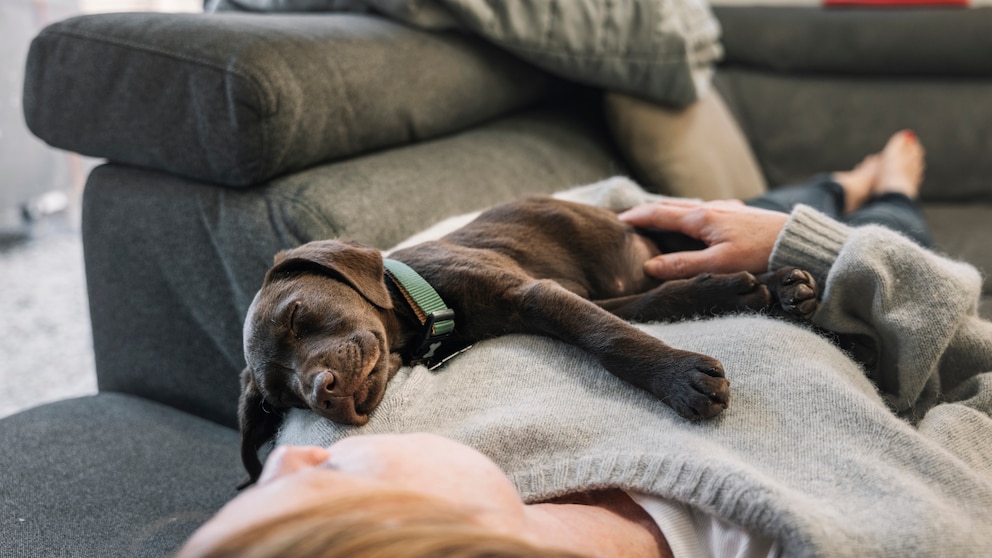
You’re sitting on the sofa, book in hand, and suddenly it becomes warm and heavy. The dog has sprawled across your legs, maybe even on your stomach or chest. Many owners wonder in such moments: Why is my dog lying on me? Katharina Marioth, dog trainer and author, explains the most common reasons.
Cuddling Creates Bonds
The question comes up surprisingly often in consultations. Usually, it’s tied to a notion many have heard somewhere: Animals that lie on people want to dominate. But I can reassure you. In most cases, there’s something much simpler behind it—and it rarely has to do with a power struggle.
The most common reason is actually closeness. Dogs are social animals, and physical contact is one of the most important forms of security and affection for them. Even puppies sleep in piles, on top of each other, huddled together, and this need doesn’t disappear just because a puppy becomes an adult dog.
When he lies on you, he’s seeking a connection with a person he trusts. Research on humans and dogs shows that mutual eye contact and petting release similar chemicals in both parties that are related to bonding. So, you both genuinely feel better when you’re lying together like this.
Why Your Lap Is So Attractive
Often, there’s something practical involved. You’re warm, you smell familiar, and your lap is softer than the dog bed on the floor. Especially in fall and winter, this is easy to explain. Small and short-haired dogs particularly seek warmth, but even large dogs don’t mind a human as a heating pad. Some breeds are also real cuddle specialists. Greyhounds, pugs, or Cavaliers often lie close to their humans, while a husky often prefers to keep some distance. This also depends on character and past experiences.
When the Dog Seeks Protection
Another reason is security. Dogs that are insecure look for a place where they feel protected, and for many, that’s right next to their human. Especially during thunderstorms, New Year’s Eve fireworks, in unfamiliar surroundings, or after a move, I observe that dogs seek physical contact much more frequently. This is not a misbehavior that needs to be trained away, but a small cry for help. Being there in such moments gives the dog exactly what he needs.
Attention on Four Paws
Sometimes, we’ve taught them this ourselves. The dog lies on you, you pet him, say a few kind words, and he’s learned that this method pays off. It’s not a problem, but you should know that dogs quickly understand what gets them attention. If a dog constantly throws himself on you as soon as you sit at the desk or are on the phone, it’s usually not about closeness, but about getting you to pay attention to him.
Also interesting: Dog trainer Jochen Bendel: “How to teach your dog to stay alone”
When Clinginess Becomes a Problem
Some dogs practically cling to their humans and can hardly lie alone. If your dog follows you from room to room, gets up with every movement, and only calms down when he’s lying on you, it’s worth taking a closer look. Sometimes insecurity is behind it, sometimes a bit of separation anxiety or herding behavior. Such dogs don’t lie relaxed on you, but alert, and as soon as you get up, the calm is over.
Caution with Resource Guarding
There’s one situation where I take a closer look: when the dog not only lies on you but also guards you. He growls when someone approaches, stiffens, focuses on visitors, or becomes restless as soon as other family members sit next to you. This is not dominance in the old-fashioned, outdated sense, but resource guarding. The dog sees the person as something valuable that he doesn’t want to share. Professional help is worthwhile here, as such patterns intensify if left unchecked, and scolding achieves the opposite.
Take Sudden Changes Seriously
And then there are cases where behavior suddenly changes. A dog that previously kept a two-meter distance and now constantly lies on you, or vice versa, should be checked by a veterinarian. Pain, nausea, hormonal changes, or sensory losses like diminished hearing and sight often make dogs clingier. They seek protection because something is not right. I advise not to take such changes lightly and to have them checked out rather once too often than too little.
Also interesting: How do I recognize a good veterinarian?
Relaxed or Tense? Here’s What to Watch For
How can you tell if your dog is lying on you relaxed? A content dog has soft muscles, breathes calmly and deeply, may sigh, and lets his eyes half-close. Often, he becomes heavier over minutes as he relaxes more and more. A tense dog, on the other hand, lies as if ready to spring. The body appears stiff, the ears turn at every sound, the gaze wanders or fixes on a point, and he pants for no apparent reason. The difference is often small, but once you’ve seen it, you won’t overlook it again.
Can the Dog Sleep in the Bed?
A word about the bed. Many owners ask if the dog can lie next to or on them at night. From a behavioral perspective, there’s little against it, as long as the dog is healthy, sleeps quietly, and no one in the household is disturbed. However, if you sleep poorly because an animal is lying on your chest, it’s not good for you or the dog.

Did You Know? Some Cats Tuck Their Humans Into Bed

Why Cats Sleep on Their Owners’ Heads–and What It Means
When the Closeness Becomes Too Much
How do you handle a dog that lies on you? First, the good news: If you enjoy it and the dog is relaxed, there’s no reason to change anything. Cuddling is not a training mistake, and a dog that seeks physical contact is not a spoiled dog. I even emphasize that dogs learn to enjoy closeness, as it helps with examinations, care, and daily life.
It’s different if it becomes too much for you. This can also simply be due to life circumstances: a pregnancy, a baby in the house, or a fresh surgical scar that shouldn’t be stressed. Maybe the dog weighs 40 kilos, your knees hurt, you have small children, or you just want to sit undisturbed. Then you can introduce a different rule, kindly but clearly. The simplest way is to offer the dog an alternative. Place a blanket next to the sofa or where you sit, and reward him when he lies there. A simple command like “blanket” or “place” helps. It’s important that the dog finds the calm there pleasant, with a chew toy, praise, or your proximity within reach. He can stay close to you, just not on you.
What I don’t recommend is roughly pushing the dog off or scolding him. That confuses him, and many dogs respond by clinging even more. Calmly stand up, gently guide the dog to his place, and confirm him there. It may take a few weeks for the new rule to stick, and everyone in the household should support it. Otherwise, the dog learns that it works with some people.
What Your Dog Wants to Tell You
In the end, there’s a simple realization. When your dog lies on you, he’s telling you something. Most of the time, he’s saying: I feel comfortable with you. Sometimes he’s saying: I’m feeling insecure. And rarely, he’s saying: Something’s not right. By closely observing when, how, and where the dog lies and how he looks while doing so, you can usually quickly understand which of the three messages is coming through.