

July 28, 2025, 8:54 am | Read time: 5 minutes
Naturopathy is an unstoppable trend and is increasingly coming into focus. The ancient, traditional healing method of Ayurveda is not only for humans; it is also recommended for pets like dogs and cats and is applied in various areas of animal health. PETBOOK author and health consultant for cats and dogs, Philine Ebert, provides an overview.
The term Ayurveda is composed of the words “Ayus” (life) and “Veda” (knowledge) and means something like life wisdom, life science, or knowledge of life. Life is seen as a unity of body, mind, and soul.
It is a holistic healing system consisting of central elements:
- the Ayurvedic nutritional teachings
- Ayurveda massage and cleansing techniques
- spiritual yoga
- herbal medicine
The History and Principle of Ayurvedic Healing and Veterinary Medicine
Ayurvedic medicine originated in India. It is also taught and accepted as a healing method in Nepal, Sri Lanka, and particularly in Asia. Even in ancient temples and agriculture, Ayurvedic medicine was used on animals. Since cows, elephants, or horses instinctively sought their medicine in nature for certain ailments, they showed and taught the “Vaidyas,” the healers in the villages, which medicinal plants they could use. This led to the development of Ayurvedic healing arts for animals, which are still used worldwide for acute or chronic diseases.
The Three Different Life Energies on the Physical Level
The three principles of life are called Doshas, which literally translates to “fault (potential).” They are divided into
- Vata, the principle of movement (wind, air, and ether)
- Pitta, the principle of metabolism, transformation (fire and water)
- Kapha, the structural principle of cohesion (earth and water)
According to Ayurvedic thought, the Doshas are present in every organism and indicate which diseases an animal may be prone to. Complaints or diseases only arise when these energies become imbalanced. In Ayurveda, a disease is seen as a disturbance of one’s constitutional balance, digestion, or tissue.
In most living beings, only two Doshas are predominant; rarely are all three equally pronounced. Therefore, the assignment of the Doshas is the basis for a treatment tailored to the organism.
Ayurveda Aims to Activate Self-Healing–Even in Animals
In Indian veterinary medicine, Ayurveda is often understood as traditional medicine. The goal of Ayurvedic healing is fundamentally to activate self-healing powers, restore the balance between body and mind, and optimally strengthen and maintain health.
Particularly noteworthy is the individuality with which the Ayurvedic lifestyle or treatment is applied. Once the constitution is determined, all recommendations for care, movement, nutrition, training, and healing are individually tailored to the animal’s current needs and treated, for example, with dietary supplements in the form of spices, Ayurvedic herbs, or metabolism-strengthening measures.
Ayurveda for Dogs and Cats in Germany
Specially trained Ayurveda animal therapists or animal health consultants and coaches can provide detailed and precise advice, treatment, and therapy on this topic. The animal must be presented, and an individual constitution test must be created.
Therapeutic Approaches of Ayurvedic Medicine for Animals
- elimination procedures
- cleansing procedures
- strengthening the immune system
- treatment of skin and coat
- treatment of gastrointestinal complaints
- treatment of respiratory diseases
- treatment of musculoskeletal disorders
- treatment of metabolic disorders
- treatment of psychological imbalance
Positive Support of Nutrition Through Ayurveda
It goes without saying that a healthy, balanced diet and the associated good digestion are the most important factors for a long and healthy life for animals. According to Ayurvedic teachings, food and feed are seen not only as nourishment but also as medicine.
Each food is classified according to its properties and selected or excluded for the corresponding constitution of the animal. Attention is paid not only to the ingredients but also to the preparation of the food, feeding times, and quantity.
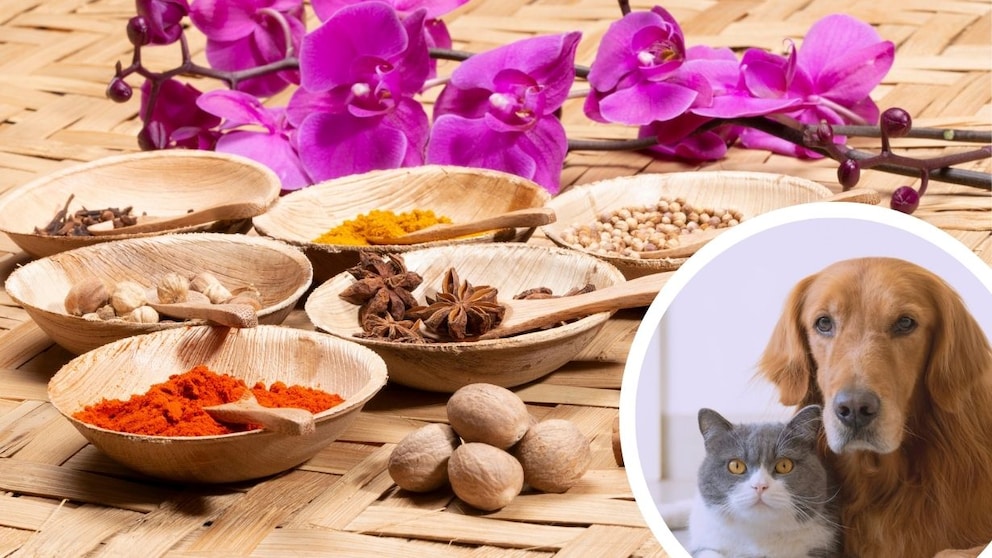
Examples of typical Ayurvedic food supplements can be found in Indian cuisine: These include cardamom, ginger, turmeric, saffron, or coriander. But even in our German cuisine, there are some foods with Ayurvedic effects, such as cloves, cinnamon, peppermint, dill, basil, fenugreek, fennel, or sage.
Ayurvedic Animal Massage and Yoga
Ayurvedic massages are ideal for cats and dogs because they are not only soothing and relaxing but also specifically resolve physical or psychological blockages. At the same time, detoxification and purification are stimulated.
Dogs love massages, possibly with a special oil, enjoying every touch and the closeness to their human. The use of oil should be tested carefully. Special caution is required with cats, as they cannot tolerate essential oils.
A relaxing yoga session is also a welcome activity for dogs, bringing variety and relaxation. Many dogs instinctively perform yoga exercises and enjoy doing it with their humans. It’s no coincidence that one of the most famous exercises is called “the downward-facing dog.” But cats also appreciate a yoga session with their human, as PETBOOK editor Louisa Stoeffler describes in her article: Doing Yoga with Cats? Editor Gives Tips on Strengthening the Bond with Your Pet

How Healing Clay Can Help Dogs with These Problems

Is Aromatherapy Suitable for Dogs and Cats?
Through the Year with Ayurveda
The different seasons also affect the health, body, and mind of our pets. They are influenced by the biorhythm of nature just like humans.
This is expressed through:
- coat changes and skin problems
- allergies
- parasite infestation
- immune weakness
- acidosis
- inflammatory processes in the body
- mood swings
- temperature-related complaints due to heat or cold
During these phases, dogs and cats can be naturally supported by Ayurveda to stay healthy.
Conclusion
The Ayurvedic teachings are very extensive, complex, but incredibly interesting. There is a wealth of information and great book material to explore and delve into this exciting healing doctrine. For internal application in pets, I recommend visiting an experienced Ayurveda animal therapist to find the right, appropriate treatment for the animal.

About the Author
Philine Ebert has been self-employed as a certified health, nutrition, and BARF consultant for dogs since 2023. Through writing competitions and travel reports for the “DOG and Travel Magazine,” she joined PETBOOK, where she writes as part of the expert team and shares her passion with readers.